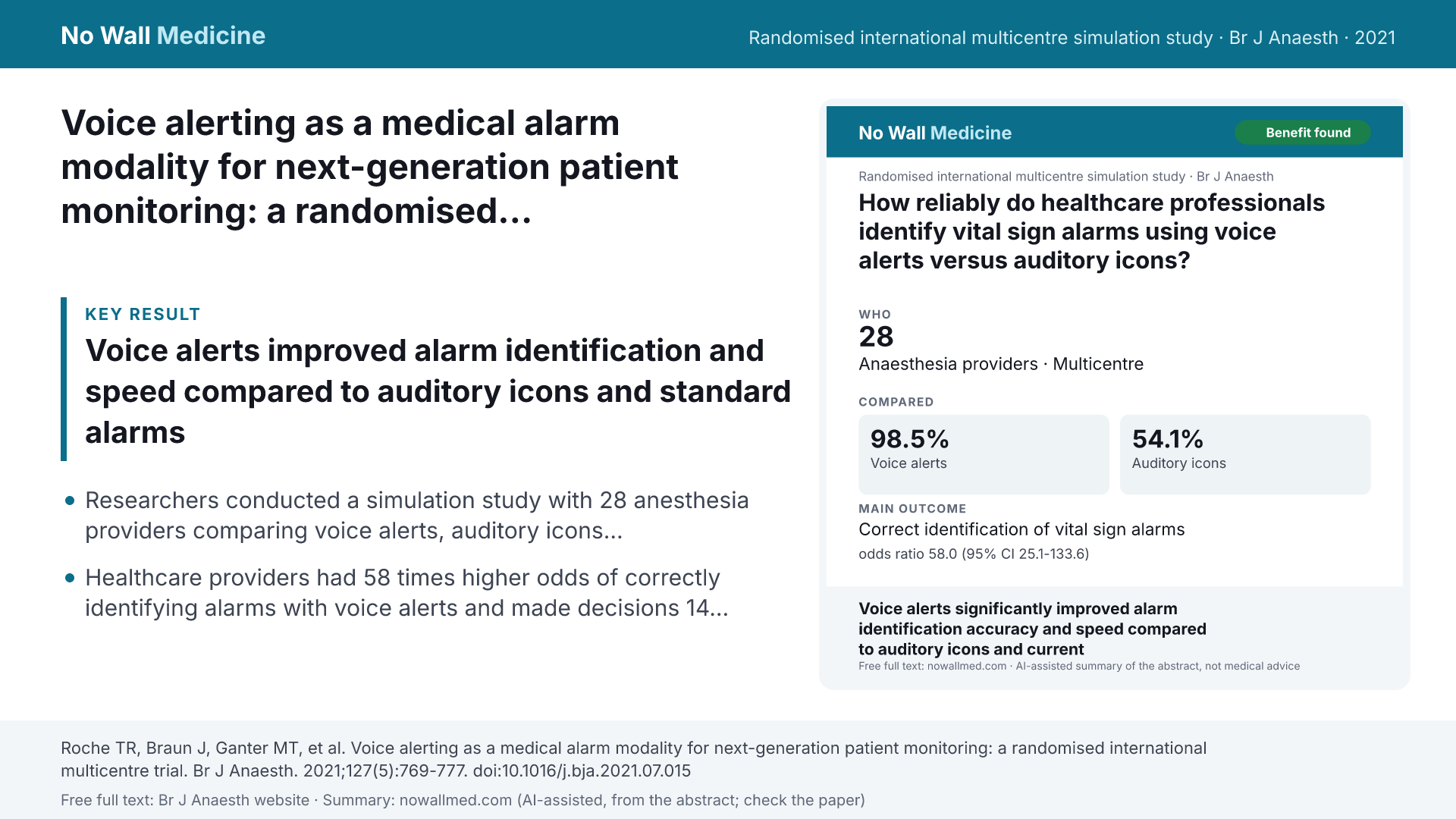
Voice alerting as a medical alarm modality for next-generation patient monitoring: a randomised international multicentre trial
Key result: Voice alerts improved alarm identification and speed compared to auditory icons and standard alarms
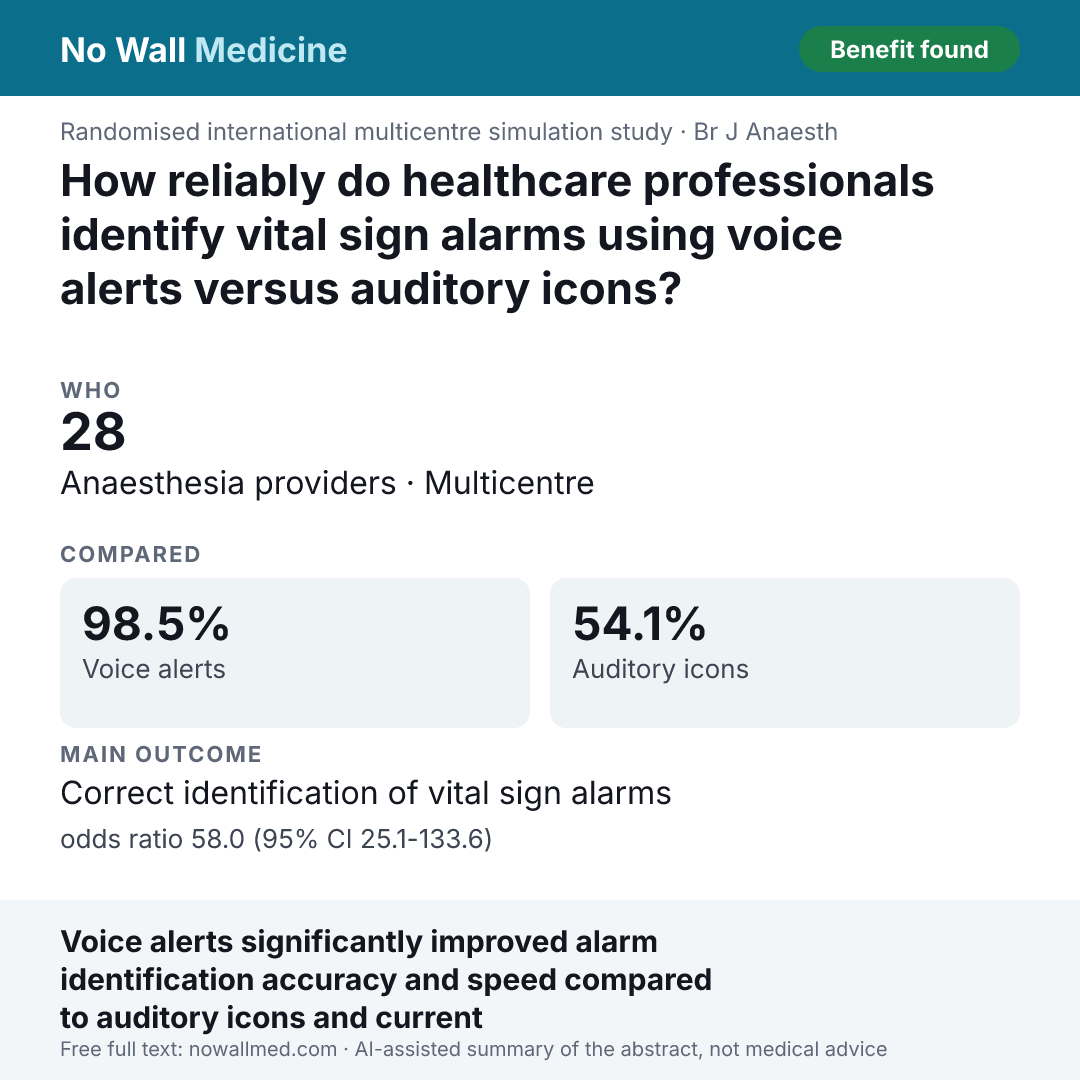
Randomised international multicentre simulation studyBenefit found
How reliably do healthcare professionals identify vital sign alarms using voice alerts versus auditory icons?
Who
28
Anaesthesia providers · Multicentre
Compared
98.5%Voice alerts
54.1%Auditory icons
Main outcome
Correct identification of vital sign alarms
Result: odds ratio 58.0 (95% CI 25.1-133.6)
Bottom line: Voice alerts significantly improved alarm identification accuracy and speed compared to auditory icons and current state-of-the-art alarms.
Br J Anaesth · 2021-08-26 · Save PNG
Key points
- Researchers conducted a simulation study with 28 anesthesia providers comparing voice alerts, auditory icons (metaphorical sounds), and standard medical device alarms.
- Healthcare providers had 58 times higher odds of correctly identifying alarms with voice alerts and made decisions 14 s faster than with auditory icons.
- Voice alerts resulted in 98.5% correct identification, while auditory icons reached 54.1% and standard alarms reached 17.9%.
Why it matters: Current medical device alarms are often indistinguishable from one another, which contributes to alarm fatigue among healthcare professionals.
Discussion prompts
- Would these patients look like yours? Who was left out?
- Is the main outcome one that matters to patients?
- Is the difference large enough to change what you do?
Cite: Roche TR, Braun J, Ganter MT, et al. Voice alerting as a medical alarm modality for next-generation patient monitoring: a randomised international multicentre trial. Br J Anaesth. 2021;127(5):769-777. doi:10.1016/j.bja.2021.07.015
Free full text: Br J Anaesth website · Summary and visual abstract: nowallmed.com/a/voice-alerting-as-a-medical-alarm-modality-for-next-generation-vknh08/ (AI-assisted from the abstract; check the paper before relying on it).