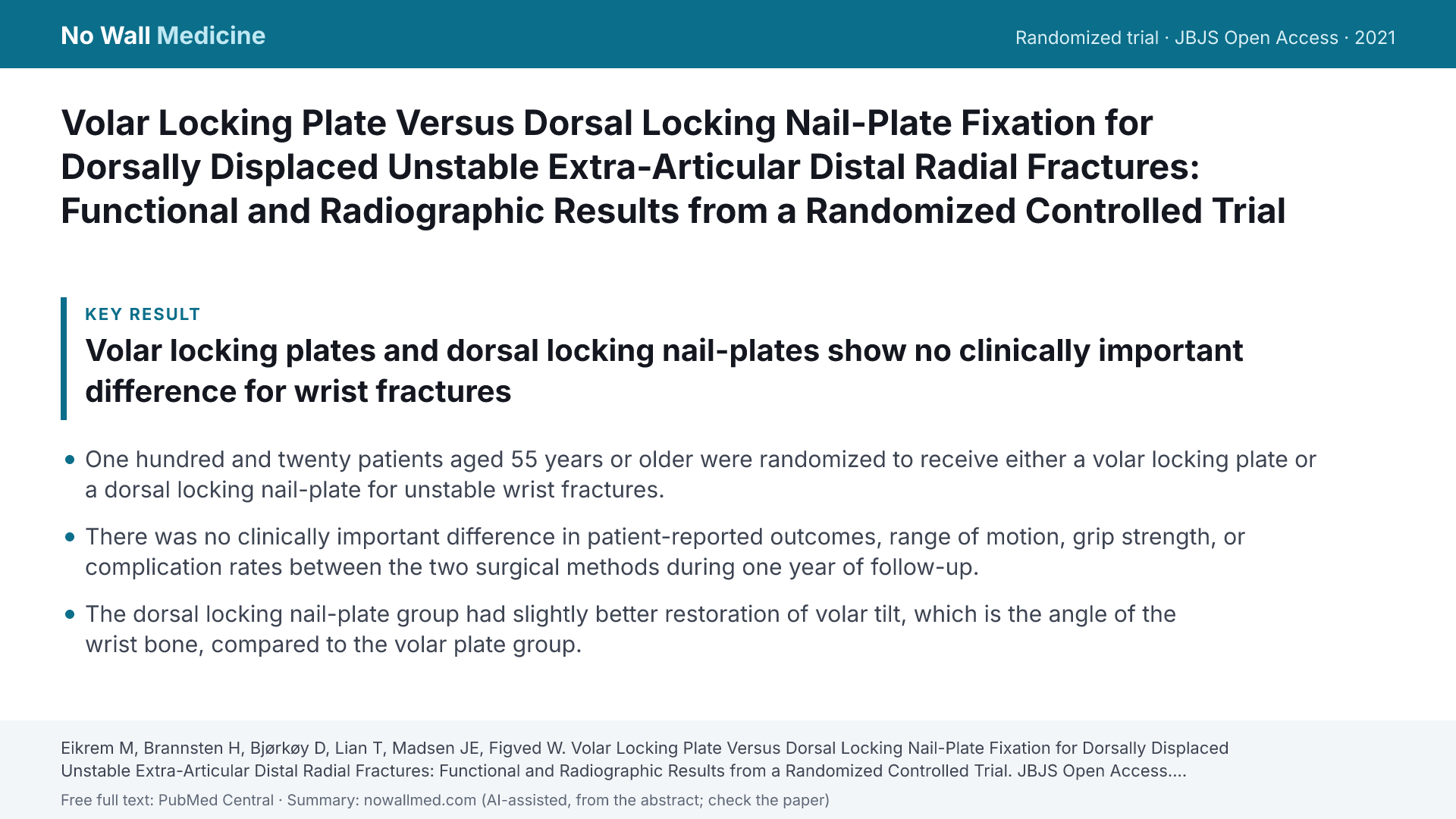
Volar Locking Plate Versus Dorsal Locking Nail-Plate Fixation for Dorsally Displaced Unstable Extra-Articular Distal Radial Fractures: Functional and Radiographic Results from a Randomized Controlled Trial
Key result: Volar locking plates and dorsal locking nail-plates show no clinically important difference for wrist fractures
Key points
- One hundred and twenty patients aged 55 years or older were randomized to receive either a volar locking plate or a dorsal locking nail-plate for unstable wrist fractures.
- There was no clinically important difference in patient-reported outcomes, range of motion, grip strength, or complication rates between the two surgical methods during one year of follow-up.
- The dorsal locking nail-plate group had slightly better restoration of volar tilt, which is the angle of the wrist bone, compared to the volar plate group.
Discussion prompts
- Would these patients look like yours? Who was left out?
- Is the main outcome one that matters to patients?
- Is the difference large enough to change what you do?
Cite: Eikrem M, Brannsten H, Bjørkøy D, Lian T, Madsen JE, Figved W. Volar Locking Plate Versus Dorsal Locking Nail-Plate Fixation for Dorsally Displaced Unstable Extra-Articular Distal Radial Fractures: Functional and Radiographic Results from a Randomized Controlled Trial. JBJS Open Access. 2021. doi:10.2106/JBJS.OA.21.00068
Free full text: PubMed Central · Summary and visual abstract: nowallmed.com/a/volar-locking-plate-versus-dorsal-locking-nail-plate-fixation-for-14i46c/ (AI-assisted from the abstract; check the paper before relying on it).