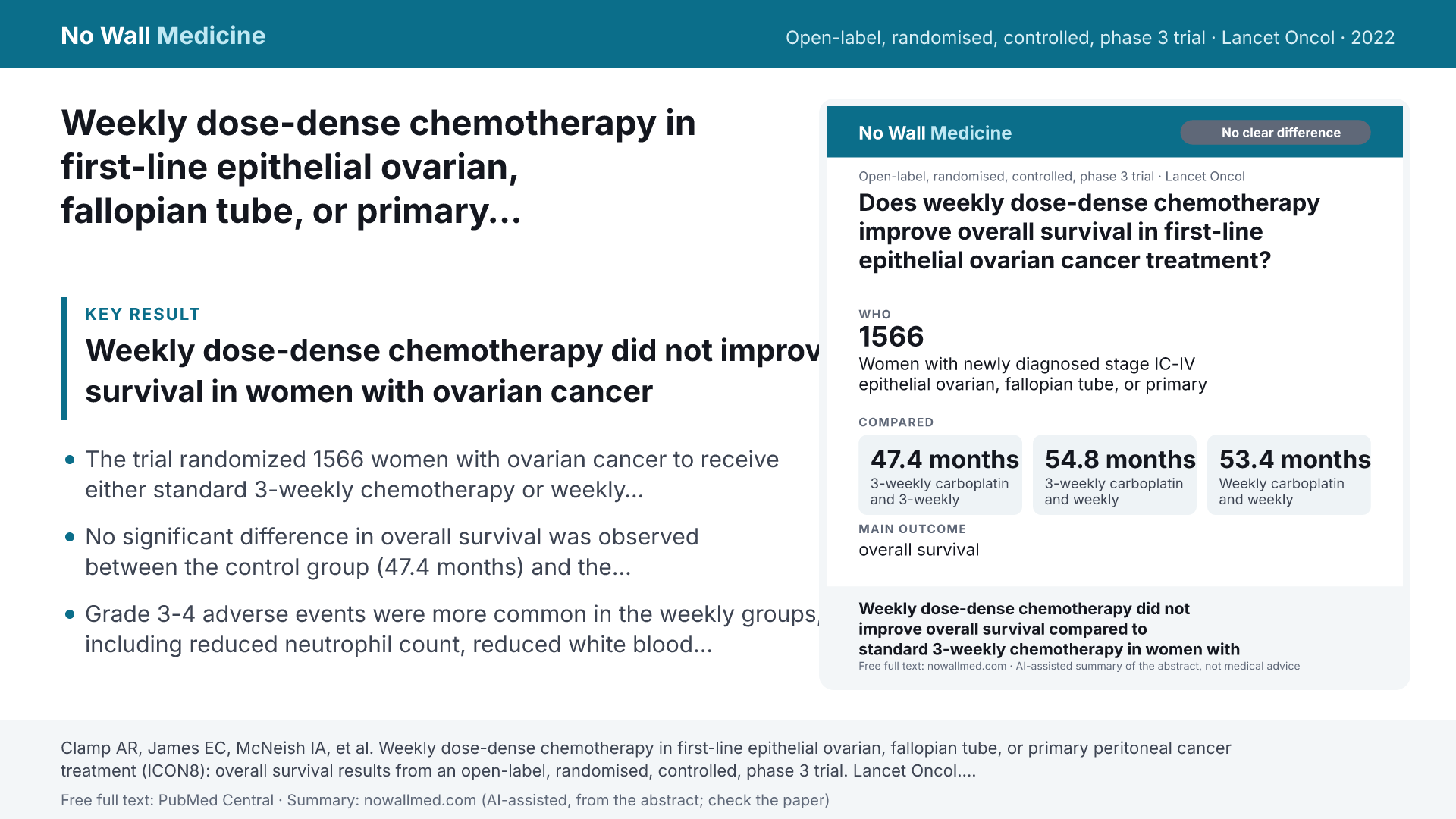
Weekly dose-dense chemotherapy did not improve survival in women with ovarian cancer
Weekly dose-dense chemotherapy in first-line epithelial ovarian, fallopian tube, or primary peritoneal cancer treatment (ICON8): overall survival results from an open-label, randomised, controlled, phase 3 trial
Open-label, randomised, controlled, phase 3 trialNo clear difference
Does weekly dose-dense chemotherapy improve overall survival in first-line epithelial ovarian cancer treatment?
Who
1566
Women with newly diagnosed stage IC-IV epithelial ovarian, fallopian tube, or primary peritoneal carcinoma · 117 hospitals in UK, Australia, New Zealand, Mexico, South Korea, and Ireland
Compared
47.4 months3-weekly carboplatin and 3-weekly paclitaxel (95% CI 43.1-54.8)
54.8 months3-weekly carboplatin and weekly paclitaxel (46.6-61.6)
53.4 monthsWeekly carboplatin and weekly paclitaxel (49.2-59.6)
Main outcome
overall survival
Result: hazard ratio 0.87 (97.5% CI 0.73-1.05); hazard ratio 0.91 (97.5% CI 0.76-1.09)
Bottom line: Weekly dose-dense chemotherapy did not improve overall survival compared to standard 3-weekly chemotherapy in women with epithelial ovarian cancer.
Limitation: evidence of non-proportional hazards was seen
Lancet Oncol · 2022-06-09Download image
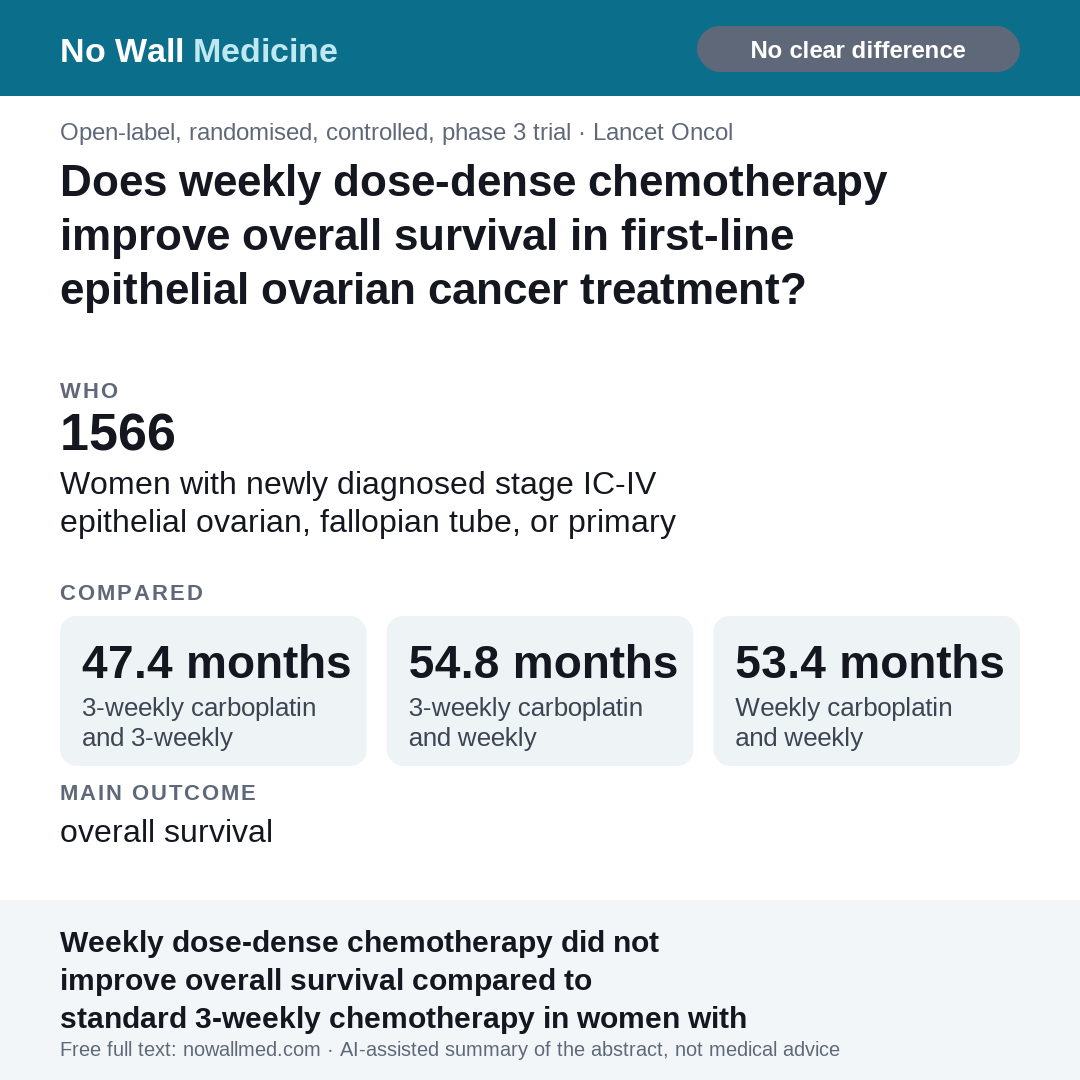
Clinical question: Does weekly dose-dense chemotherapy improve overall survival in first-line epithelial ovarian cancer treatment?
Key points
- The trial randomized 1566 women with ovarian cancer to receive either standard 3-weekly chemotherapy or weekly dose-dense chemotherapy regimens.
- No significant difference in overall survival was observed between the control group (47.4 months) and the weekly paclitaxel group (54.8 months) or the weekly carboplatin and paclitaxel group (53.4 months).
- Grade 3-4 adverse events were more common in the weekly groups, including reduced neutrophil count, reduced white blood cell count, and anaemia.
Headline and key points written with AI from the paper’s abstract, with every number checked against it. Read the paper before relying on them.
Was this summary helpful?
Abstract
Background
Standard-of-care first-line chemotherapy for epithelial ovarian cancer is carboplatin and paclitaxel administered once every 3 weeks. The JGOG 3016 trial reported significant improvement in progression-free and overall survival with dose-dense weekly paclitaxel and 3-weekly (ie, once every 3 weeks) carboplatin. However, this benefit was not observed in the previously reported progression-free survival results of ICON8. Here, we present the final coprimary outcomes of overall survival and updated progression-free survival analyses of ICON8. Methods
In this open-label, randomised, controlled, phase 3 trial (ICON8), women aged 18 years or older with newly diagnosed stage IC-IV epithelial ovarian, primary peritoneal, or fallopian tube carcinoma (here collectively termed ovarian cancer, as defined by International Federation of Gynecology and Obstetrics [FIGO] 1988 criteria) and an Eastern Cooperative Oncology Group performance status of 0-2 were recruited from 117 hospitals with oncology departments in the UK, Australia and New Zealand, Mexico, South Korea, and Ireland. Patients could enter the trial after immediate primary surgery (IPS) or with planned delayed primary surgery (DPS) during chemotherapy, or could have no planned surgery. Participants were randomly assigned (1:1:1), using the Medical Research Council Clinical Trials Unit at University College London randomisation line with stratification by Gynecologic Cancer Intergroup group, FIGO disease stage, and outcome and timing of surgery, to either 3-weekly carboplatin area under the curve (AUC)5 or AUC6 and 3-weekly paclitaxel 175 mg/m2 (control; group 1), 3-weekly carboplatin AUC5 or AUC6 and weekly paclitaxel 80 mg/m2 (group 2), or weekly carboplatin AUC2 and weekly paclitaxel 80 mg/m2 (group 3), all administered via intravenous infusion for a total of six 21-day cycles. Coprimary outcomes were progression-free survival and overall survival, with comparisons done between group 2 and group 1, and group 3 and group 1, in the intention-to-treat population. Safety was assessed in all patients who started at least one chemotherapy cycle. The trial is registered on ClinicalTrials.gov, NCT01654146, and ISRCTN registry, ISRCTN10356387, and is closed to accrual. Findings
Between June 6, 2011, and Nov 28, 2014, 1566 patients were randomly assigned to group 1 (n=522), group 2 (n=523), or group 3 (n=521). The median age was 62 years (IQR 54-68), 1073 (69%) of 1566 patients had high-grade serous carcinoma, 1119 (71%) had stage IIIC-IV disease, and 745 (48%) had IPS. As of data cutoff (March 31, 2020), with a median follow-up of 69 months (IQR 61-75), no significant difference in overall survival was observed in either comparison: median overall survival of 47·4 months (95% CI 43·1-54·8) in group 1, 54·8 months (46·6-61·6) in group 2, and 53·4 months (49·2-59·6) in group 3 (group 2 vs group 1: hazard ratio 0·87 [97·5% CI 0·73-1·05]; group 3 vs group 1: 0·91 [0·76-1·09]). No significant difference was observed for progression-free survival in either comparison and evidence of non-proportional hazards was seen (p=0·037), with restricted mean survival time of 23·9 months (97·5% CI 22·1-25·6) in group 1, 25·3 months (23·6-27·1) in group 2, and 24·8 months (23·0-26·5) in group 3. The most common grade 3-4 adverse events were reduced neutrophil count (78 [15%] of 511 patients in group 1, 183 [36%] of 514 in group 2, and 154 [30%] of 513 in group 3), reduced white blood cell count (22 [4%] in group 1, 80 [16%] in group 2, and 71 [14%] in group 3), and anaemia (26 [5%] in group 1, 66 [13%] in group 2, and 24 [5%] in group 3). No new serious adverse events were reported. Seven treatment-related deaths were reported (two in group 1, four in group 2, and one in group 3). Interpretation
In our cohort of predominantly European women with epithelial ovarian cancer, we found that first-line weekly dose-dense chemotherapy did not improve overall or progression-free survival compared with standard 3-weekly chemotherapy and should not be used as part of standard multimodality front-line therapy in this patient group. Funding
Cancer Research UK, Medical Research Council, Health Research Board in Ireland, Irish Cancer Society, and Cancer Australia.
Abstract reproduced under the article’s CC BY licence.
Subject terms
Cite this article
Clamp AR, James EC, McNeish IA, et al. Weekly dose-dense chemotherapy in first-line epithelial ovarian, fallopian tube, or primary peritoneal cancer treatment (ICON8): overall survival results from an open-label, randomised, controlled, phase 3 trial. Lancet Oncol. 2022. doi:10.1016/S1470-2045(22)00283-2
Spotted a mistake? Suggest a correction