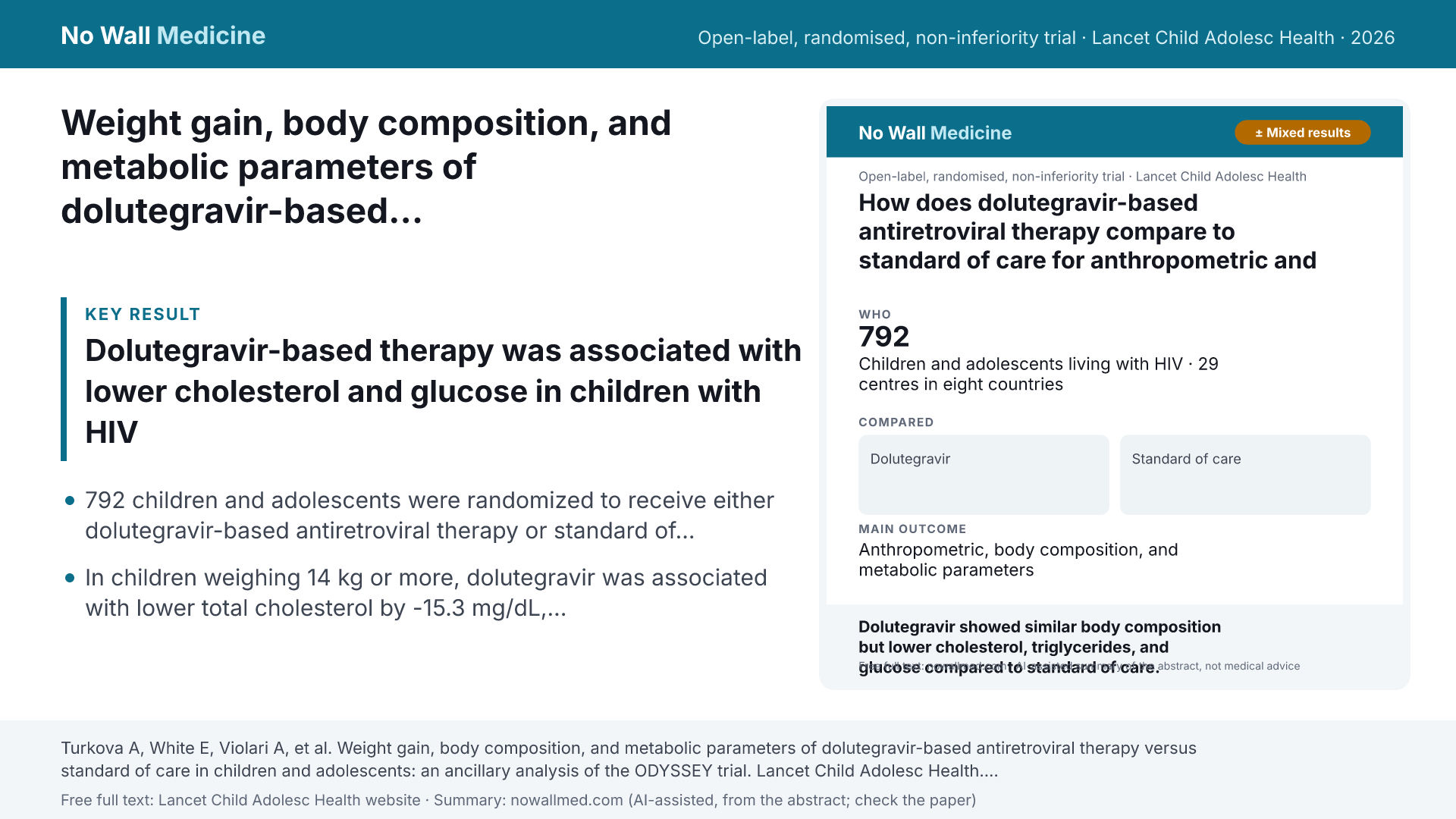
Dolutegravir-based therapy was associated with lower cholesterol and glucose in children with HIV
Weight gain, body composition, and metabolic parameters of dolutegravir-based antiretroviral therapy versus standard of care in children and adolescents: an ancillary analysis of the ODYSSEY trial
Secondary analysis of a trialMixed results
How does dolutegravir-based antiretroviral therapy compare to standard of care for anthropometric and metabolic outcomes?
Who
792
Children and adolescents living with HIV · 29 centres in eight countries
Compared
Dolutegravir
Standard of care
Main outcome
Anthropometric, body composition, and metabolic parameters
Bottom line: Dolutegravir showed similar body composition but lower cholesterol, triglycerides, and glucose compared to standard of care.
Lancet Child Adolesc Health · 2026-01-21 · Save PNG

Same trial (NCT02259127, ISRCTN91737921)
Papers we list that report this registered trial, oldest first. Read a secondary analysis alongside the main results.
- Related analysis Benefit found
Dolutegravir-based treatment was superior to standard care for children starting HIV-1 therapy NEJM 2021-12 - Main results Benefit found
Twice-daily dolutegravir maintained effective levels in children taking rifampicin for TB Lancet HIV 2022-07 - Related analysis Benefit found
Dolutegravir-based therapy showed lower treatment failure in children weighing less than 14 kg Lancet HIV 2022-09 - Secondary analysis Mixed results
This paper Lancet Child Adolesc Health 2026-01
Clinical question: How does dolutegravir-based antiretroviral therapy compare to standard of care for anthropometric and metabolic outcomes?
Key points
- 792 children and adolescents were randomized to receive either dolutegravir-based antiretroviral therapy or standard of care over approximately 5 years.
- In children weighing 14 kg or more, dolutegravir was associated with lower total cholesterol by -15.3 mg/dL, lower triglycerides by -14.4 mg/dL, and lower glucose by -4.4 mg/dL.
- For children weighing 14 kg or more, the difference in weight at week 240 was 1.0 kg (95% CI -0.2 to 2.2; p=0.095), which was not statistically significant.
Headline and key points written with AI from the paper’s abstract, with every number checked against it. Read the paper before relying on them.
Was this summary helpful?
Abstract
Background
ODYSSEY trial showed superior efficacy of dolutegravir-based antiretroviral therapy (ART) versus then-current, non-dolutegravir standard of care over 96 weeks in children and adolescents living with HIV. The aim of this ancillary analysis was to compare anthropometric and body composition outcomes, including weight, height, BMI-for-age Z score, weight-for-age and height-for-age Z scores (<14 kg), mid-upper-arm circumference (MUAC), waist circumference, hip circumference, and body fat percentage, as well as metabolic outcomes (lipids and glucose), between dolutegravir and standard of care over approximately 5 years of follow-up. Methods
In this open-label, randomised, non-inferiority trial, children (aged ≥4 weeks and <18 years), weighing 3 kg or more, starting first-line ART (ODYSSEY-A) or switching to second-line ART (ODYSSEY-B) were enrolled in 29 centres in Germany, Portugal, South Africa, Spain, Thailand, Uganda, Zimbabwe, and the UK in two cohorts (children weighing ≥14 kg and children weighing <14 kg). Treatment effects (dolutegravir vs standard of care) were estimated on randomised allocation, accounting for treatment switches (substantial in standard of care arm during extended follow-up) through censoring and inverse-probability-of-censoring-weights. Changes in continuous outcomes were compared using linear mixed models, accounting for correlated slope and baseline value. Proportions of participants with unfavourable outcomes were compared using logistic mixed models. ODYSSEY is registered with ClinicalTrials.gov, NCT02259127, EUDRACT, 2014-002632-14, and ISRCTN, ISRCTN91737921. Findings
Between Sept 20, 2016, and Aug 26, 2019, 792 children were randomly assigned (392 to dolutegravir and 400 to standard of care). Of 707 children in the 14 kg or more cohort, 311 received first-line ART (ODYSSEY-A; 145 [92%] of 157 received efavirenz-based ART as standard of care) and 396 received second-line ART (ODYSSEY-B; 195 [98%] of 200 received boosted protease inhibitors as standard of care). Of 85 children in the less than 14 kg cohort, 72 received first-line ART (32 [74%] of 43 received lopinavir-ritonavir as first-line or second-line standard of care). Median follow-up on randomised allocation was 287 weeks (IQR 240-311) on dolutegravir-based ART and 205 weeks (168-240) on standard of care in the 14 kg or more cohort, and 220 weeks (208-232) on dolutegravir-based ART and 144 weeks (127-192) on standard of care in the less than 14 kg cohort. In the 14 kg or more cohort, 345 (49%) were female and 362 (51%) were male, 623 (88%) were Black African, median enrolment age was 12·2 years (IQR 9·1 to 14·9), weight 30·7 kg (23·4 to 43·0), and BMI-for-age Z score -0·6 (-1·4 to 0·1); 35 (5%) were overweight and six (1%) were obese. At week 240, adjusted mean differences (dolutegravir minus standard of care) were 1·0 kg for weight (95% CI -0·2 to 2·2; p=0·095) and 0·4 cm for MUAC (0·0 to 0·8; p=0·030), driven by differences in first-line participants, where higher increases were also observed in height, waist circumference, and hip circumference. Increases in BMI-for-age Z score, body fat percentage, and cross-sectional waist-to-height ratio were similar on dolutegravir-based ART and standard of care. Total cholesterol (-15·3 mg/dL [-21·0 to -9·5]; p<0·0001), triglycerides (-14·4 mg/dL [-25·2 to -3·6]; p=0·0089), and glucose (-4·4 mg/dL [-6·8 to -1·9]; p=0·0004) were lower with dolutegravir than standard of care. In the less than 14 kg cohort, 44 (52%) were female and 41 (48%) were male, 83 (98%) were Black African, median enrolment age was 1·4 years (IQR 0·6 to 2·0), weight 8·1 kg (5·4-10·0) and BMI-for-age Z score -0·8 (-1·9 to 0·2); three (4%) were overweight and none obese. Changes in weight, weight-for-age, BMI-for-age and height-for-age Z scores by 192 weeks were similar on dolutegravir and standard of care; there were small differences in MUAC (0·6 cm [-0·1 to 1·3]; p=0·070) and height (-2·5 cm [-4·5 to -0·5]; p=0·016). No significant differences in lipid biomarkers were observed; glucose decreased with standard of care but not with dolutegravir. Interpretation
Over approximately 5 years, indices defining excessive weight gain and central adiposity were similar with dolutegravir and other anchor drugs, and lipid and glycaemia profiles with dolutegravir were reassuring, providing supporting evidence for dolutegravir-based ART as the preferred treatment in children and adolescents. Funding
Fondazione Penta ETS, ViiV Healthcare, and UK Medical Research Council.
Abstract reproduced under the article’s CC BY licence.
Subject terms
Headline, design, result, key points, caveat and citation as plain text.
Cite this article
Turkova A, White E, Violari A, et al. Weight gain, body composition, and metabolic parameters of dolutegravir-based antiretroviral therapy versus standard of care in children and adolescents: an ancillary analysis of the ODYSSEY trial. Lancet Child Adolesc Health. 2026;10(3):189-202. doi:10.1016/S2352-4642(25)00339-6
Spotted a mistake? Suggest a correction