Mediterranean-style diet and calorie restriction show similar weight loss results after 24 months
Weight Loss Intervention Promoting an Adapted Mediterranean-Style Dietary Pattern: The DELISH Randomized Clinical Trial
Randomized clinical trialNo clear difference
Does a Mediterranean-style dietary pattern yield more sustained weight loss than energy restriction?
Who
360
Patients with body mass index of 30 or higher, aged 18 to 75 years · 1 academic and 6 community primary care practices, North Carolina
Compared
-3.40%Mediterranean-style intervention (0.60%)
-3.51%Control intervention (0.66%)
Main outcome
percentage change in body weight at 24-month follow-up
Result: difference, -0.11; 95% CI, -1.79 to 1.57
Bottom line: A Mediterranean-style weight loss intervention showed no material difference in weight loss compared to a control intervention at 24 months.
JAMA Netw Open · 2026-08-03Download image
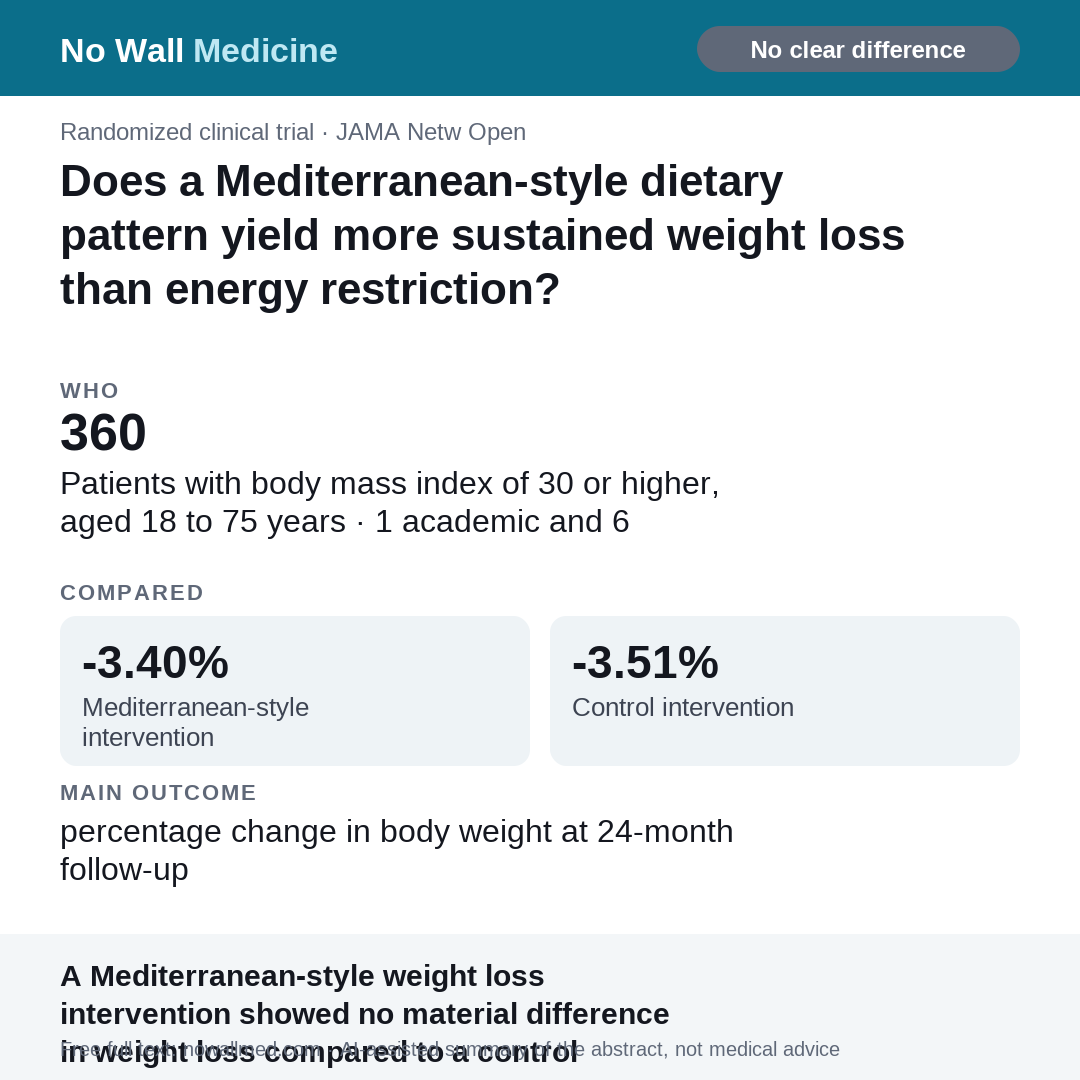
Clinical question: Does a Mediterranean-style dietary pattern yield more sustained weight loss than energy restriction?
Why it matters: Mediterranean-style dietary patterns have been shown to reduce chronic disease morbidity but have been understudied in weight loss intervention trials in the United States.
Key points
- Researchers studied 360 participants with a body mass index of 30 or higher, comparing a Mediterranean-style diet program to a control program focused on reducing energy intake.
- At the 24-month follow-up, the Mediterranean-style group had a mean weight change of -3.40% and the control group had a mean change of -3.51%.
- The Mediterranean-style group achieved a higher diet quality score using the Alternative Healthy Eating Index-2010 compared to the control group.
Headline and key points written with AI from the paper’s abstract, with every number checked against it. Read the paper before relying on them.
Topics
Cite this article
Keyserling TC, Wu Q, Ammerman AS, Berkowitz SA, Buse JB, Couper DJ. Weight Loss Intervention Promoting an Adapted Mediterranean-Style Dietary Pattern: The DELISH Randomized Clinical Trial. JAMA Netw Open. 2026. doi:10.1001/jamanetworkopen.2026.29006
Spotted a mistake? Suggest a correction