What helps or hinders the communication of poor prognosis between secondary and primary care? A systematic review with narrative synthesis
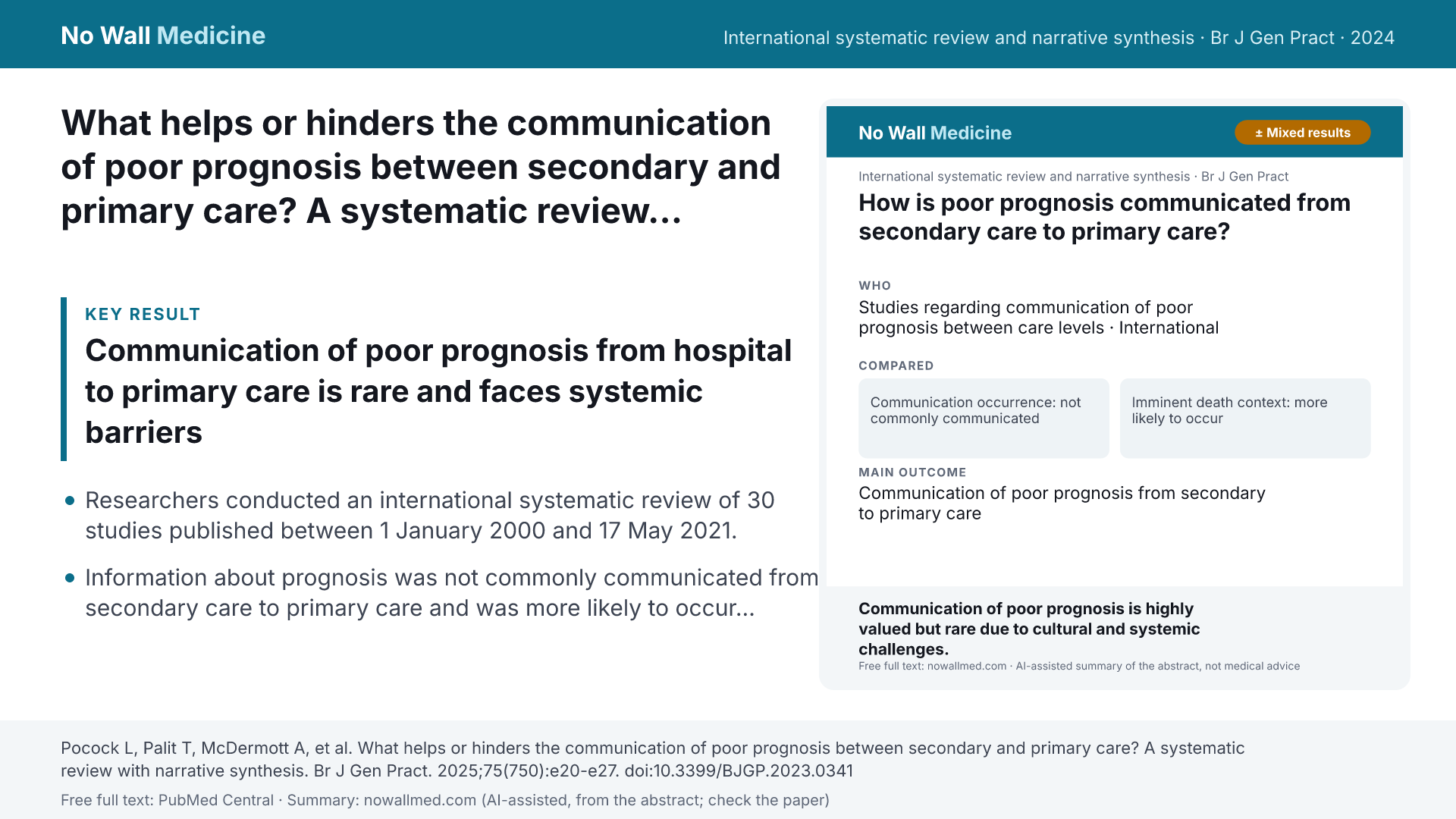
Key result: Communication of poor prognosis from hospital to primary care is rare and faces systemic barriers
International systematic review and narrative synthesisMixed results
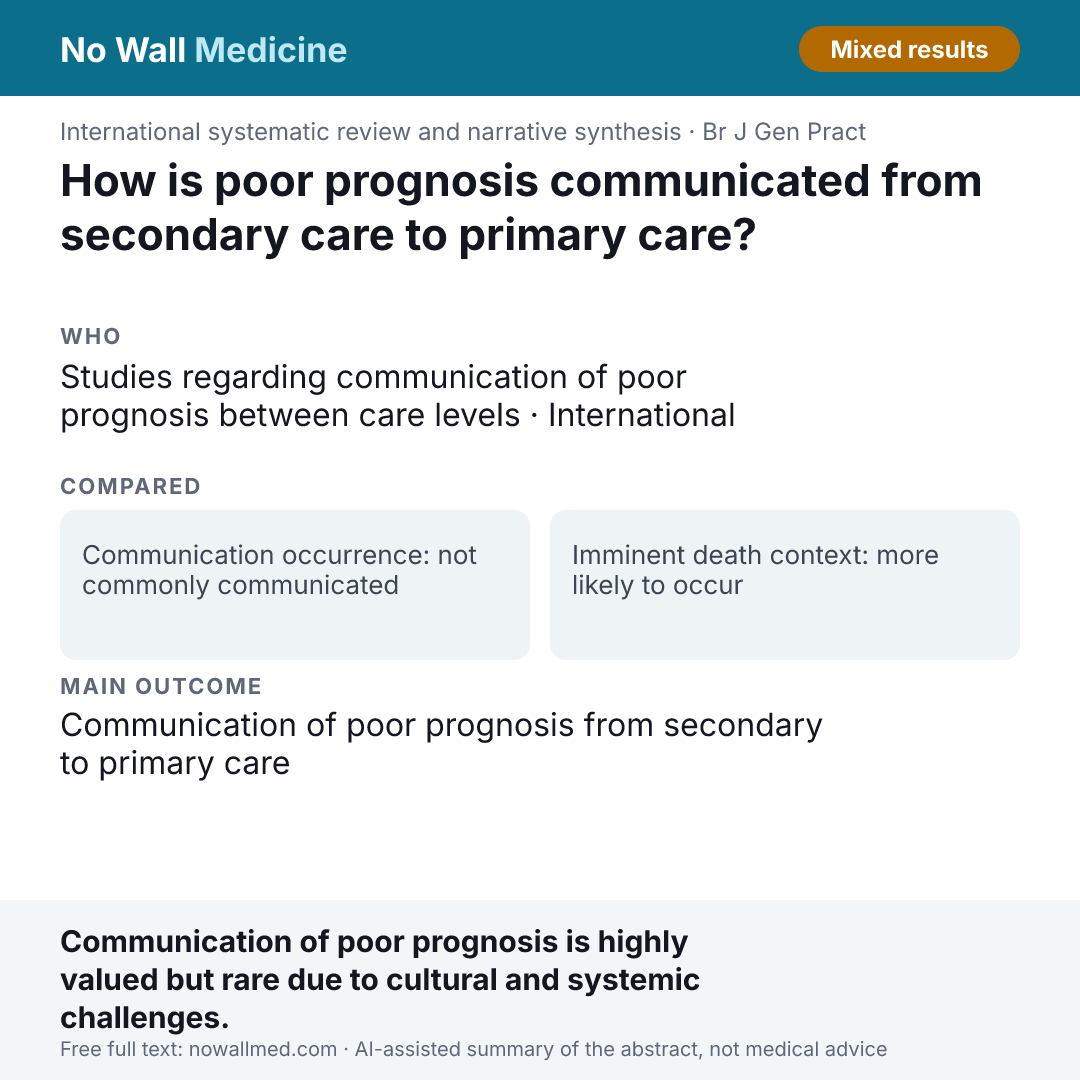
How is poor prognosis communicated from secondary care to primary care?
Who
Studies regarding communication of poor prognosis between care levels · International
Compared
Communication occurrence: not commonly communicated
Imminent death context: more likely to occur
Main outcome
Communication of poor prognosis from secondary to primary care
Bottom line: Communication of poor prognosis is highly valued but rare due to cultural and systemic challenges.
Limitation: Few studies had a focus on the interprofessional communication of poor prognosis.
Br J Gen Pract · 2024-12-26 · Save PNG
Key points
- Researchers conducted an international systematic review of 30 studies published between 1 January 2000 and 17 May 2021.
- Information about prognosis was not commonly communicated from secondary care to primary care and was more likely to occur if death was imminent.
- Barriers included a lack of identification of poor prognosis by secondary care teams, while shared electronic records and direct clinician contact were facilitators.
Discussion prompts
- Would these patients look like yours? Who was left out?
- Is the main outcome one that matters to patients?
- Is the difference large enough to change what you do?
Cite: Pocock L, Palit T, McDermott A, et al. What helps or hinders the communication of poor prognosis between secondary and primary care? A systematic review with narrative synthesis. Br J Gen Pract. 2025;75(750):e20-e27. doi:10.3399/BJGP.2023.0341
Free full text: PubMed Central · Summary and visual abstract: nowallmed.com/a/what-helps-or-hinders-the-communication-of-poor-prognosis-between-17rixjx/ (AI-assisted from the abstract; check the paper before relying on it).