What's the optimal temperature control strategy in patients receiving ECPR after cardiac arrest? A network meta-analysis
Network meta-analysisNo clear difference
What is the optimal temperature control strategy in patients receiving extracorporeal cardiopulmonary resuscitation?
Who
5622
Patients receiving extracorporeal cardiopulmonary resuscitation after cardiac arrest
Compared
moderate hypothermia (32-34 °C)
mild hypothermia (34.1-36 °C)
normothermia (36.1-37.5 °C)
Main outcome
overall survival and neurological outcome
Bottom line: No significant differences in survival or neurological outcomes were found across temperature control strategies in the network meta-analysis.
Limitation: lower level of the evidence
Am J Emerg Med · 2024-11-02Download image
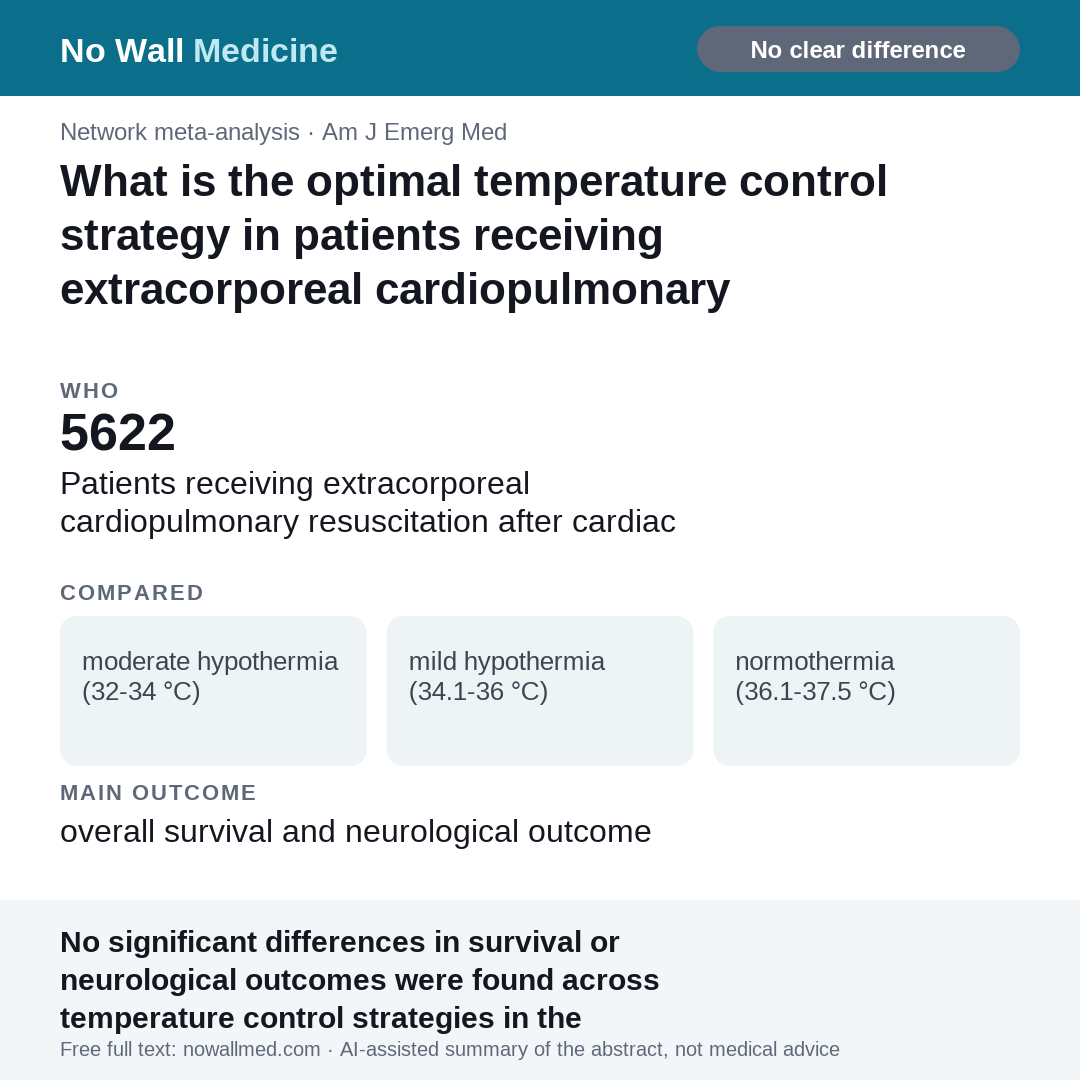
Clinical question: What is the optimal temperature control strategy in patients receiving extracorporeal cardiopulmonary resuscitation?
Abstract
Background
The optimal temperature control strategy in extracorporeal cardiopulmonary resuscitation (ECPR) patients is unknown, and several trials have reported conflicting results regarding its effectiveness. We aimed to conduct a systemic review and network meta-analysis (NMA) to assess the efficacy of temperature control in ECPR patients. Methods
Database searching of studies reporting data on temperature control strategy during ECPR in MEDLINE, EMBASE, Scopus, and Cochrane Library was performed. Primary outcomes were overall survival and neurological outcome. Pairwise meta-analysis and Bayesian NMA were performed on studies comparing outcomes among groups of moderate hypothermia (32-34 °C), mild hypothermia (34.1-36 °C) and normothermia (36.1-37.5 °C). Results
Nineteen retrospective studies were included (5622 patients). Statistically significant differences in good neurological outcome were observed in the direct comparison of moderate hypothermia and mild hypothermia (OR, 1.73; 95 % CI: 1.07-2.81) as well as moderate hypothermia and normothermia (OR, 2.14; 95 % CI: 1.24-3.67), but no significant differences were found in the NMA result. There was no difference in either survival outcome or the incidence of bleeding complications among any groups according to direct or indirect analysis. Conclusions
Direct evidence suggests that moderate hypothermia might be associated with improved neurological outcomes in ECPR patients. However, no significant differences in survival outcomes were observed in either the direct or NMA results. Given the lower level of the evidence, interpretation should be made with caution.
Topics
Cite this article
Wang J, Zhang H, Wang T, Liu G, Teng Y, Wang J. What's the optimal temperature control strategy in patients receiving ECPR after cardiac arrest? A network meta-analysis. Am J Emerg Med. 2024. doi:10.1016/j.ajem.2024.11.001
Spotted a mistake? Suggest a correction
Top studies every Monday
The week’s key trials and guidelines in your specialties, plus any topics you follow. By email, free.
Get the weekly digest