Where do we stand with revision surgery for recurrent carpal tunnel syndrome? A systematic review
Systematic reviewUnclear result
What are the outcomes of revision surgery for recurrent carpal tunnel syndrome?
Who
816
Adults undergoing revision surgery for recurrent carpal tunnel syndrome
Compared
flap cohorts: 5.60 points VAS improvement
non-flap cohorts: 4.08 points VAS improvement
Main outcome
Patient-reported outcomes, complications, and re-revision
Bottom line: Revision surgery generally improves symptoms, but no single technique is proven superior due to heterogeneous evidence.
Limitation: Heterogeneity in recurrence definitions, indications, surgical techniques, follow-up, and outcome reporting.
JPRAS Open · 2026-08-06Download image
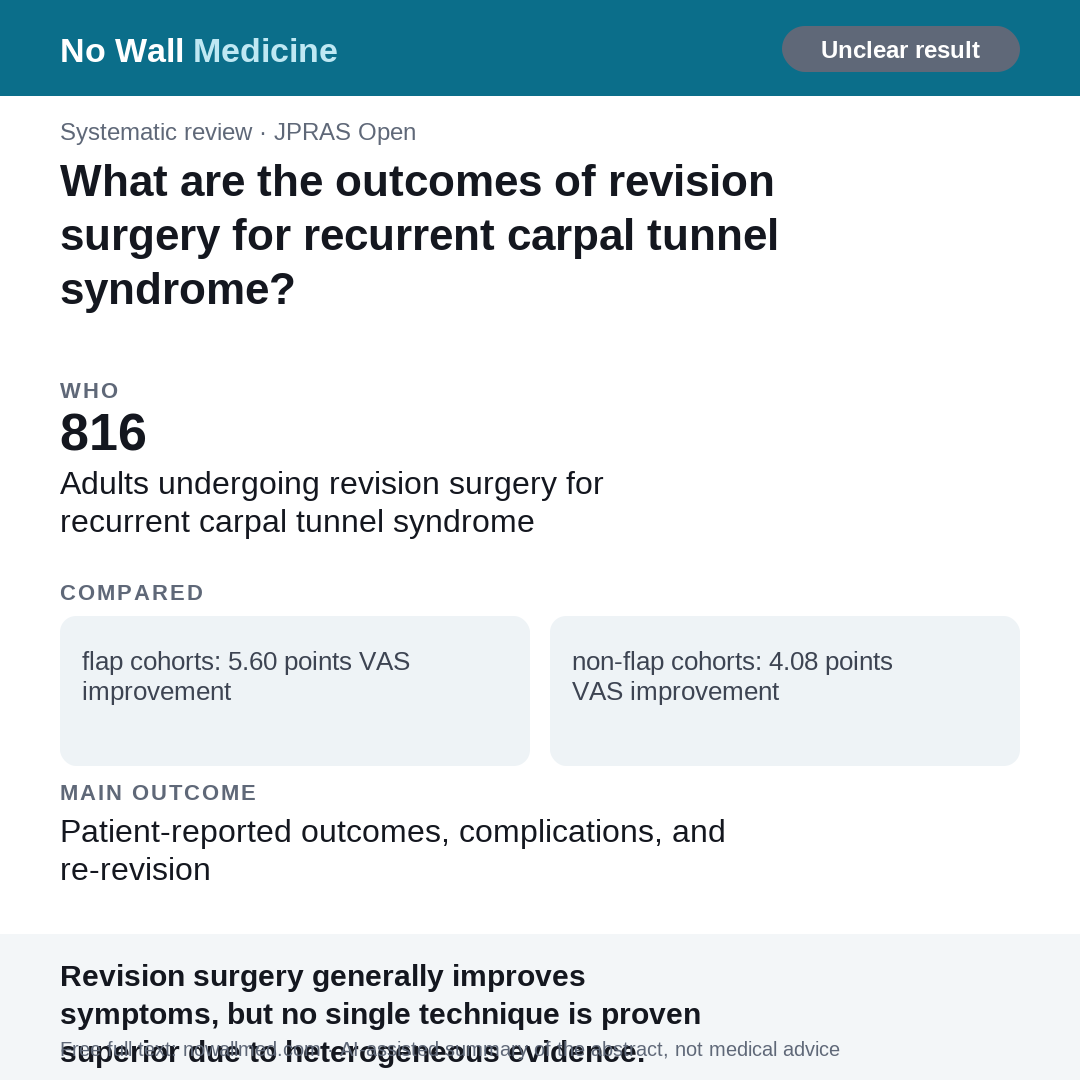
Clinical question: What are the outcomes of revision surgery for recurrent carpal tunnel syndrome?
Abstract
Introduction
Recurrent carpal tunnel syndrome (CTS) after carpal tunnel release may require revision surgery, but the relative value of decompression, neurolysis, vascularised coverage, nerve wrapping, fat grafting, and other adjuncts remains uncertain. This study synthesised patient-reported outcomes, complications, and re-revision after revision surgery for recurrent CTS, with emphasis on mechanism-based interpretation rather than technique superiority. Methods
A PRISMA-guided systematic review was performed across PubMed, EMBASE, Scopus, Web of Science and CENTRAL (PROSPERO CRD420261323775). Studies of adults undergoing revision surgery for recurrent CTS and reporting clinical outcomes were included. Owing to heterogeneity in recurrence definitions, operative indications, surgical techniques, follow-up, and outcome reporting, findings were synthesised narratively. Results
Thirty-five studies (816 patients, 844 hands) were analysed. Most studies were retrospective single-arm case series with heterogeneous definitions, indications, techniques, and outcome measures. Revision surgery was generally associated with symptomatic improvement. Descriptively, pooled VAS improvement was 5.60 points in flap cohorts and 4.08 points in non-flap cohorts, with substantial heterogeneity. Patient-reported outcomes generally improved when reported, but use of validated outcomes was inconsistent. Complications were infrequent. Re-revision was uncommon overall, occurring in 25 cases, representing 3.1% of reported cases, but sparse events and variable follow-up limited interpretation. Conclusion
Revision surgery for recurrent CTS is generally associated with improved symptoms, but current evidence cannot establish superiority of any technique. Re-revision is best interpreted as an observational durability outcome. Operative planning should be guided by the primary mechanism of failure rather than the presumed superiority of any single revision strategy.
Cite this article
Kiew CYK, Lai RJE, Lee DKR, Duru DO, Lam WL. Where do we stand with revision surgery for recurrent carpal tunnel syndrome? A systematic review. JPRAS Open. 2026. doi:10.1016/j.jpra.2026.07.039
Spotted a mistake? Suggest a correction
Top studies every Monday
The week’s key trials and guidelines in your specialties, plus any topics you follow. By email, free.
Get the weekly digest