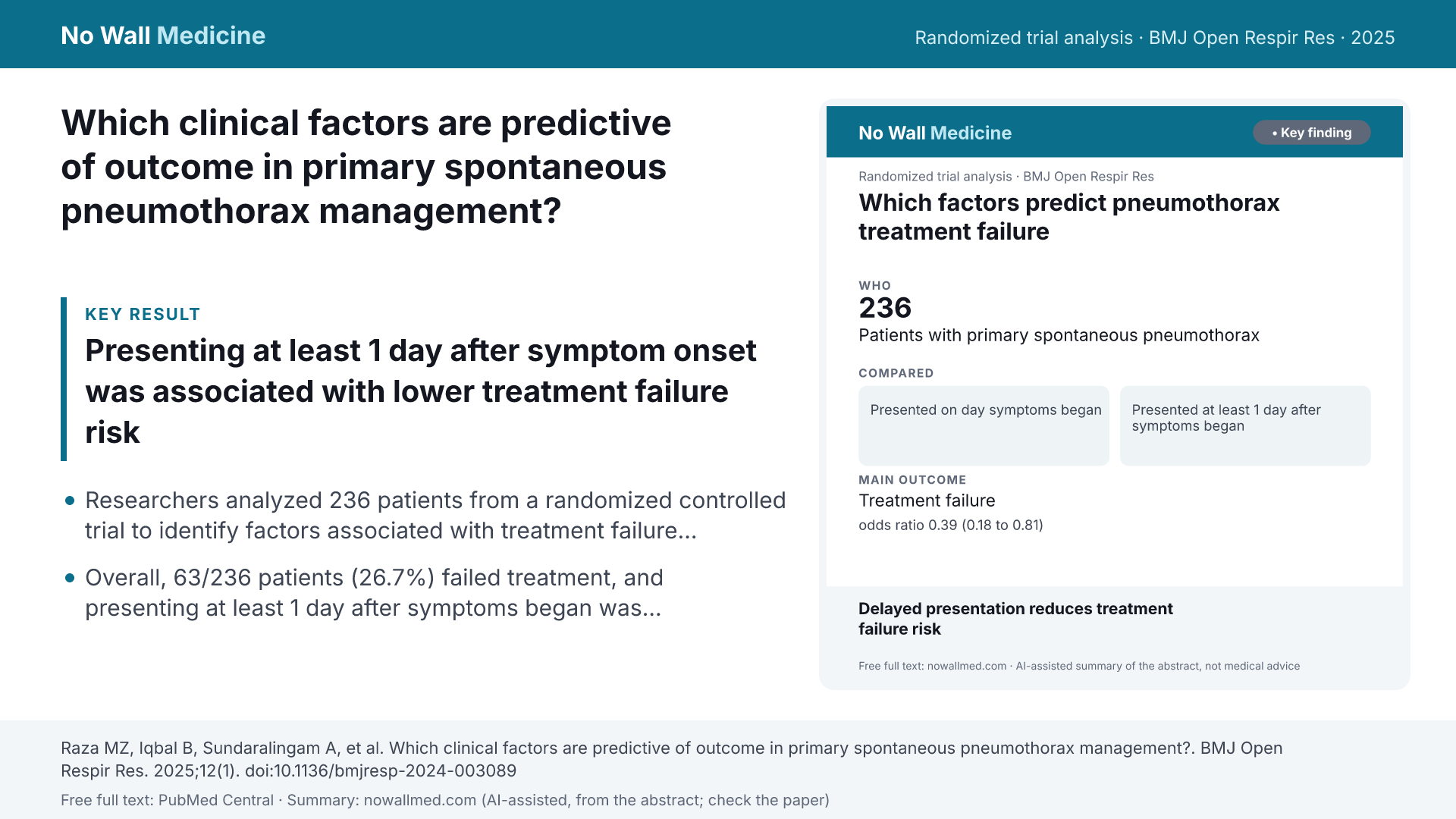
Presenting at least 1 day after symptom onset was associated with lower treatment failure risk
Which clinical factors are predictive of outcome in primary spontaneous pneumothorax management?
Randomized trial analysisKey finding
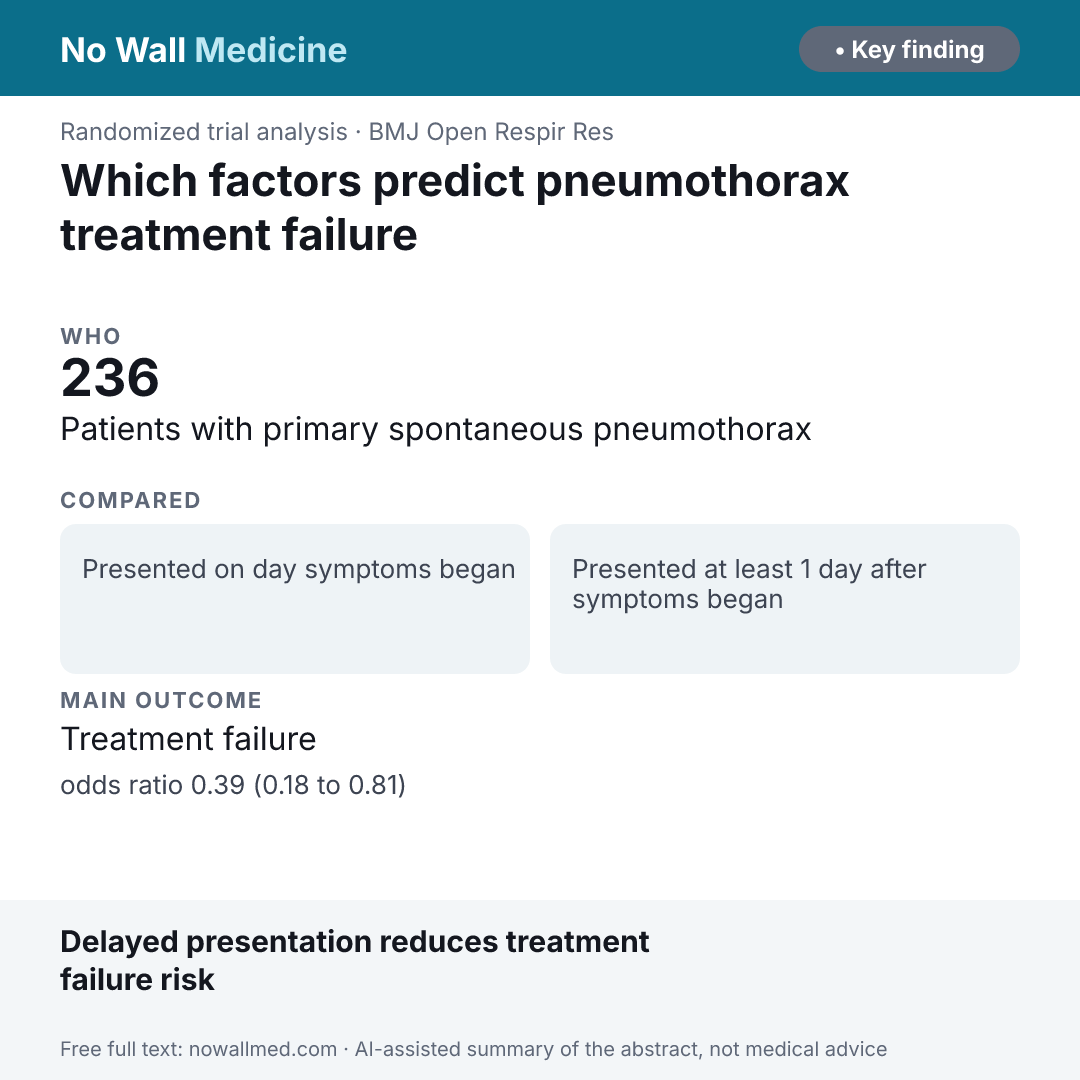
Which factors predict pneumothorax treatment failure
Who
236
Patients with primary spontaneous pneumothorax
Compared
Presented on day symptoms began
Presented at least 1 day after symptoms began
Main outcome
Treatment failure
Result: odds ratio 0.39 (0.18 to 0.81)
Bottom line: Delayed presentation reduces treatment failure risk
BMJ Open Respir Res · 2025-06-19 · Save PNG
Why it matters: It is currently not possible to predict which patients with primary spontaneous pneumothorax will fail medical treatment due to an ongoing air leak.
Key points
- Researchers analyzed 236 patients from a randomized controlled trial to identify factors associated with treatment failure in primary spontaneous pneumothorax, which is air leaking into the space around the lungs.
- Overall, 63/236 patients (26.7%) failed treatment, and presenting at least 1 day after symptoms began was associated with a lower risk of failure compared to presenting on the same day.
- On average, symptoms for the participants started 1 day before admission.
Headline and key points written with AI from the paper’s abstract, with every number checked against it. Read the paper before relying on them.
Was this summary helpful?
Abstract
Background
Primary spontaneous pneumothorax (PSP) occurs when air leaks into the pleural space in patients without known underlying lung disease, causing pain and breathlessness. Optimal management of PSP is not defined and we are unable to predict who will fail medical treatment (ongoing pneumothorax with prolonged air leak). We hypothesised that patients with longer symptom duration and higher symptom scores would be more likely to fail treatment. Methods
Prospectively collected data from the Randomised Ambulatory Management of Primary Pneumothorax randomised controlled trial of ambulatory management were used to determine which clinical factors are associated with treatment failure including symptom scores, time from symptom onset to presentation, treatment allocation, vital signs, history of prior pneumothorax and size of initial pneumothorax. Results
Overall, 63/236 patients (26.7%) failed treatment. On average, symptoms started 1 day before admission. Multivariable analysis found that patients who presented at least 1 day after symptoms began had a lower risk of treatment failure than those presenting on the day symptoms began (ORs 0.39 (0.18 to 0.81)). Conclusion
Further work is required to determine psychological drivers of PSP presentation and risks of prolonged air leak.
Abstract reproduced under the article’s CC BY licence.
Subject terms
Headline, design, result, key points, caveat and citation as plain text.
Cite this article
Raza MZ, Iqbal B, Sundaralingam A, et al. Which clinical factors are predictive of outcome in primary spontaneous pneumothorax management?. BMJ Open Respir Res. 2025;12(1). doi:10.1136/bmjresp-2024-003089
Spotted a mistake? Suggest a correction