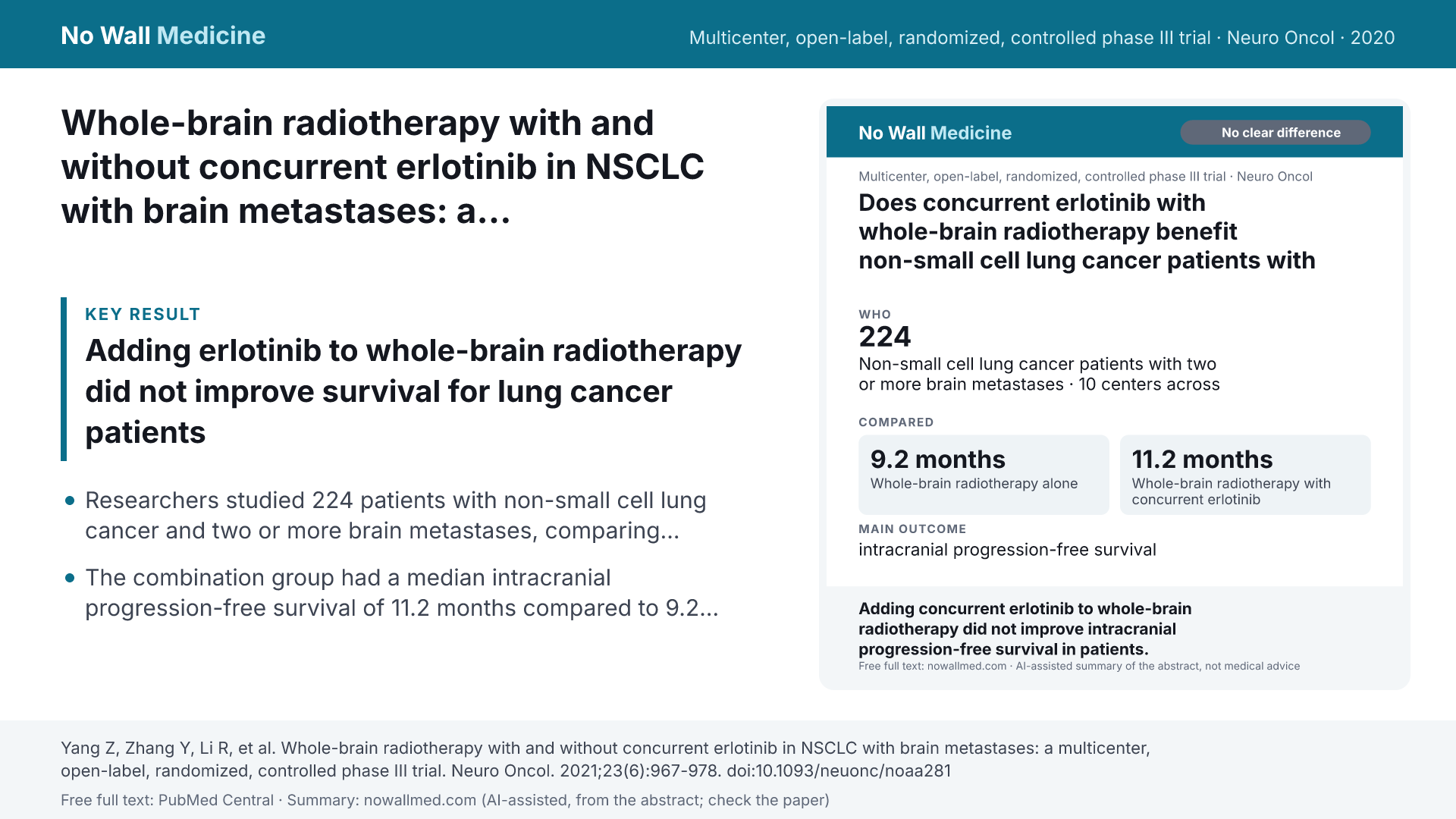
Adding erlotinib to whole-brain radiotherapy did not improve survival for lung cancer patients
Whole-brain radiotherapy with and without concurrent erlotinib in NSCLC with brain metastases: a multicenter, open-label, randomized, controlled phase III trial
Multicenter, open-label, randomized, controlled phase III trialNo clear difference
Does concurrent erlotinib with whole-brain radiotherapy benefit non-small cell lung cancer patients with brain metastases?
Who
224
Non-small cell lung cancer patients with two or more brain metastases · 10 centers across China
Compared
9.2 monthsWhole-brain radiotherapy alone
11.2 monthsWhole-brain radiotherapy with concurrent erlotinib
Main outcome
intracranial progression-free survival
Bottom line: Adding concurrent erlotinib to whole-brain radiotherapy did not improve intracranial progression-free survival in patients.
Neuro Oncol · 2020-12-18Download image
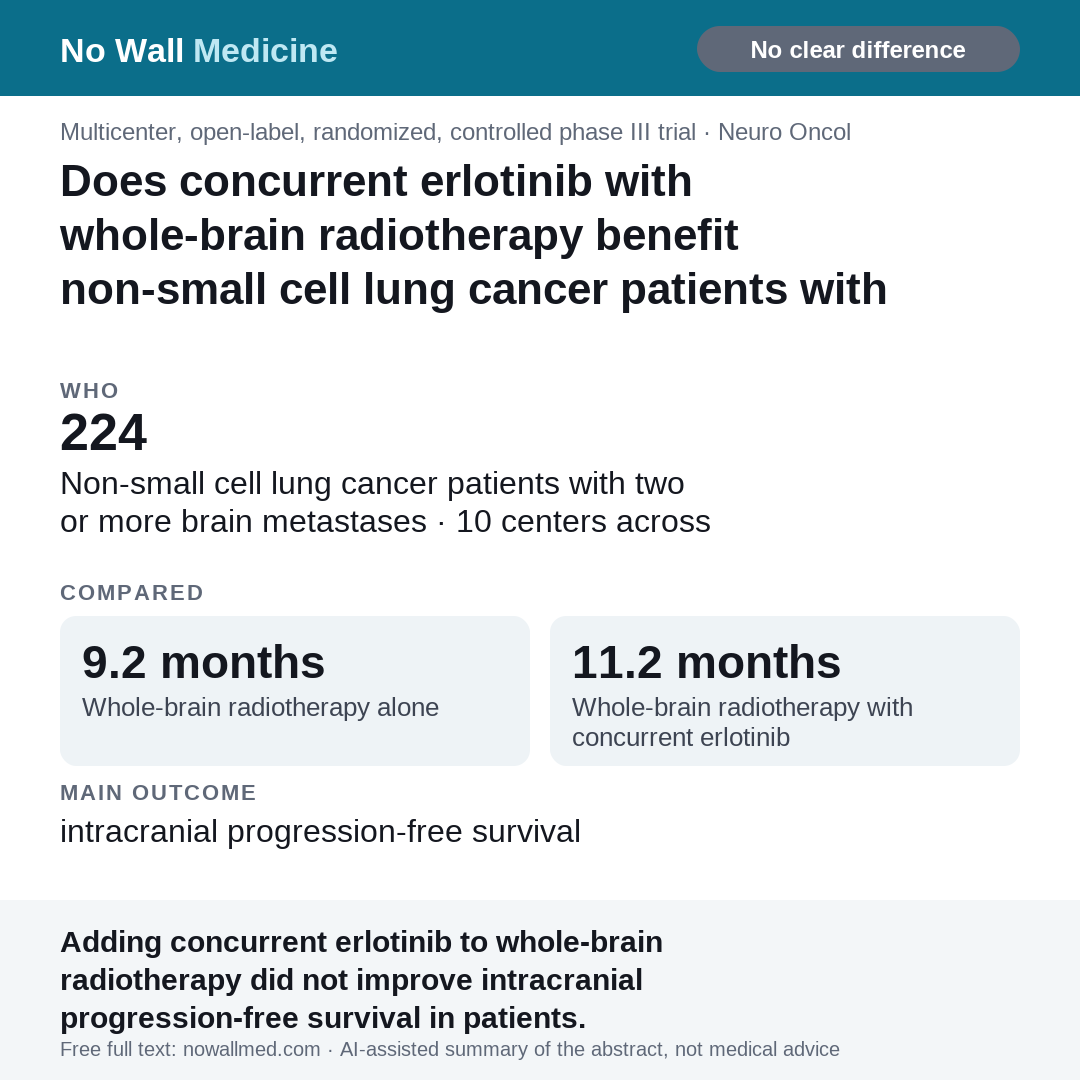
Clinical question: Does concurrent erlotinib with whole-brain radiotherapy benefit non-small cell lung cancer patients with brain metastases?
Why it matters: It was unknown if adding erlotinib, a type of epidermal growth factor receptor tyrosine kinase inhibitor, to whole-brain radiotherapy would improve outcomes for patients with lung cancer brain metastases.
Key points
- Researchers studied 224 patients with non-small cell lung cancer and two or more brain metastases, comparing whole-brain radiotherapy alone to combined treatment with erlotinib.
- The combination group had a median intracranial progression-free survival of 11.2 months compared to 9.2 months for radiotherapy alone, which was not a statistically significant difference.
- In patients with EGFR mutations, the combination group showed no significant improvement in overall survival, which was 17.5 months versus 16.9 months for radiotherapy alone.
Headline and key points written with AI from the paper’s abstract, with every number checked against it. Read the paper before relying on them.
Was this summary helpful?
Subject terms
Cite this article
Yang Z, Zhang Y, Li R, Yisikandaer A, Ren B, Sun J. Whole-brain radiotherapy with and without concurrent erlotinib in NSCLC with brain metastases: a multicenter, open-label, randomized, controlled phase III trial. Neuro Oncol. 2020. doi:10.1093/neuonc/noaa281
Spotted a mistake? Suggest a correction
Top studies every Monday
The week’s key trials and guidelines in your specialties, plus any topics you follow. By email, free.
Get the weekly digest