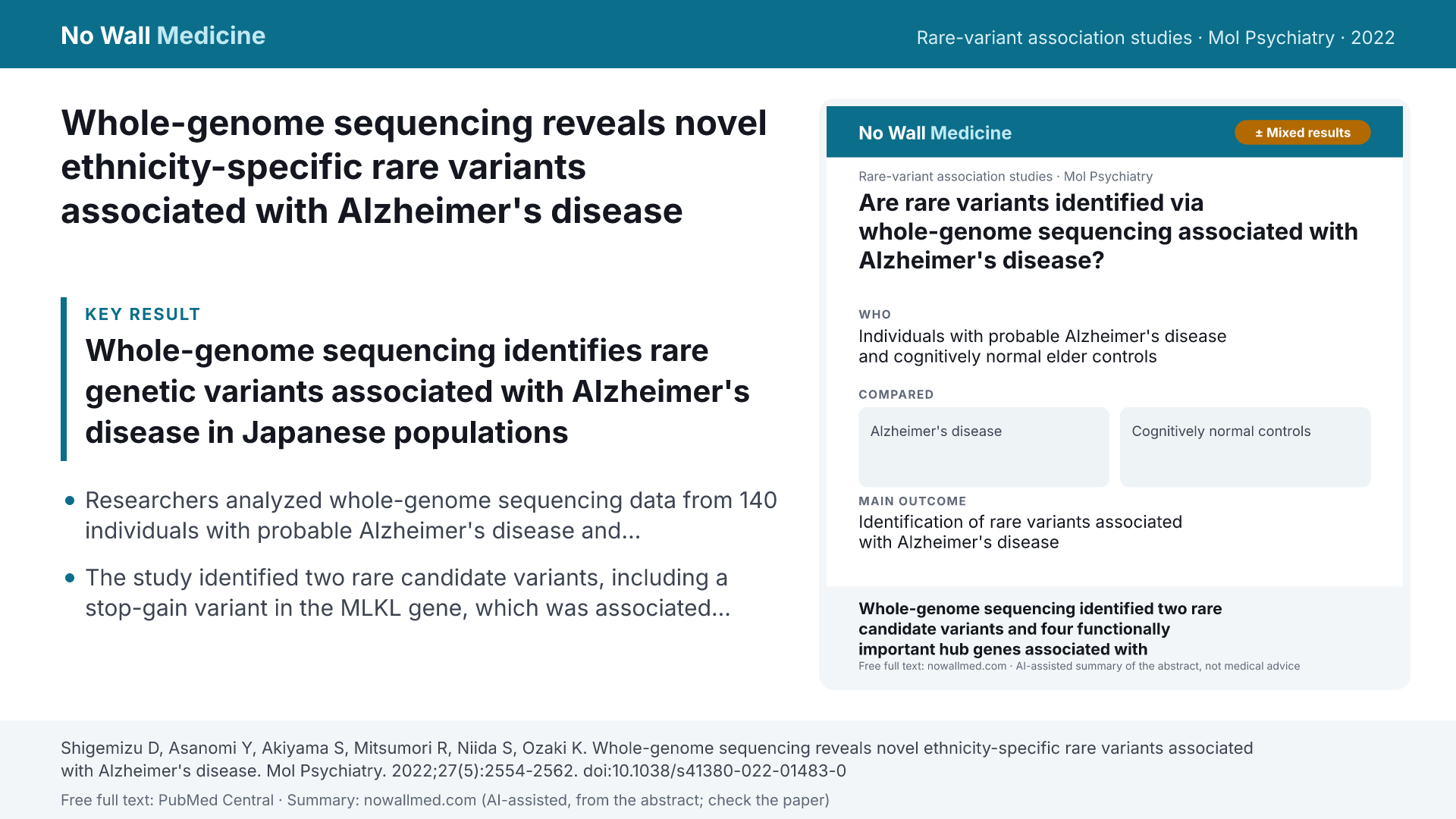
Whole-genome sequencing identifies rare genetic variants associated with Alzheimer's disease in Japanese populations
Whole-genome sequencing reveals novel ethnicity-specific rare variants associated with Alzheimer's disease
Rare-variant association studiesMixed results
Are rare variants identified via whole-genome sequencing associated with Alzheimer's disease?
Who
Individuals with probable Alzheimer's disease and cognitively normal elder controls
Compared
Alzheimer's disease
Cognitively normal controls
Main outcome
Identification of rare variants associated with Alzheimer's disease
Bottom line: Whole-genome sequencing identified two rare candidate variants and four functionally important hub genes associated with Alzheimer's disease.
Mol Psychiatry · 2022-03-10Download image
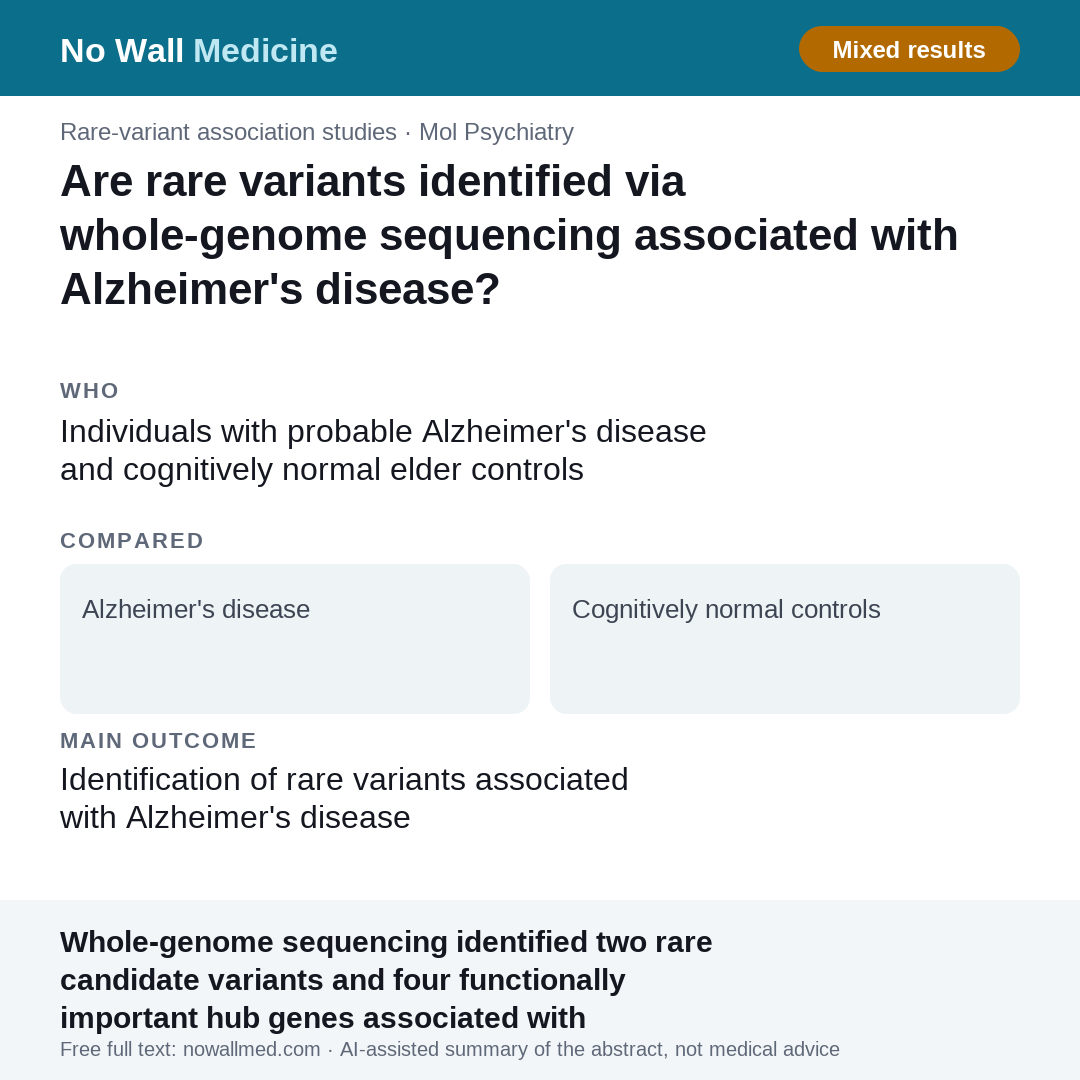
Clinical question: Are rare variants identified via whole-genome sequencing associated with Alzheimer's disease?
Why it matters: Genome-wide association studies focus on common genetic variants with small effects, leaving the role of rare variants with potentially larger effects in Alzheimer's disease insufficiently investigated.
Key points
- Researchers analyzed whole-genome sequencing data from 140 individuals with probable Alzheimer's disease and 798 cognitively normal controls, alongside genotyping data from 1604 Alzheimer's patients and 1235 controls.
- The study identified two rare candidate variants, including a stop-gain variant in the MLKL gene, which was associated with changes in the ratio of Aβ42 to Aβ40.
- A network-based meta-analysis identified four functionally important hub genes, including NCOR2, PLEC, DMD, and NEDD4, through gene-based association tests of rare variants.
Headline and key points written with AI from the paper’s abstract, with every number checked against it. Read the paper before relying on them.
Was this summary helpful?
Subject terms
Cite this article
Shigemizu D, Asanomi Y, Akiyama S, Mitsumori R, Niida S, Ozaki K. Whole-genome sequencing reveals novel ethnicity-specific rare variants associated with Alzheimer's disease. Mol Psychiatry. 2022. doi:10.1038/s41380-022-01483-0
Spotted a mistake? Suggest a correction