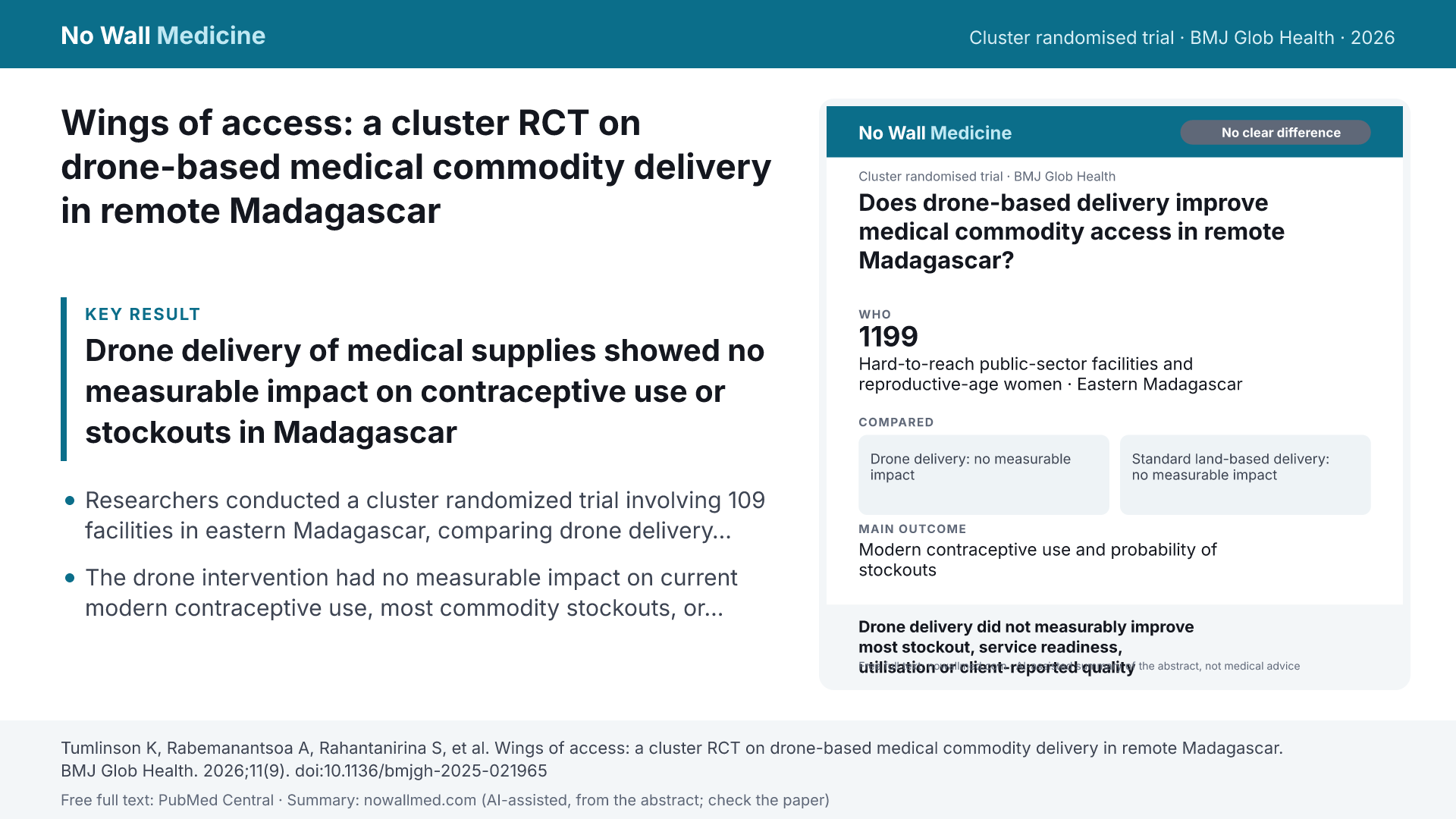
Drone delivery of medical supplies showed no measurable impact on contraceptive use or stockouts in Madagascar
Wings of access: a cluster RCT on drone-based medical commodity delivery in remote Madagascar
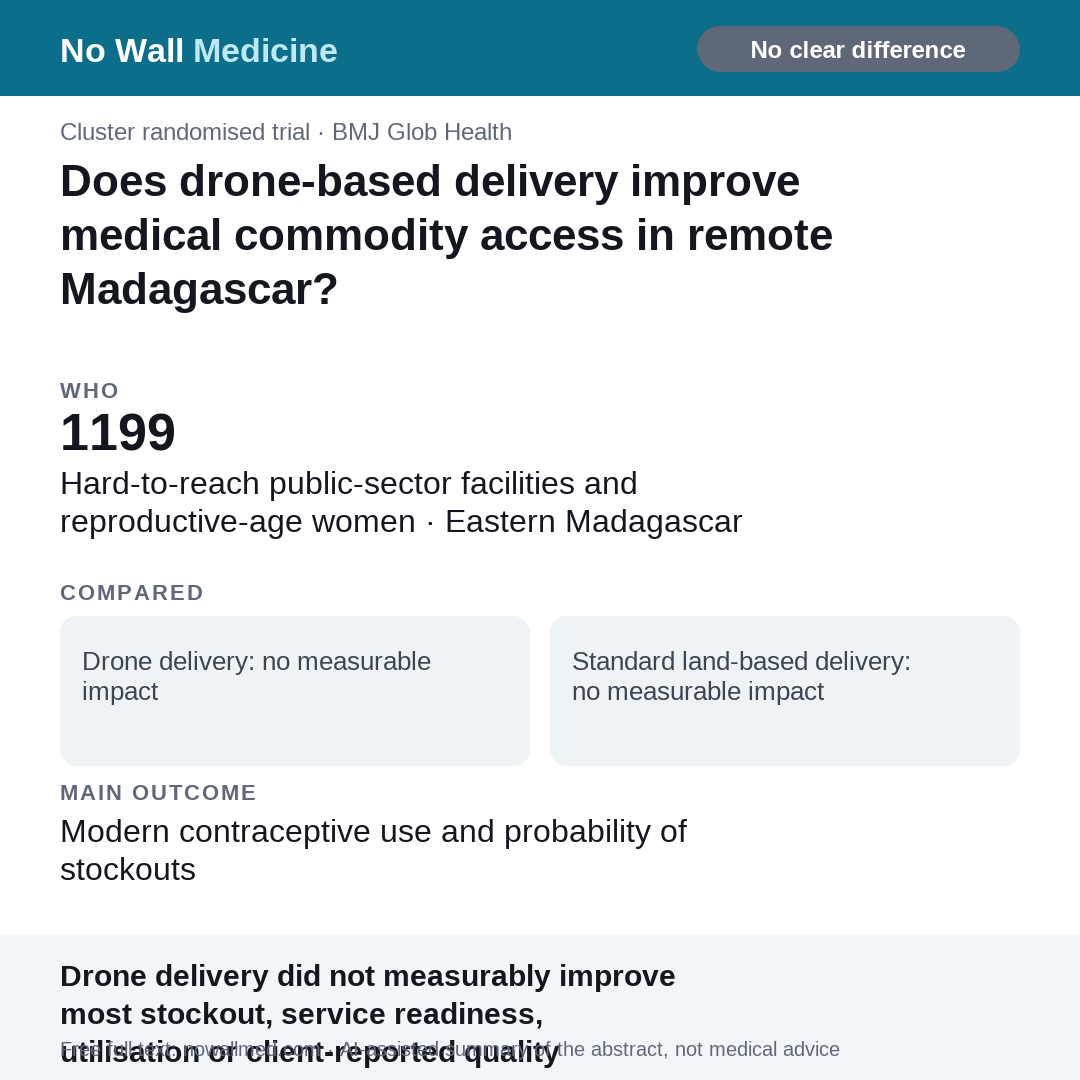
Cluster randomised trialNo clear difference
Does drone-based delivery improve medical commodity access in remote Madagascar?
Who
1199
Hard-to-reach public-sector facilities and reproductive-age women · Eastern Madagascar
Compared
Drone delivery: no measurable impact
Standard land-based delivery: no measurable impact
Main outcome
Modern contraceptive use and probability of stockouts
Bottom line: Drone delivery did not measurably improve most stockout, service readiness, utilisation or client-reported quality outcomes.
Limitation: Upstream supply-chain constraints may remain binding.
BMJ Glob Health · 2026-09-29Download image
Clinical question: Does drone-based delivery improve medical commodity access in remote Madagascar?
Why it matters: Stockouts of essential medicines remain a persistent challenge in the Global South, and researchers sought to see if unmanned aerial vehicles could improve healthcare access.
Key points
- Researchers conducted a cluster randomized trial involving 109 facilities in eastern Madagascar, comparing drone delivery to standard land-based delivery.
- The drone intervention had no measurable impact on current modern contraceptive use, most commodity stockouts, or malaria rapid diagnostic test stockouts.
- The study also found no significant changes in most client-reported quality measures or service readiness following the drone delivery implementation.
Headline and key points written with AI from the paper’s abstract, with every number checked against it. Read the paper before relying on them.
Was this summary helpful?
Abstract
Background
Stockouts of essential medicines remain a persistent challenge across the Global South, undermining healthcare access. Unmanned aerial vehicles or drones have emerged as a promising solution to improve delivery. Methods
We implemented a two-arm cluster randomised trial in eastern Madagascar. Hard-to-reach public-sector facilities were randomised to drone delivery or standard land-based delivery of medical commodities. Preintervention and postintervention data included audits, provider and client interviews and population-based surveys of reproductive-age women. Our primary outcomes were (1) current modern contraceptive use and (2) the probability of stockouts. Secondary outcomes included aligned and preferred contraceptive use, vaccine and malaria outcomes and perceived quality. For each outcome, we compared intervention and control clusters using analysis of covariance (ANCOVA) regressions. Facilities randomised to drone delivery received continuous service from September 2023 to October 2024; outcomes were measured at baseline (June-August 2023) and endline (October 2024-March 2025). Results
Between June and August 2023, 109 facilities were randomised to drone intervention (n=55) or control (n=54). Within the corresponding communities, a representative sample of 1199 reproductive-age women (n=605 treatment, 594 control) completed a baseline survey. In primary ANCOVA analyses, drone delivery had no measurable impact on current modern contraceptive use, stockouts of most commodities, malaria rapid diagnostic test stockouts or most client-reported quality measures. Supporting difference-in-difference analyses suggested possible reductions in malaria rapid diagnostic test stockouts and modest improvements in aligned and preferred contraceptive use, but these findings were not consistently replicated in the primary specification. Conclusion
In this cluster randomised trial, drone delivery did not measurably improve most stockout, service readiness, utilisation or client-reported quality outcomes. These findings suggest that drone delivery alone may be insufficient to improve commodity availability where upstream supply-chain constraints remain binding. Prior estimates of drone impact across a broad range of supplies may have been inflated by methodological limitations. Rigorousstudies in additional settings are needed before further integration of drones into national health systems in the Global South. Trial registration number
AEARCTR-0011710.
Abstract reproduced under the article’s CC BY NC licence.
Subject terms
Cite this article
Tumlinson K, Rabemanantsoa A, Rahantanirina S, et al. Wings of access: a cluster RCT on drone-based medical commodity delivery in remote Madagascar. BMJ Glob Health. 2026. doi:10.1136/bmjgh-2025-021965
Spotted a mistake? Suggest a correction