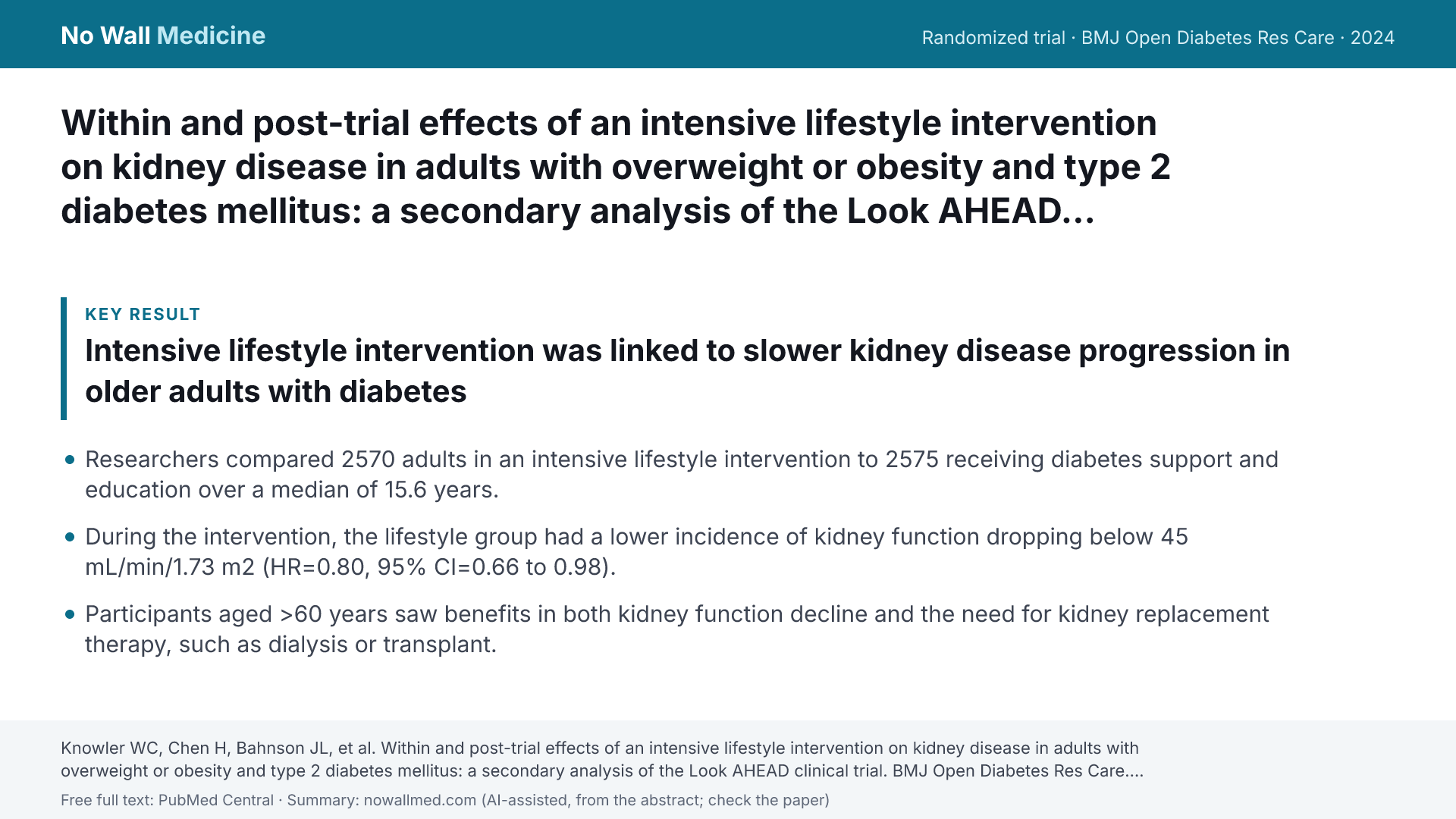
Intensive lifestyle intervention was linked to slower kidney disease progression in older adults with diabetes
Within and post-trial effects of an intensive lifestyle intervention on kidney disease in adults with overweight or obesity and type 2 diabetes mellitus: a secondary analysis of the Look AHEAD clinical trial
Key points
- Researchers compared 2570 adults in an intensive lifestyle intervention to 2575 receiving diabetes support and education over a median of 15.6 years.
- During the intervention, the lifestyle group had a lower incidence of kidney function dropping below 45 mL/min/1.73 m2 (HR=0.80, 95% CI=0.66 to 0.98).
- Participants aged >60 years saw benefits in both kidney function decline and the need for kidney replacement therapy, such as dialysis or transplant.
Headline and key points written with AI from the paper’s abstract, with every number checked against it. Read the paper before relying on them.
Was this summary helpful?
Abstract
Introduction
The Look AHEAD randomized clinical trial reported that an 8-year intensive lifestyle intervention (ILI) compared with diabetes support and education (DSE) in adults aged 45-76 years with type 2 diabetes and overweight/obesity delayed kidney disease progression. Here, we report long-term post-intervention follow-up for the trial's secondary outcome of kidney disease. Research design and methods
We examined effects of ILI (n=2570) versus DSE (n=2575) on decline in estimated glomerular filtration rate (eGFR) to <45 mL/min/1.73 m2 or need for kidney replacement therapy (KRT: dialysis or kidney transplant) during intervention and post-intervention follow-up (median 15.6 years overall). Results
Incidence of eGFR <45 mL/min/1.73 m2 was lower in ILI during the intervention (HR=0.80, 95% CI=0.66 to 0.98) but not post-intervention (HR=1.03, 0.86 to 1.23) or overall (HR=0.92, 0.80 to 1.04). There were no significant treatment group differences in KRT. In prespecified subgroup analyses, age×treatment interactions were significant over total follow-up: p=0.001 for eGFR <45 mL/min/1.73 m2 and p=0.01 for KRT. The 2205 participants aged >60 years at baseline had benefit in both kidney outcomes during intervention and overall (HR=0.75, 0.62 to 0.90 for eGFR <45 mL/min/1.73 m2; HR=0.62, 0.43 to 0.91 for KRT). The absolute treatment effects were greater post-intervention: ILI reduced the rate of eGFR <45 mL/min/1.73 m2 by 0.46 and 0.76 cases/100 person-years during and post-intervention, respectively; and reduced KRT by 0.15 and 0.21 cases/100 person-years. The younger participants experienced no such post-intervention benefits. Conclusions
ILI reduced kidney disease progression during and following the active intervention in persons aged ≥60 years. ILI should be considered for reducing kidney disease incidence in older persons with type 2 diabetes.
Abstract reproduced under the article’s CC BY licence.
Subject terms
Headline, design, result, key points, caveat and citation as plain text.
Cite this article
Knowler WC, Chen H, Bahnson JL, et al. Within and post-trial effects of an intensive lifestyle intervention on kidney disease in adults with overweight or obesity and type 2 diabetes mellitus: a secondary analysis of the Look AHEAD clinical trial. BMJ Open Diabetes Res Care. 2024;12(3). doi:10.1136/bmjdrc-2024-004079
Spotted a mistake? Suggest a correction