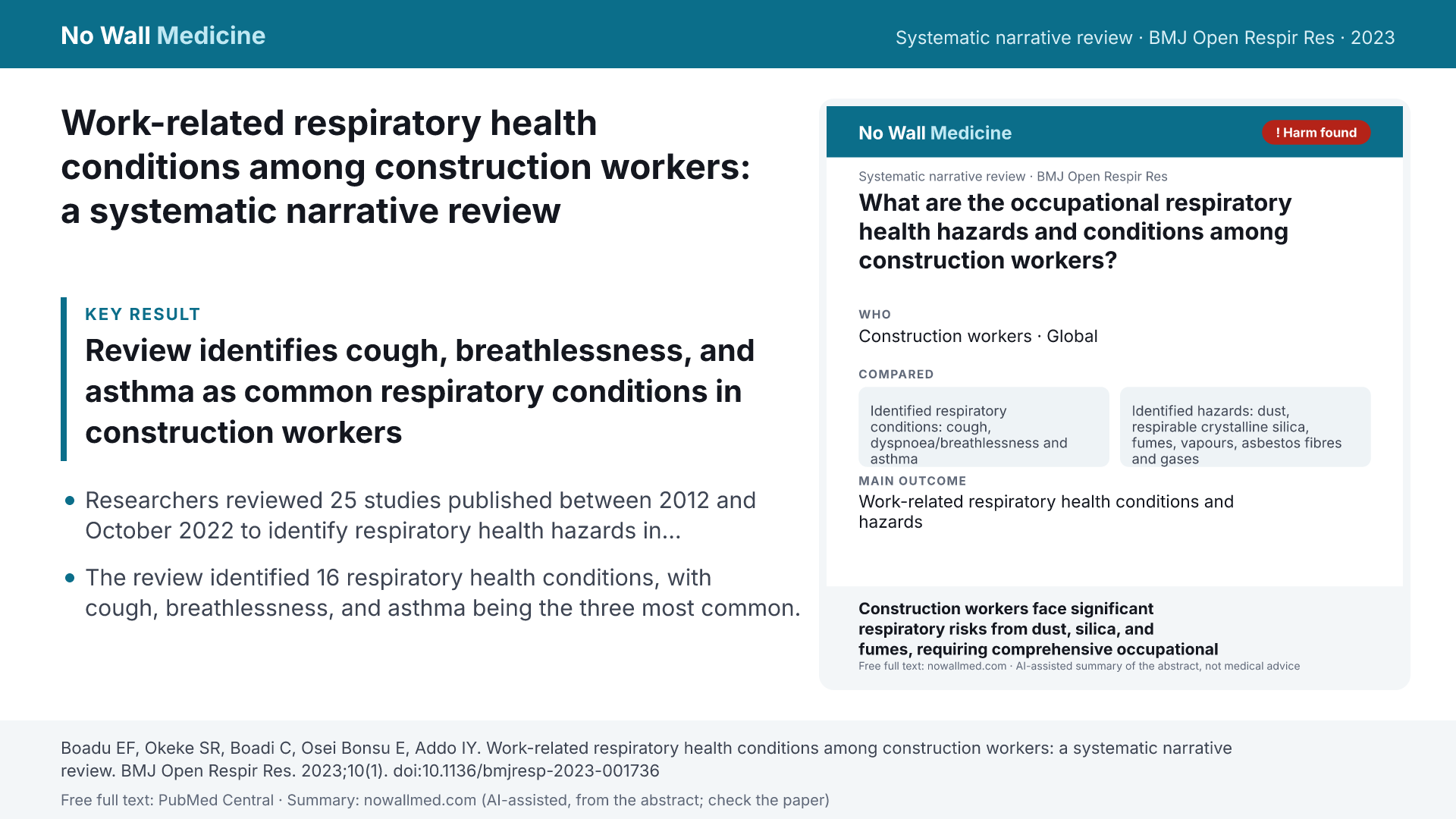
Review identifies cough, breathlessness, and asthma as common respiratory conditions in construction workers
Work-related respiratory health conditions among construction workers: a systematic narrative review
Systematic narrative reviewHarm found
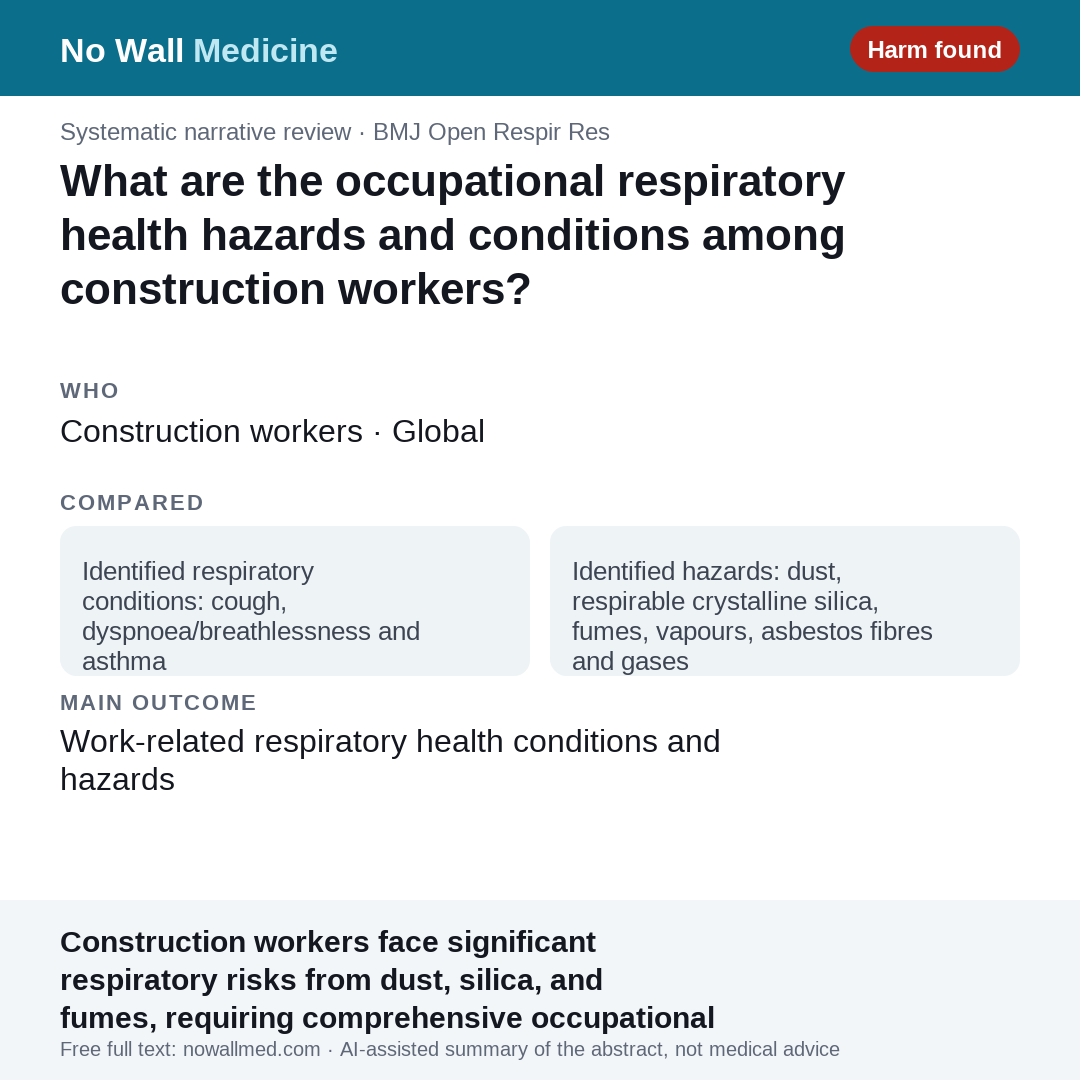
What are the occupational respiratory health hazards and conditions among construction workers?
Who
Construction workers · Global
Compared
Identified respiratory conditions: cough, dyspnoea/breathlessness and asthma
Identified hazards: dust, respirable crystalline silica, fumes, vapours, asbestos fibres and gases
Main outcome
Work-related respiratory health conditions and hazards
Bottom line: Construction workers face significant respiratory risks from dust, silica, and fumes, requiring comprehensive occupational health programmes.
BMJ Open Respir Res · 2023-06-27Download image
Clinical question: What are the occupational respiratory health hazards and conditions among construction workers?
Why it matters: A comprehensive synthesis of global evidence regarding occupational respiratory health hazards and conditions specifically among construction workers was missing from existing literature.
Key points
- Researchers reviewed 25 studies published between 2012 and October 2022 to identify respiratory health hazards in the construction industry.
- The review identified 16 respiratory health conditions, with cough, breathlessness, and asthma being the three most common.
- Exposure to dust, silica, fumes, vapors, asbestos, and gases was associated with respiratory health conditions in these workers.
Headline and key points written with AI from the paper’s abstract, with every number checked against it. Read the paper before relying on them.
Was this summary helpful?
Abstract
Background
Emerging evidence in both developed and developing countries indicate that occupational health hazards and diseases among construction workers constitute a significant public health challenge. While occupational health hazards and conditions in the construction sector are diverse, a burgeoning body of knowledge is emerging about respiratory health hazards and diseases. Yet, there is a notable gap in the existing literature in terms of comprehensive syntheses of the available evidence on this topic. In light of this research gap, this study systematically reviewed the global evidence on occupational health hazards and related respiratory health conditions among construction workers. Methods
Using meta-aggregation, guided by the Condition (respiratory health conditions), Context (construction industry) and Population (construction workers) (CoCoPop) framework and Preferred Reporting Items for Systematic Reviews and Meta-Analyses guidelines, literature searches were conducted on Scopus, PubMed, Web of Science and Google Scholar for relevant studies on respiratory health conditions affecting construction workers. Four eligibility criteria were used in scrutinising studies for inclusion. The quality of the included studies was assessed based on Joanna Briggs Institute's Critical Appraisal tool, while the reporting of the results was guided by the Synthesis Without Meta-analysis guidelines. Results
From an initial pool of 256 studies from the various databases, 25 studies published between 2012 and October 2022 were identified as meeting the inclusion criteria. In all, 16 respiratory health conditions were identified, with cough (ie, dry and with phlegm), dyspnoea/breathlessness and asthma emerging as the top three respiratory conditions among construction workers. The study identified six overarching themes of hazards that are associated with respiratory health conditions among construction workers. These hazards include exposure to dust, respirable crystalline silica, fumes, vapours, asbestos fibres and gases. Smoking and extended period of exposure to the respiratory hazard were found to increase the risk of contracting respiratory diseases. Conclusions
Our systematic review indicates that construction workers are exposed to hazards and conditions that have adverse effects on their health and well-being. Given the considerable impact that work-related health hazards can have on the health and socioeconomic well-being of construction workers, we suggest that the implementation of a comprehensive occupational health programme is essential. Such a programme would extend beyond the mere provision of personal protective equipment and would incorporate a range of proactive measures aimed at controlling the hazards and mitigating the risk of exposure to the occupational health hazards.
Abstract reproduced under the article’s CC BY NC licence.
Subject terms
Cite this article
Boadu EF, Okeke SR, Boadi C, Osei Bonsu E, Addo IY. Work-related respiratory health conditions among construction workers: a systematic narrative review. BMJ Open Respir Res. 2023. doi:10.1136/bmjresp-2023-001736
Spotted a mistake? Suggest a correction