World Health Organization hand hygiene strategy led to sustained improvements in Ugandan healthcare facilities
World Health Organization Multimodal Improvement Strategy for Hand Hygiene: A Stepped-Wedge Cluster Randomized Trial
Stepped-wedge cluster randomized trialBenefit found
Does the WHO multimodal improvement strategy improve hand hygiene performance in Uganda?
Who
27895
All health care workers at participating sites · 8 health care facilities in eastern Uganda
Compared
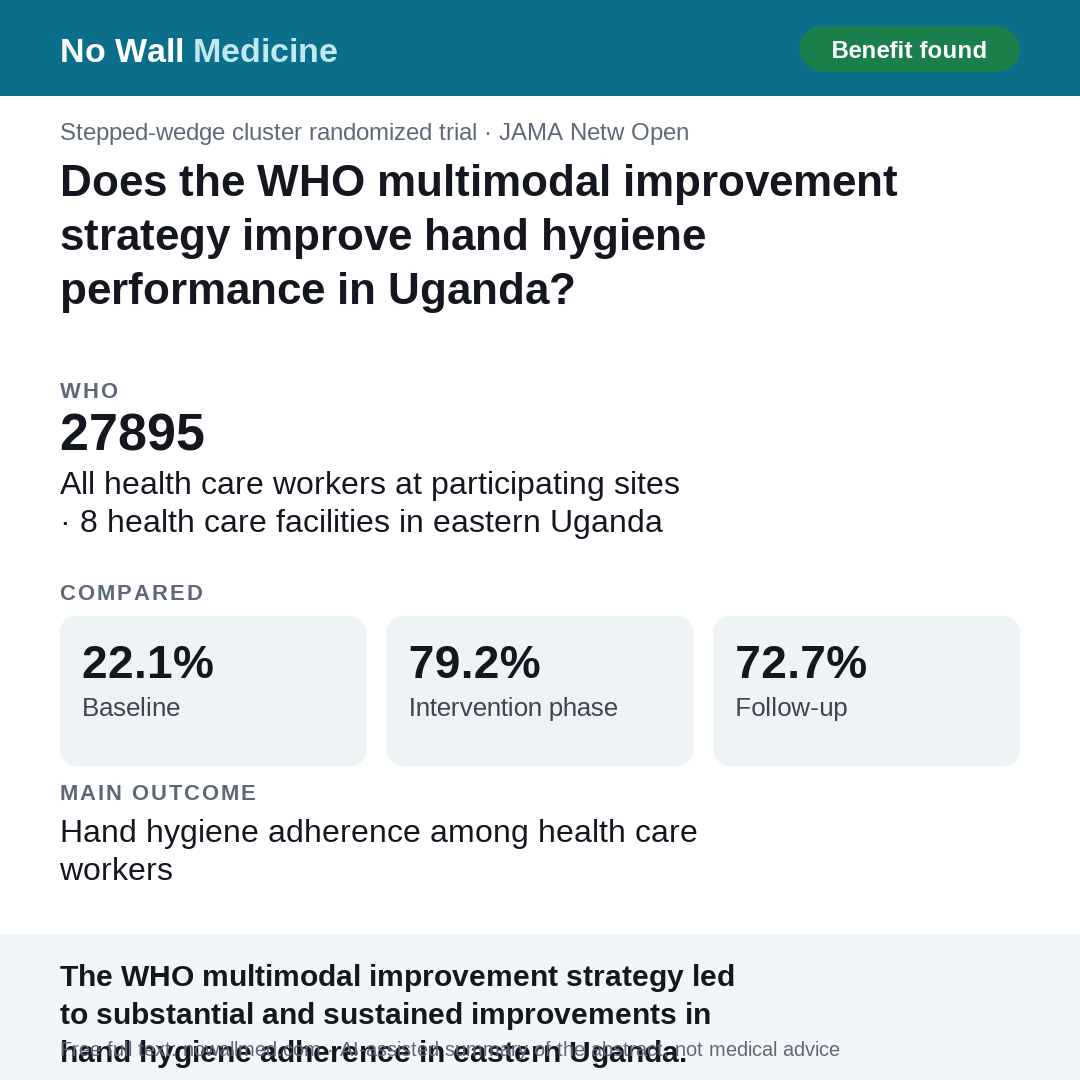
22.1%Baseline (95% CI, 11.4%-32.8%)
79.2%Intervention phase (95% CI, 67.2%-91.2%)
72.7%Follow-up (95% CI, 57.8%-87.6%)
Main outcome
Hand hygiene adherence among health care workers
Bottom line: The WHO multimodal improvement strategy led to substantial and sustained improvements in hand hygiene adherence in eastern Uganda.
JAMA Netw Open · 2026-07-01Download image
Clinical question: Does the WHO multimodal improvement strategy improve hand hygiene performance in Uganda?
Why it matters: Evidence on hand hygiene promotion in resource-limited settings is sparse, and the long-term sustainability of such programs is poorly understood.
Key points
- Researchers studied healthcare workers at 8 facilities across 4 districts in eastern Uganda over 45 months using a stepped-wedge cluster randomized trial.
- Hand hygiene adherence increased from 22.1% at baseline to 79.2% during the intervention and remained at 72.7% during the follow-up period.
- Locally manufactured alcohol-based handrub accounted for more than 99% of the observed hand hygiene actions during the intervention and follow-up phases.
Headline and key points written with AI from the paper’s abstract, with every number checked against it. Read the paper before relying on them.
Topics
Cite this article
Nyawere E, Saito H, Ajok R, Aber B, Owori F, Pittet D. World Health Organization Multimodal Improvement Strategy for Hand Hygiene: A Stepped-Wedge Cluster Randomized Trial. JAMA Netw Open. 2026. doi:10.1001/jamanetworkopen.2026.25250
Spotted a mistake? Suggest a correction