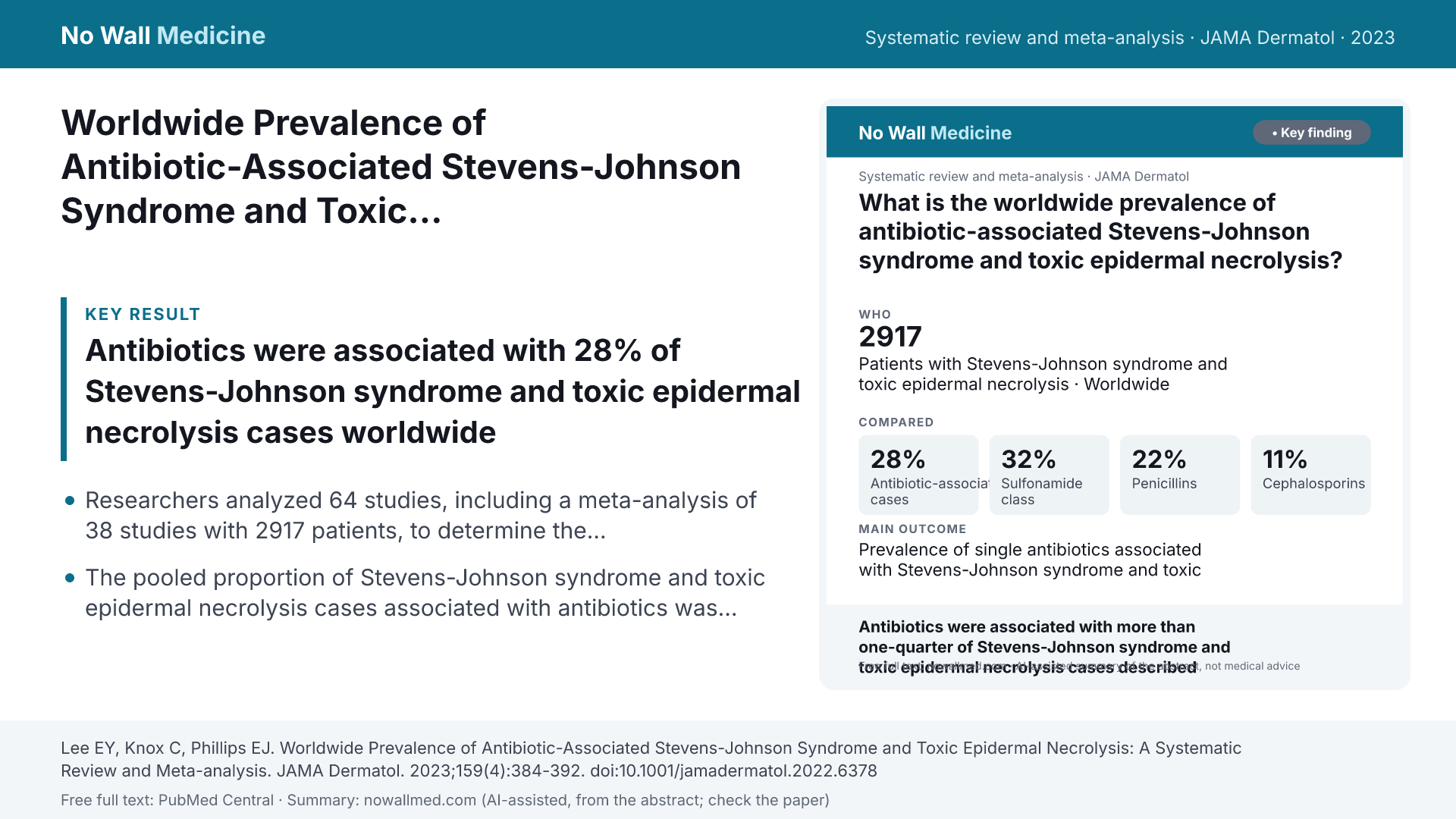
Antibiotics were associated with 28% of Stevens-Johnson syndrome and toxic epidermal necrolysis cases worldwide
Worldwide Prevalence of Antibiotic-Associated Stevens-Johnson Syndrome and Toxic Epidermal Necrolysis: A Systematic Review and Meta-analysis
Systematic review and meta-analysisKey finding
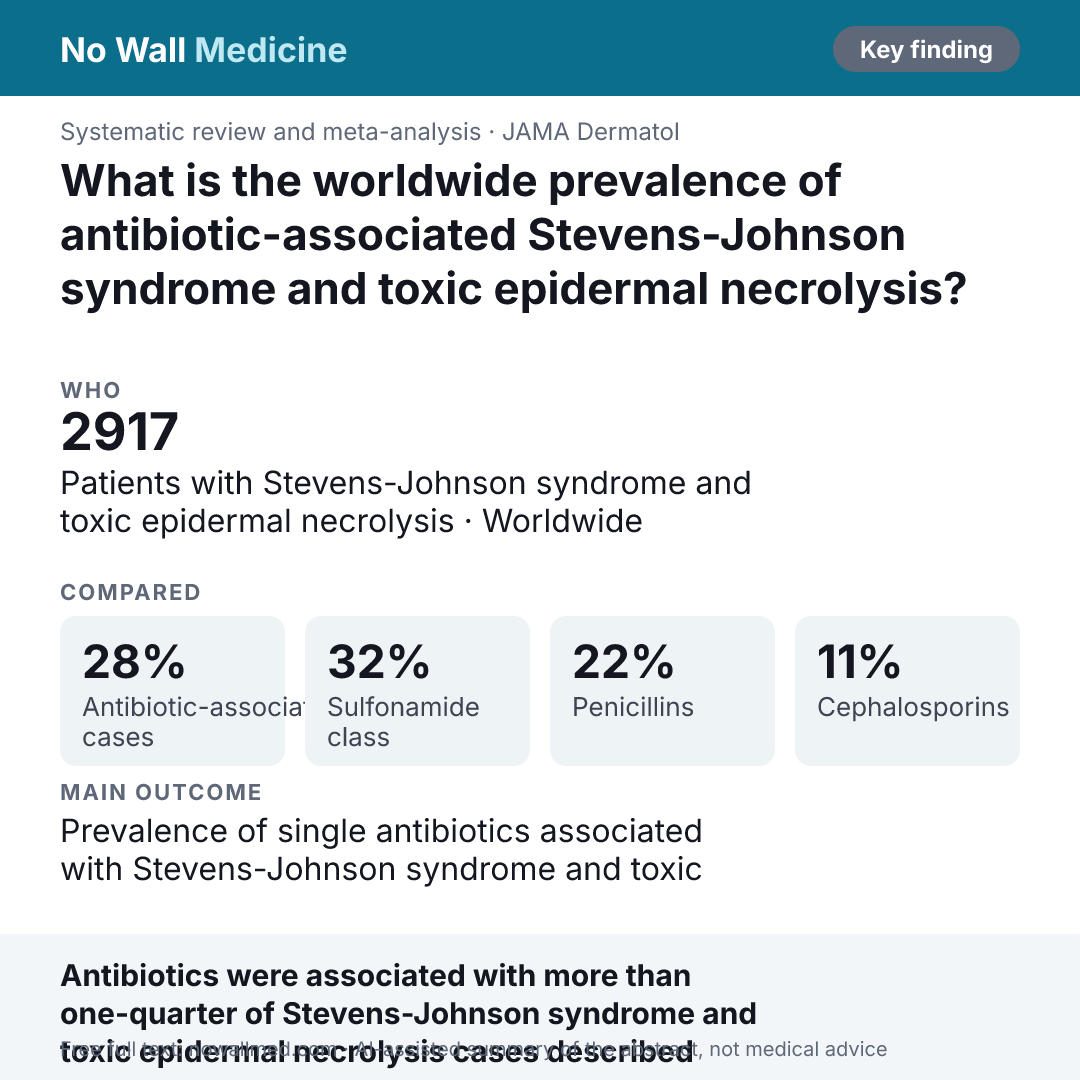
What is the worldwide prevalence of antibiotic-associated Stevens-Johnson syndrome and toxic epidermal necrolysis?
Who
2917
Patients with Stevens-Johnson syndrome and toxic epidermal necrolysis · Worldwide
Compared
28%Antibiotic-associated cases (95% CI, 24%-33%)
32%Sulfonamide class (95% CI, 22%-44%)
22%Penicillins (95% CI, 17%-28%)
11%Cephalosporins (95% CI, 6%-17%)
Main outcome
Prevalence of single antibiotics associated with Stevens-Johnson syndrome and toxic epidermal necrolysis
Result: 28% (95% CI, 24%-33%)
Bottom line: Antibiotics were associated with more than one-quarter of Stevens-Johnson syndrome and toxic epidermal necrolysis cases described worldwide.
Limitation: Statistically significant heterogeneity was present in the meta-analysis.
JAMA Dermatol · 2023-02-16 · Save PNG
Clinical question: What is the worldwide prevalence of antibiotic-associated Stevens-Johnson syndrome and toxic epidermal necrolysis?
Why it matters: The global prevalence of Stevens-Johnson syndrome and toxic epidermal necrolysis specifically associated with antibiotics was not previously described in a systematic review.
Key points
- Researchers analyzed 64 studies, including a meta-analysis of 38 studies with 2917 patients, to determine the global prevalence of antibiotic-associated Stevens-Johnson syndrome and toxic epidermal necrolysis.
- The pooled proportion of Stevens-Johnson syndrome and toxic epidermal necrolysis cases associated with antibiotics was 28% (95% CI, 24%-33%).
- Among these cases, sulfonamides were associated with 32% (95% CI, 22%-44%), penicillins with 22% (95% CI, 17%-28%), and cephalosporins with 11% (95% CI, 6%-17%).
Limitation the authors note: There was a statistically significant heterogeneity in the meta-analysis, which could be partially explained by continents.
Headline and key points written with AI from the paper’s abstract, with every number checked against it. Read the paper before relying on them.
Was this summary helpful?
Subject terms
Headline, design, result, key points, caveat and citation as plain text.
Cite this article
Lee EY, Knox C, Phillips EJ. Worldwide Prevalence of Antibiotic-Associated Stevens-Johnson Syndrome and Toxic Epidermal Necrolysis: A Systematic Review and Meta-analysis. JAMA Dermatol. 2023;159(4):384-392. doi:10.1001/jamadermatol.2022.6378
Spotted a mistake? Suggest a correction