Allopurinol did not reduce white matter hyperintensity progression after ischaemic stroke or transient ischaemic attack
Xanthine oxidase inhibition and white matter hyperintensity progression following ischaemic stroke and transient ischaemic attack (XILO-FIST): a multicentre, double-blinded, randomised, placebo-controlled trial
Multicentre, double-blinded, randomised, placebo-controlled trialNo clear difference
Does allopurinol reduce white matter hyperintensity progression following ischaemic stroke or transient ischaemic attack?
Who
464
Participants within 30 days of ischaemic stroke or transient ischaemic attack · 22 stroke units in the United Kingdom
Compared
1.3allopurinol 300 mg twice daily (SD 1.8)
1.5placebo (SD 1.9)
Main outcome
White matter hyperintensity Rotterdam Progression Score at week 104
Result: -0.17, 95% CI -0.52 to 0.17
Bottom line: Allopurinol use did not reduce white matter hyperintensity progression in people with recent ischaemic stroke or transient ischaemic attack.
Funded by: British Heart Foundation and the UK Stroke Association
eClinicalMedicine · 2023-02-16Download image
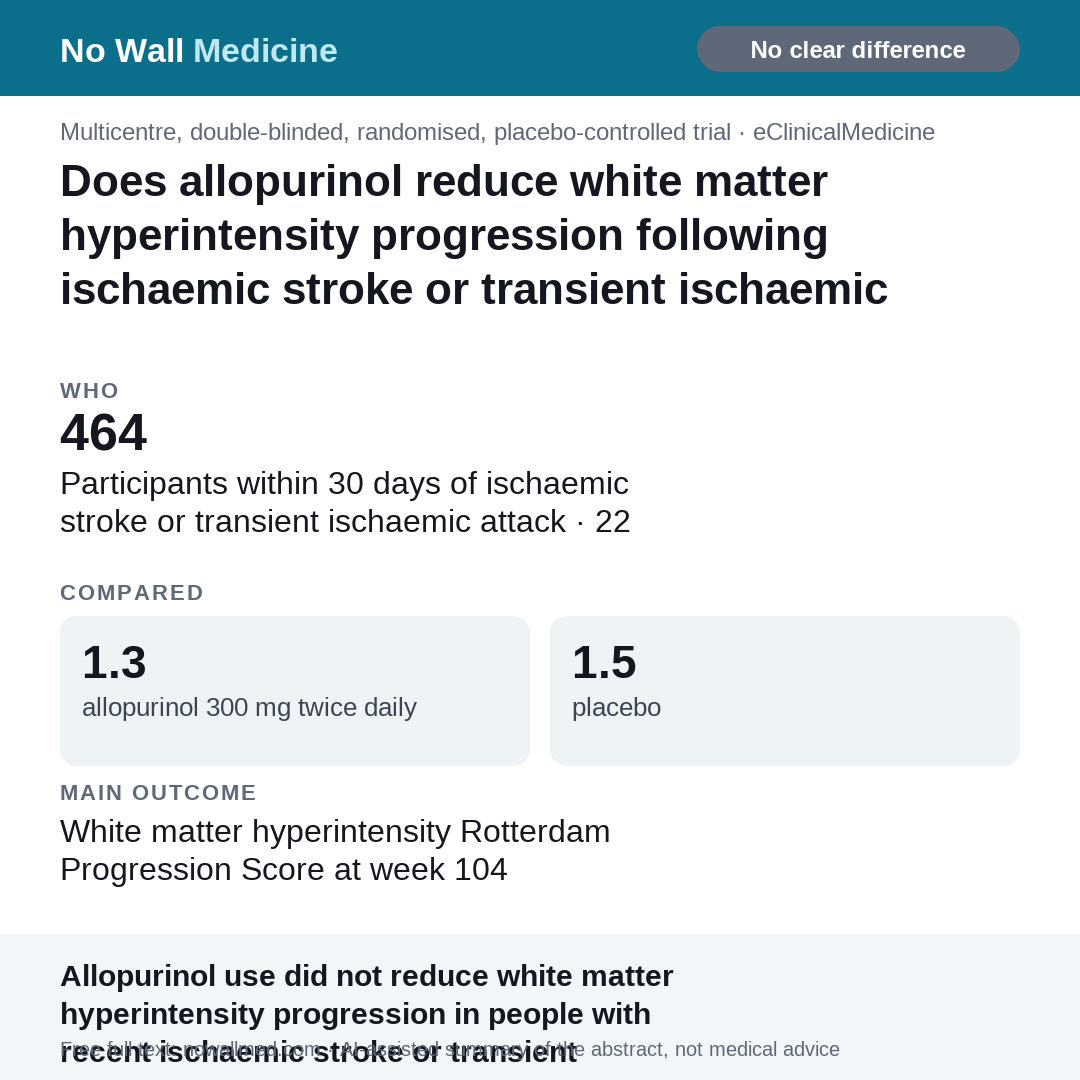
Clinical question: Does allopurinol reduce white matter hyperintensity progression following ischaemic stroke or transient ischaemic attack?
Why it matters: It was unknown if inhibiting the enzyme xanthine oxidase with allopurinol could slow the progression of white matter hyperintensity or blood pressure after a stroke or transient ischaemic attack.
Key points
- The trial studied 464 participants who received either 300 mg of allopurinol twice daily or a placebo within 30 days of an ischaemic stroke or transient ischaemic attack.
- At 104 weeks, the white matter hyperintensity Rotterdam Progression Score was 1.3 (SD 1.8) with allopurinol and 1.5 (SD 1.9) with placebo, showing no significant difference.
- Serious adverse events occurred in 32% of participants receiving allopurinol and 28% of those receiving the placebo.
Headline and key points written with AI from the paper’s abstract, with every number checked against it. Read the paper before relying on them.
Was this summary helpful?
Cite this article
Dawson J, Robertson M, Dickie DA, Bath P, Forbes K, Quinn T. Xanthine oxidase inhibition and white matter hyperintensity progression following ischaemic stroke and transient ischaemic attack (XILO-FIST): a multicentre, double-blinded, randomised, placebo-controlled trial. eClinicalMedicine. 2023. doi:10.1016/j.eclinm.2023.101863
Spotted a mistake? Suggest a correction
Top studies every Monday
The week’s key trials and guidelines in your specialties, plus any topics you follow. By email, free.
Get the weekly digest