Zamtocabtagene autoleucel prolonged event-free survival in large B-cell lymphoma patients
Zamtocabtagene autoleucel, a tandem CD20-CD19-directed CAR T-cell therapy, for second line treatment of large B-cell lymphoma in patients ineligible for transplantation (DALY 2-EU): primary analysis of an open-label, multicentre, randomised phase 2 study
Randomized, open-label trialBenefit found
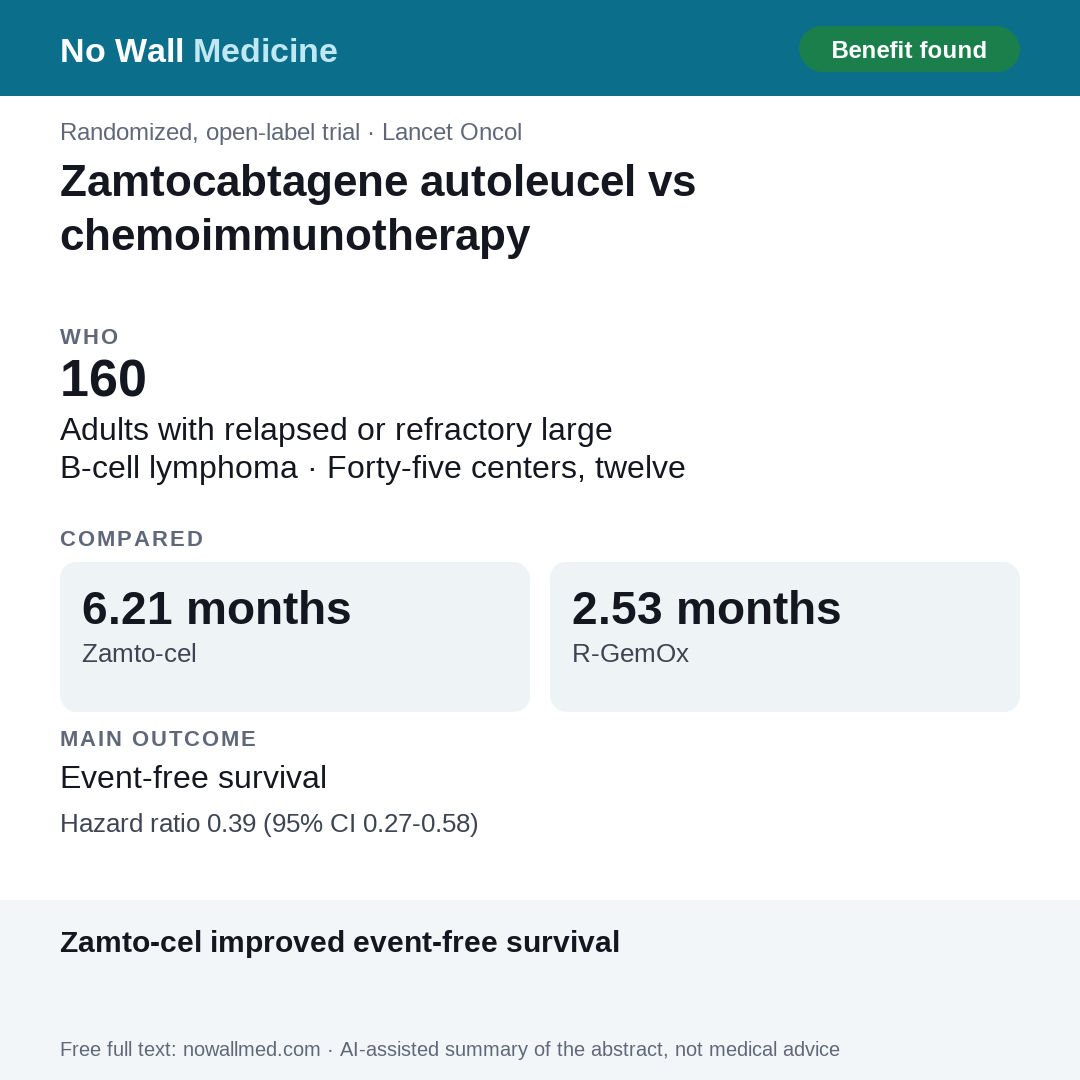
Zamtocabtagene autoleucel vs chemoimmunotherapy
Who
160
Adults with relapsed or refractory large B-cell lymphoma · Forty-five centers, twelve countries
Compared
6.21 monthsZamto-cel (95% CI 3.84-13.77)
2.53 monthsR-GemOx (1.97-3.35)
Main outcome
Event-free survival
Result: Hazard ratio 0.39 (95% CI 0.27-0.58)
Bottom line: Zamto-cel improved event-free survival
Funded by: Miltenyi Biomedicine
Lancet Oncol · 2026-10-26Download image
Why it matters: There is no evidence from randomised controlled trials on second-line treatments for large B-cell lymphoma patients ineligible for transplantation
Key points
- 160 patients with relapsed or refractory large B-cell lymphoma were randomly assigned to zamto-cel or R-GemOx chemoimmunotherapy.
- Event-free survival was 6·21 months with zamto-cel versus 2·53 months with R-GemOx.
- Grade 3 or higher adverse events occurred in 83% of zamto-cel patients and 86% of R-GemOx patients.
Headline and key points written with AI from the paper’s abstract, with every number checked against it. Read the paper before relying on them.
Abstract
Background
Anti-CD19 CAR T-cell therapy is the standard second-line treatment for patients with relapsed or refractory large B-cell lymphoma. However, there is no evidence from randomised controlled trials in patients ineligible for transplantation. To address this gap, we compared zamtocabtagene autoleucel (zamto-cel), a CAR T-cell therapy directed at CD20 and CD19, with rituximab-gemcitabine-oxaliplatin (R-GemOx) chemoimmunotherapy in patients ineligible for transplantation with relapsed or refractory large B-cell lymphoma. Methods
DALY 2-EU is an open-label, multicentre, randomised, phase 2 trial conducted at 45 centres across 12 countries in Europe. Eligible patients were adults (aged ≥18 years) with second-line relapsed or refractory large B-cell lymphoma confirmed histologically who were ineligible for transplantation and had received first-line chemoimmunotherapy containing a combination of an anthracycline-based regimen and an anti-CD20 monoclonal antibody, with Eastern Cooperative Oncology Group performance status score of 2 or less. Patients were randomly assigned (1:1) to zamto-cel (single intravenous infusion of 2·5 × 106 fresh (ie, non-cryopreserved) CAR T-cells per kg, capped at 100 kg, produced in a closed automated system) or R-GemOx (rituximab [375 mg/m2 intravenously on day 1], gemcitabine [1000 mg/m2 intravenously on day 1 or 2], and oxaliplatin [100 mg/m2 intravenously on day 1 or 2] administered for up to eight 14-day cycles). Randomisation was done with an interactive web response system and stratified by age, gender, lactate dehydrogenase, International Prognostic Index, histology, time to relapse after the start of first-line therapy, and country. The primary endpoint was event-free survival assessed by a masked independent review committee and compared all patients randomly assigned to the zamto-cel and R-GemOx groups using a one-sided log-rank test. Safety was assessed in all patients who received study treatment. This ongoing trial is registered with ClinicalTrials.gov (NCT04844866). Findings
Between Oct 14, 2021, and Jul 16, 2024, 219 patients were screened and 160 were randomly assigned to zamto-cel (n=82) and R-GemOx (n=78). The median age was 74·0 years (IQR 70·5-77·0). Patients were predominantly male (100 [63%] of 160 were men and 60 [38%] women) and White (91 [57%]), with race not reported for 64 (40%). Median vein-to-vein time for zamto-cel was 15 days (IQR 15-16). With a median follow-up of 17·0 months (IQR 9·0-22·8), event-free survival was longer in the zamto-cel group than in the R-GemOx group (6·21 months [95% CI 3·84-13·77] vs 2·53 months [1·97-3·35]; HR 0·39 [95% CI 0·27-0·58]; p<0·0001). Grade 3 or higher treatment-emergent adverse events occurred in 63 (83%) of 76 with zamto-cel and in 65 (86%) of 76 with R-GemOx. The most common grade 3-4 adverse events were neutropenia (28 [37%] with zamto-cel and 17 [22%] with R-GemOx), anaemia (11 [14%] and 12 [16%]), and decreased neutrophil count (20 [26%] and seven [9%]). Serious adverse events occurred in 31 (41%) patients with zamto-cel and 50 (66%) with R-GemOx, most commonly malignant neoplasm progression (11 [14%] and 38 [50%]), cytokine release syndrome (CRS; six [8%] and none), and immune effector cell-associated neurotoxicity syndrome (four [5%] and none). Treatment-related deaths occurred in two (3%) of 82 patients with zamto-cel (due to CRS and haemophagocytic lymphohistiocytosis) and in one (1%) of 78 with R-GemOx (malignant lymphoma progression). Interpretation
The risk-benefit ratio observed in the DALY 2-EU study supports consideration of zamto-cel as a second-line standard treatment option for patients with relapsed or refractory large B-cell lymphoma who are ineligible for transplantation. Funding
Miltenyi Biomedicine.
Abstract reproduced under the article’s CC BY licence.
Topics
Cite this article
Borchmann P, van Meerten T, Iacoboni G, Bories P, Dreger P, Mutsaers P. Zamtocabtagene autoleucel, a tandem CD20-CD19-directed CAR T-cell therapy, for second line treatment of large B-cell lymphoma in patients ineligible for transplantation (DALY 2-EU): primary analysis of an open-label, multicentre, randomised phase 2 study. Lancet Oncol. 2026. doi:10.1016/S1470-2045(26)00290-1
Spotted a mistake? Suggest a correction