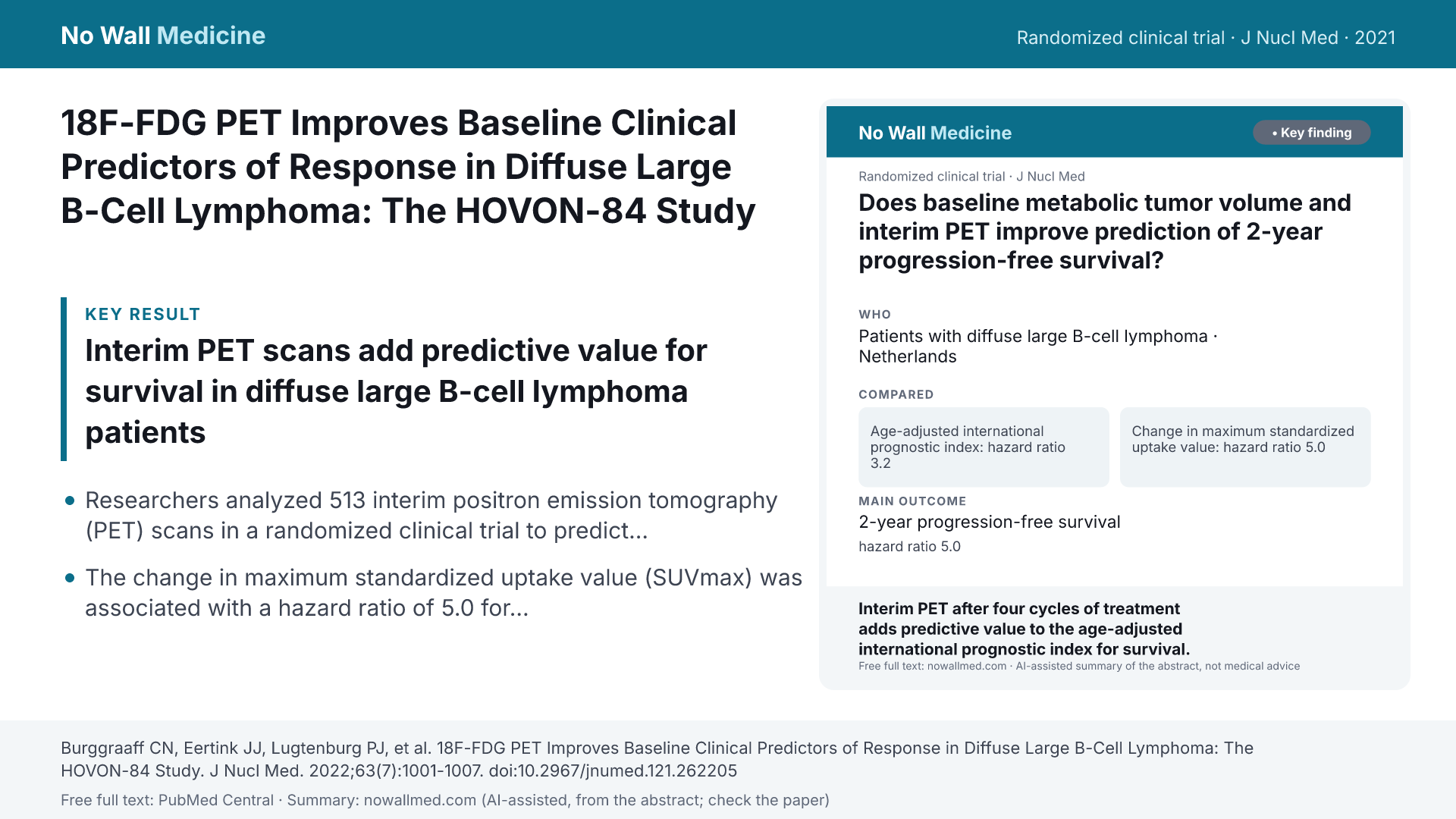
Interim PET scans add predictive value for survival in diffuse large B-cell lymphoma patients
18F-FDG PET Improves Baseline Clinical Predictors of Response in Diffuse Large B-Cell Lymphoma: The HOVON-84 Study
Randomized clinical trialBenefit found
Does baseline metabolic tumor volume and interim PET improve prediction of 2-year progression-free survival?
Who
Patients with diffuse large B-cell lymphoma · Netherlands
Compared
Age-adjusted international prognostic index: hazard ratio 3.2
Change in maximum standardized uptake value: hazard ratio 5.0
Main outcome
2-year progression-free survival
Result: hazard ratio 5.0
Bottom line: Interim PET after four cycles of treatment adds predictive value to the age-adjusted international prognostic index for survival.
J Nucl Med · 2021-10-21Download image
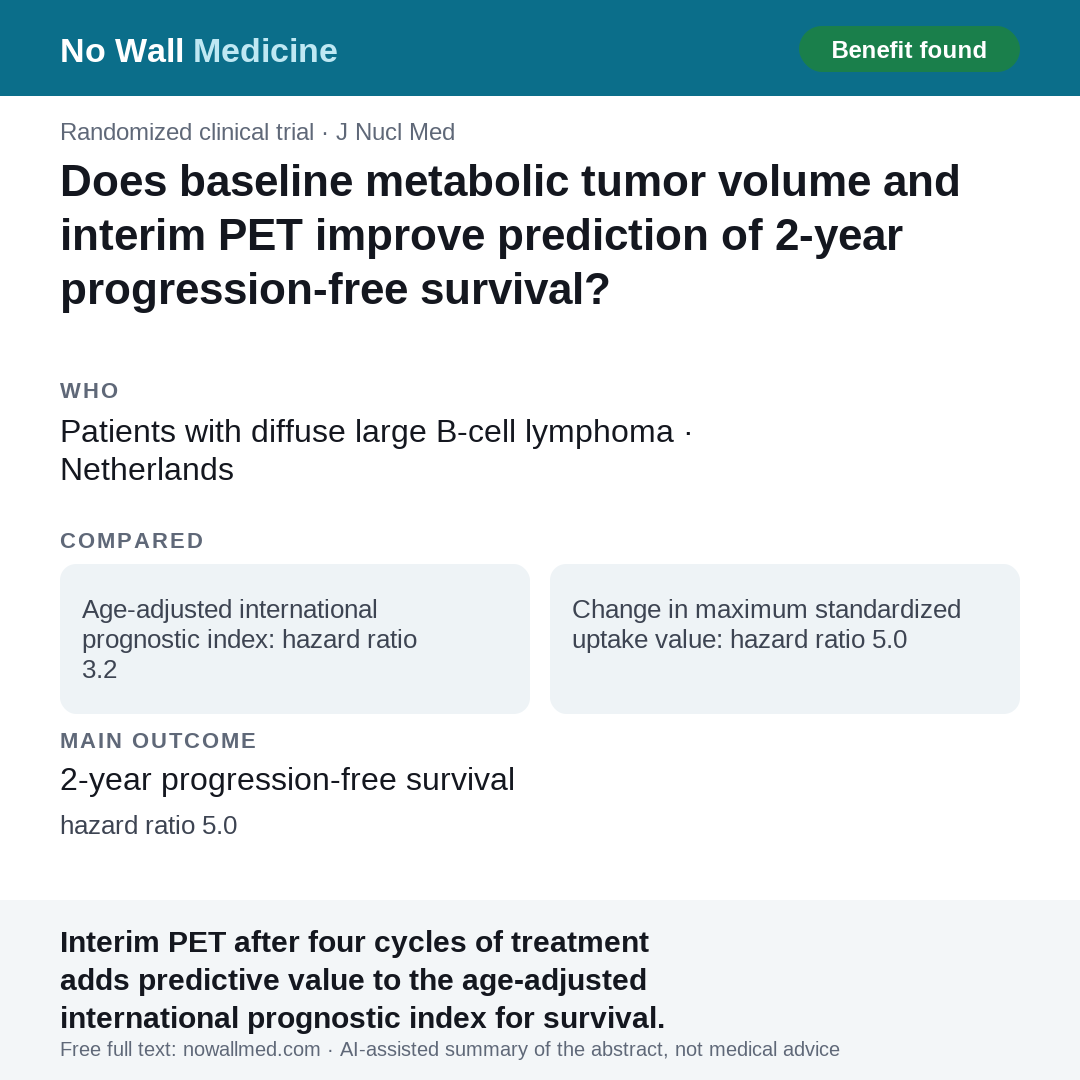
Clinical question: Does baseline metabolic tumor volume and interim PET improve prediction of 2-year progression-free survival?
Why it matters: It was unknown if adding metabolic tumor volume or interim PET scans to the age-adjusted international prognostic index could better predict 2-year progression-free survival.
Key points
- Researchers analyzed 513 interim positron emission tomography (PET) scans in a randomized clinical trial to predict 2-year progression-free survival in diffuse large B-cell lymphoma.
- The change in maximum standardized uptake value (SUVmax) was associated with a hazard ratio of 5.0 for 2-year progression-free survival, outperforming the Deauville score.
- Combining a low or low-intermediate age-adjusted international prognostic index with a change in SUVmax of more than 70% yielded a negative predictive value of 93%.
Headline and key points written with AI from the paper’s abstract, with every number checked against it. Read the paper before relying on them.
Was this summary helpful?
Subject terms
Cite this article
Burggraaff CN, Eertink JJ, Lugtenburg PJ, et al. 18F-FDG PET Improves Baseline Clinical Predictors of Response in Diffuse Large B-Cell Lymphoma: The HOVON-84 Study. J Nucl Med. 2021. doi:10.2967/jnumed.121.262205
Spotted a mistake? Suggest a correction