18F-FDG PET Improves Baseline Clinical Predictors of Response in Diffuse Large B-Cell Lymphoma: The HOVON-84 Study
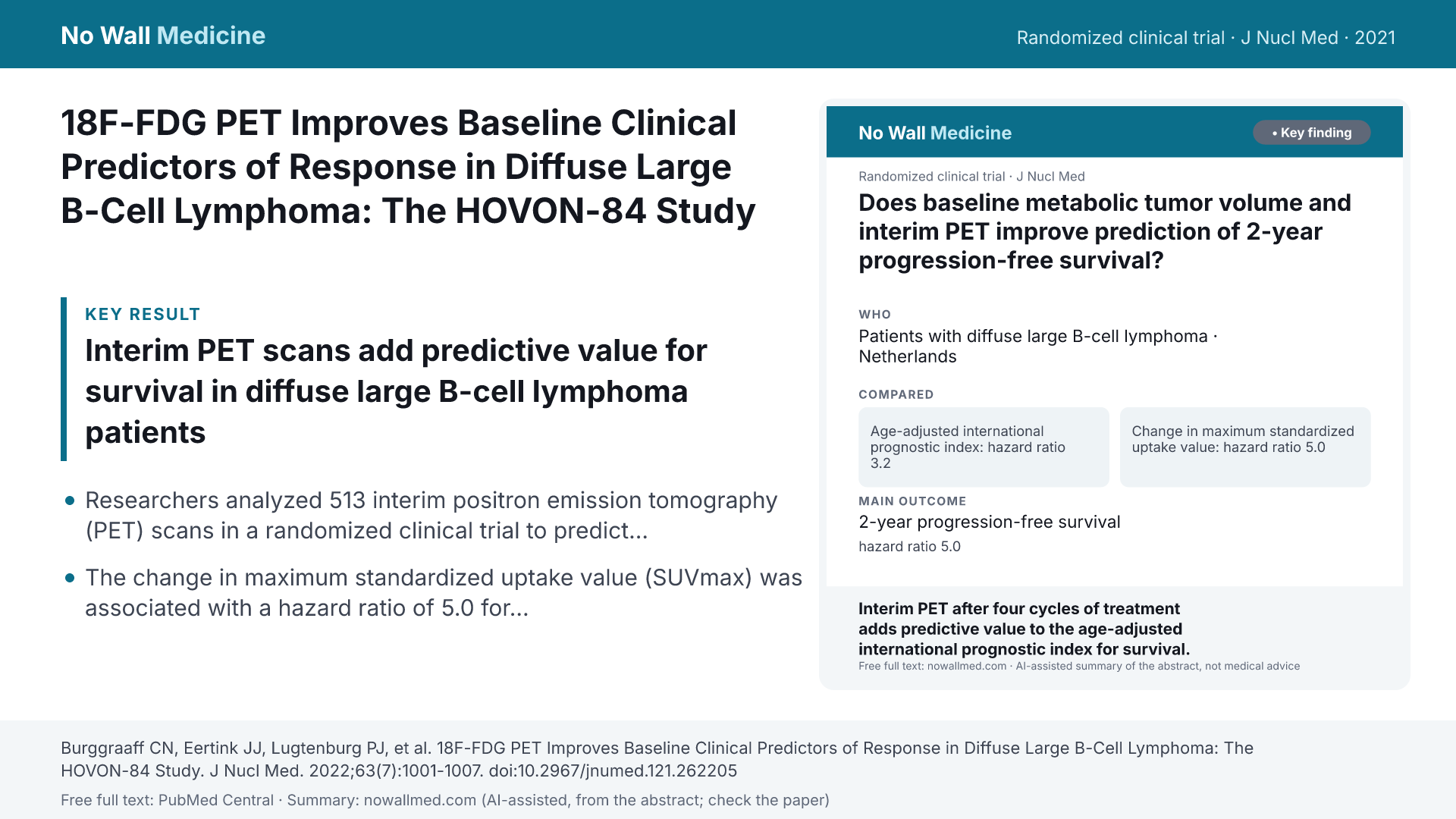
Key result: Interim PET scans add predictive value for survival in diffuse large B-cell lymphoma patients
Randomized clinical trialKey finding
Does baseline metabolic tumor volume and interim PET improve prediction of 2-year progression-free survival?
Who
Patients with diffuse large B-cell lymphoma · Netherlands
Compared
Age-adjusted international prognostic index: hazard ratio 3.2
Change in maximum standardized uptake value: hazard ratio 5.0
Main outcome
2-year progression-free survival
Result: hazard ratio 5.0
Bottom line: Interim PET after four cycles of treatment adds predictive value to the age-adjusted international prognostic index for survival.
J Nucl Med · 2021-10-21
Key points
- Researchers analyzed 513 interim positron emission tomography (PET) scans in a randomized clinical trial to predict 2-year progression-free survival in diffuse large B-cell lymphoma.
- The change in maximum standardized uptake value (SUVmax) was associated with a hazard ratio of 5.0 for 2-year progression-free survival, outperforming the Deauville score.
- Combining a low or low-intermediate age-adjusted international prognostic index with a change in SUVmax of more than 70% yielded a negative predictive value of 93%.
Discussion prompts
- Would these patients look like yours? Who was left out?
- Is the main outcome one that matters to patients?
- Is the difference large enough to change what you do?
Cite: Burggraaff CN, Eertink JJ, Lugtenburg PJ, et al. 18F-FDG PET Improves Baseline Clinical Predictors of Response in Diffuse Large B-Cell Lymphoma: The HOVON-84 Study. J Nucl Med. 2022;63(7):1001-1007. doi:10.2967/jnumed.121.262205
Free full text: PubMed Central · Summary and visual abstract: nowallmed.com/a/18f-fdg-pet-improves-baseline-clinical-predictors-of-response-in-rbxjar/ (AI-assisted from the abstract; check the paper before relying on it).