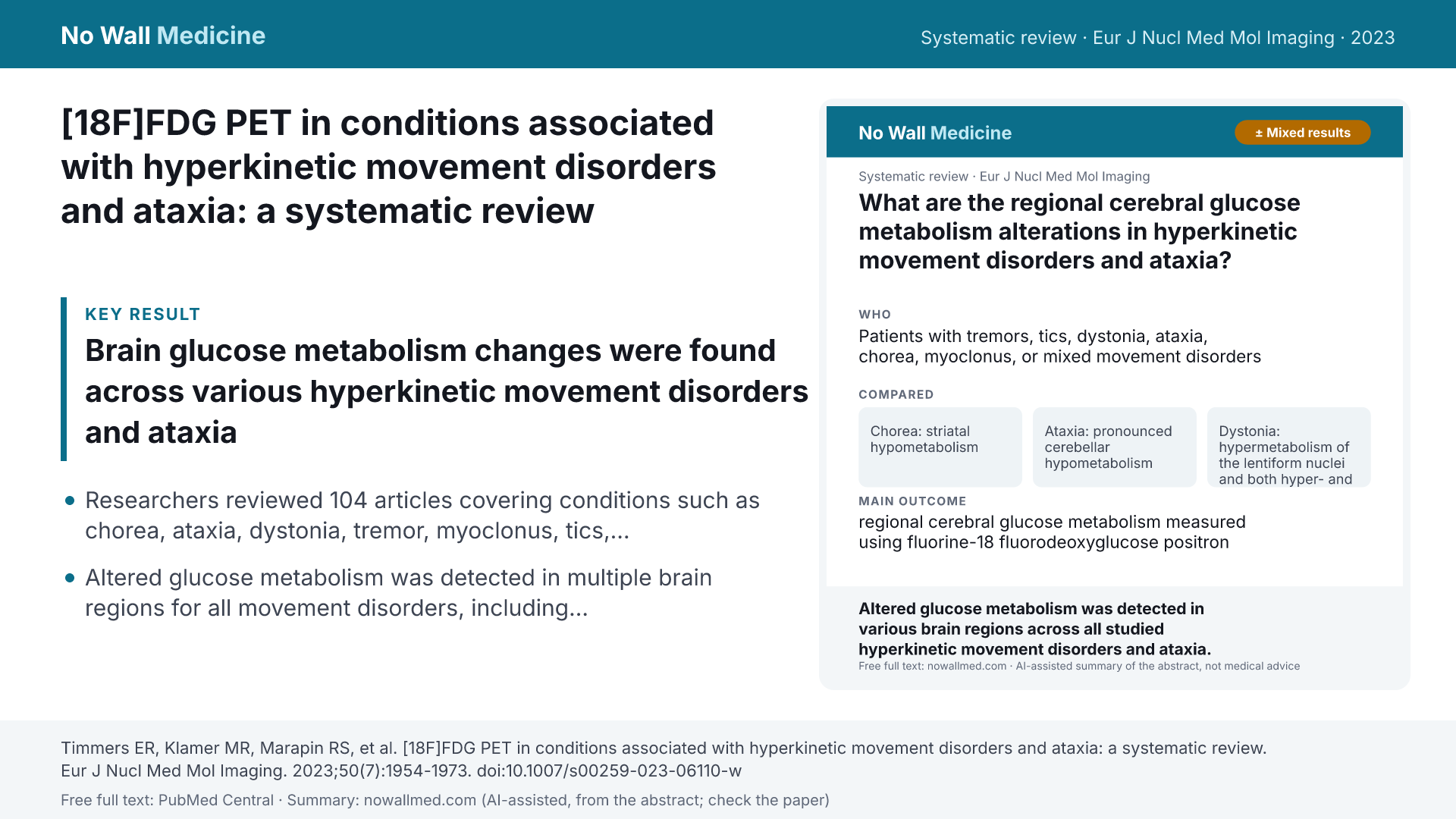
Brain glucose metabolism changes were found across various hyperkinetic movement disorders and ataxia
[18F]FDG PET in conditions associated with hyperkinetic movement disorders and ataxia: a systematic review
Systematic reviewMixed results
What are the regional cerebral glucose metabolism alterations in hyperkinetic movement disorders and ataxia?
Who
Patients with tremors, tics, dystonia, ataxia, chorea, myoclonus, or mixed movement disorders
Compared
Chorea: striatal hypometabolism
Ataxia: pronounced cerebellar hypometabolism
Dystonia: hypermetabolism of the lentiform nuclei and both hyper- and hypometabolism of the cerebellum
Main outcome
regional cerebral glucose metabolism measured using fluorine-18 fluorodeoxyglucose positron emission tomography
Bottom line: Altered glucose metabolism was detected in various brain regions across all studied hyperkinetic movement disorders and ataxia.
Eur J Nucl Med Mol Imaging · 2023-01-27Download image

Clinical question: What are the regional cerebral glucose metabolism alterations in hyperkinetic movement disorders and ataxia?
Why it matters: The specific patterns of regional cerebral glucose metabolism, measured by positron emission tomography, across different hyperkinetic movement disorders and ataxia were not comprehensively summarized.
Key points
- Researchers reviewed 104 articles covering conditions such as chorea, ataxia, dystonia, tremor, myoclonus, tics, and autoimmune or metabolic disorders.
- Altered glucose metabolism was detected in multiple brain regions for all movement disorders, including cerebellar hypometabolism in ataxia and striatal hypometabolism in chorea.
- Normalization of metabolic alterations after treatment was observed in patients with tremors, ataxia, and chorea.
Headline and key points written with AI from the paper’s abstract, with every number checked against it. Read the paper before relying on them.
Was this summary helpful?
Subject terms
Cite this article
Timmers ER, Klamer MR, Marapin RS, Lammertsma AA, de Jong BM, Dierckx RAJO. [18F]FDG PET in conditions associated with hyperkinetic movement disorders and ataxia: a systematic review. Eur J Nucl Med Mol Imaging. 2023. doi:10.1007/s00259-023-06110-w
Spotted a mistake? Suggest a correction
Top studies every Monday
The week’s key trials and guidelines in your specialties, plus any topics you follow. By email, free.
Get the weekly digest