Two-year outcomes for transcatheter versus surgical aortic valve replacement in low-risk patients
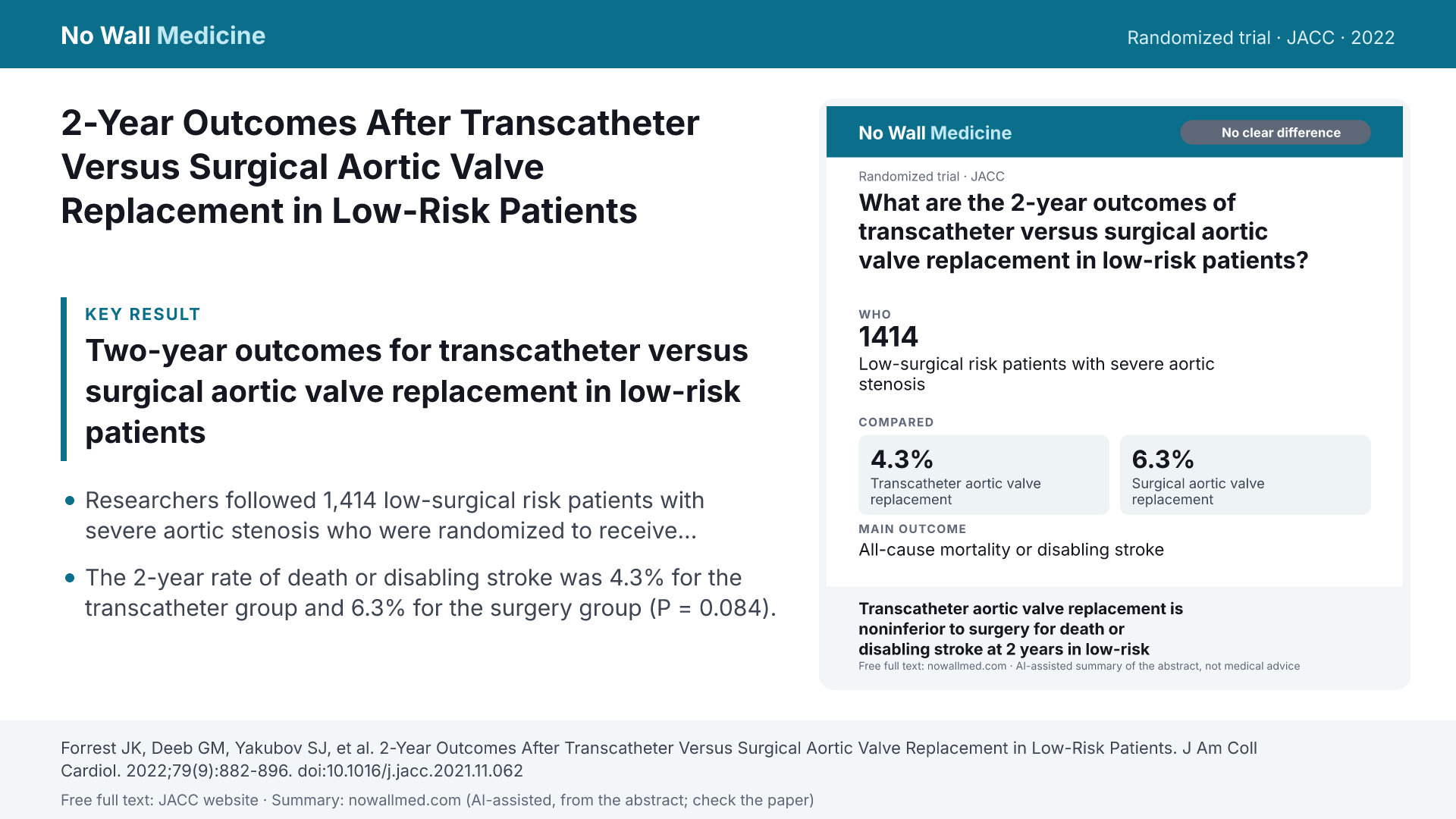
2-Year Outcomes After Transcatheter Versus Surgical Aortic Valve Replacement in Low-Risk Patients
Randomized trialNo clear difference
What are the 2-year outcomes of transcatheter versus surgical aortic valve replacement in low-risk patients?
Who
1414
Low-surgical risk patients with severe aortic stenosis
Compared
4.3%Transcatheter aortic valve replacement
6.3%Surgical aortic valve replacement
Main outcome
All-cause mortality or disabling stroke
Result: difference: -1.4%; 95% Bayesian credible interval: -4.9% to 2.1%
Bottom line: Transcatheter aortic valve replacement is noninferior to surgery for death or disabling stroke at 2 years in low-risk patients.
JACC · 2022-03-04Download image
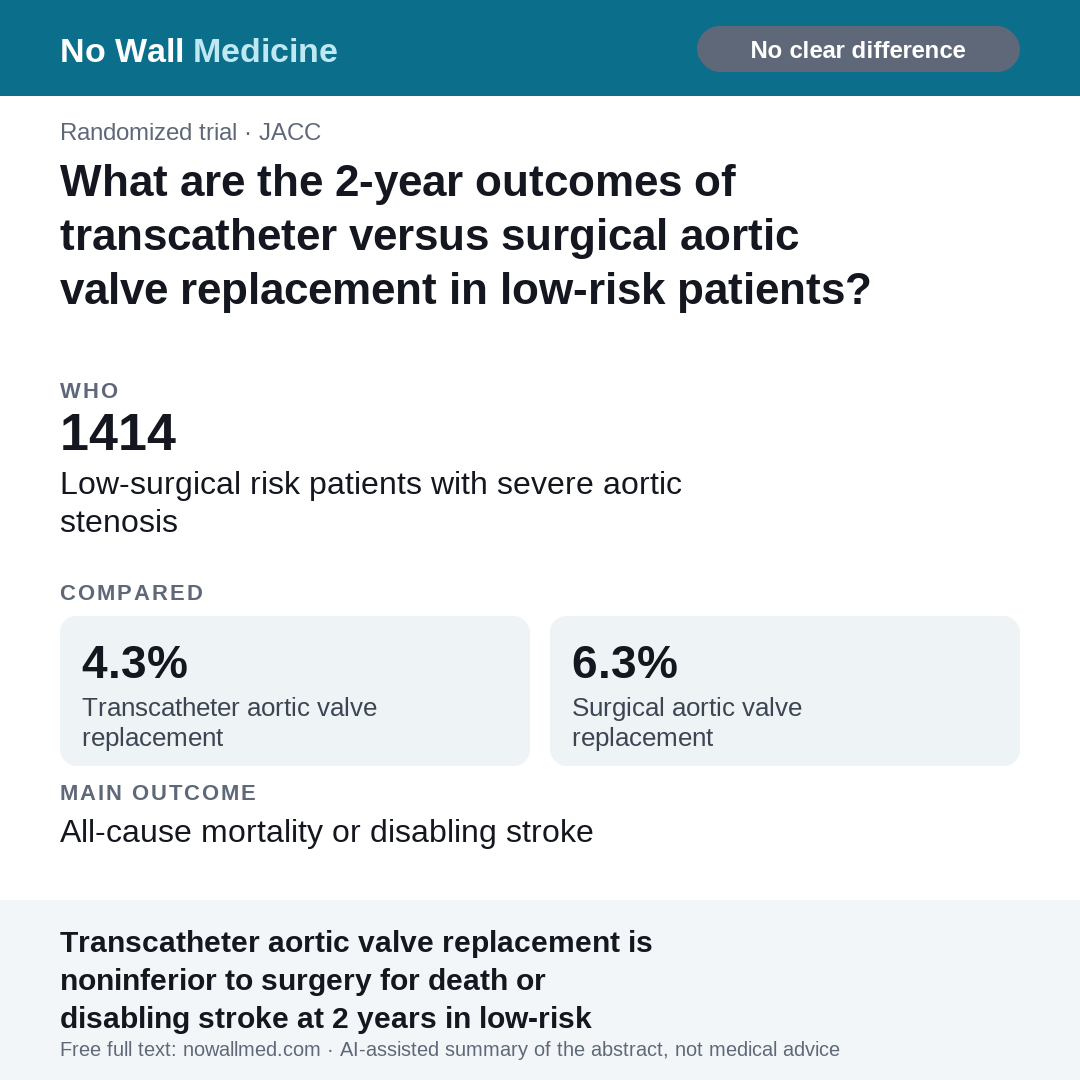
Clinical question: What are the 2-year outcomes of transcatheter versus surgical aortic valve replacement in low-risk patients?
Why it matters: It was unknown if the noninferiority of transcatheter aortic valve replacement compared to surgery would hold true for the full 2-year clinical and echocardiographic outcomes.
Key points
- Researchers followed 1,414 low-surgical risk patients with severe aortic stenosis who were randomized to receive either transcatheter aortic valve replacement or surgical aortic valve replacement.
- The 2-year rate of death or disabling stroke was 4.3% for the transcatheter group and 6.3% for the surgery group (P = 0.084).
- All-cause mortality rates were 3.5% in the transcatheter group versus 4.4% in the surgery group (P = 0.366), while disabling stroke rates were 1.5% versus 2.7% (P = 0.119).
Headline and key points written with AI from the paper’s abstract, with every number checked against it. Read the paper before relying on them.
Was this summary helpful?
Subject terms
Cite this article
Forrest JK, Deeb GM, Yakubov SJ, et al. 2-Year Outcomes After Transcatheter Versus Surgical Aortic Valve Replacement in Low-Risk Patients. JACC. 2022. doi:10.1016/j.jacc.2021.11.062
Spotted a mistake? Suggest a correction