Self-expanding valves showed better blood flow measurements than balloon-expandable valves in small surgical valve replacements
Balloon- vs Self-Expanding Valve Systems for Failed Small Surgical Aortic Valve Bioprostheses
Randomized trialBenefit found
Are balloon-expandable or self-expanding valves better for failed small surgical aortic bioprostheses?
Who
102
Patients with a failed small surgical aortic valve
Compared
Balloon-expandable valve: mean gradient 23 ± 8 mm Hg
Self-expanding valve: mean gradient 15 ± 8 mm Hg
Main outcome
Valve hemodynamics at 30 days
Bottom line: Self-expanding valves provided improved valve hemodynamics via echocardiography compared to balloon-expandable valves in patients with small failed bioprostheses.
JACC · 2022-05-18Download image
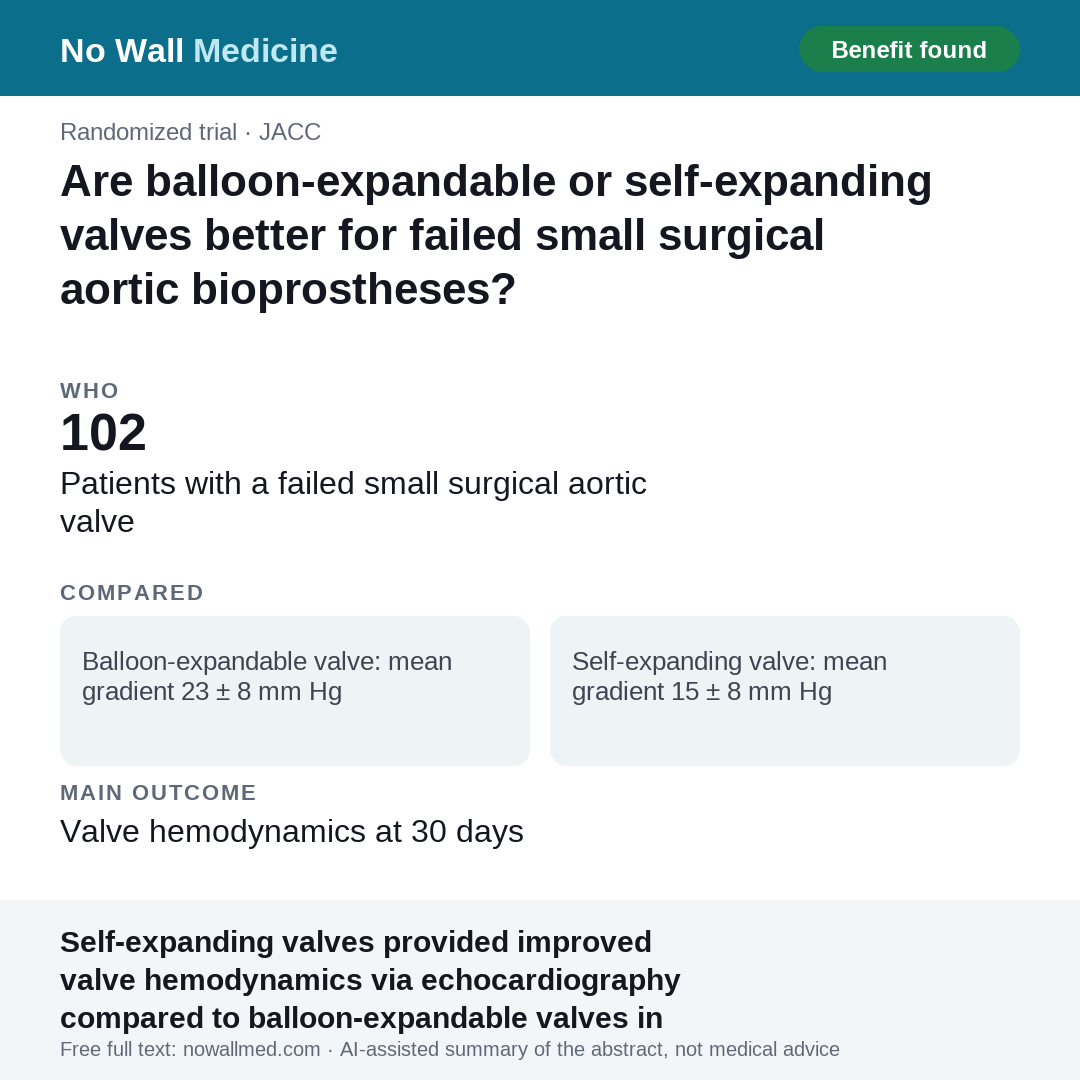
Clinical question: Are balloon-expandable or self-expanding valves better for failed small surgical aortic bioprostheses?
Why it matters: It was unknown how balloon-expandable and self-expanding valve systems compare regarding blood flow performance in patients with failed small surgical aortic valves.
Key points
- Researchers randomized 102 patients with failed small surgical aortic valves to receive either a balloon-expandable valve or a self-expanding valve.
- At 30 days, the self-expanding group had lower mean transvalvular gradients of 15 ± 8 mm Hg compared to 23 ± 8 mm Hg in the balloon-expandable group.
- There were no differences in death or stroke events between the two groups at 30 days.
Headline and key points written with AI from the paper’s abstract, with every number checked against it. Read the paper before relying on them.
Topics
Cite this article
Rodés-Cabau J, Abbas AE, Serra V, Vilalta V, Nombela-Franco L, Regueiro A. Balloon- vs Self-Expanding Valve Systems for Failed Small Surgical Aortic Valve Bioprostheses. JACC. 2022. doi:10.1016/j.jacc.2022.05.005
Spotted a mistake? Suggest a correction
Top studies every Monday
The week’s key trials and guidelines in your specialties, plus any topics you follow. By email, free.
Get the weekly digest