2-Year Outcomes of Angiographic Quantitative Flow Ratio-Guided Coronary Interventions
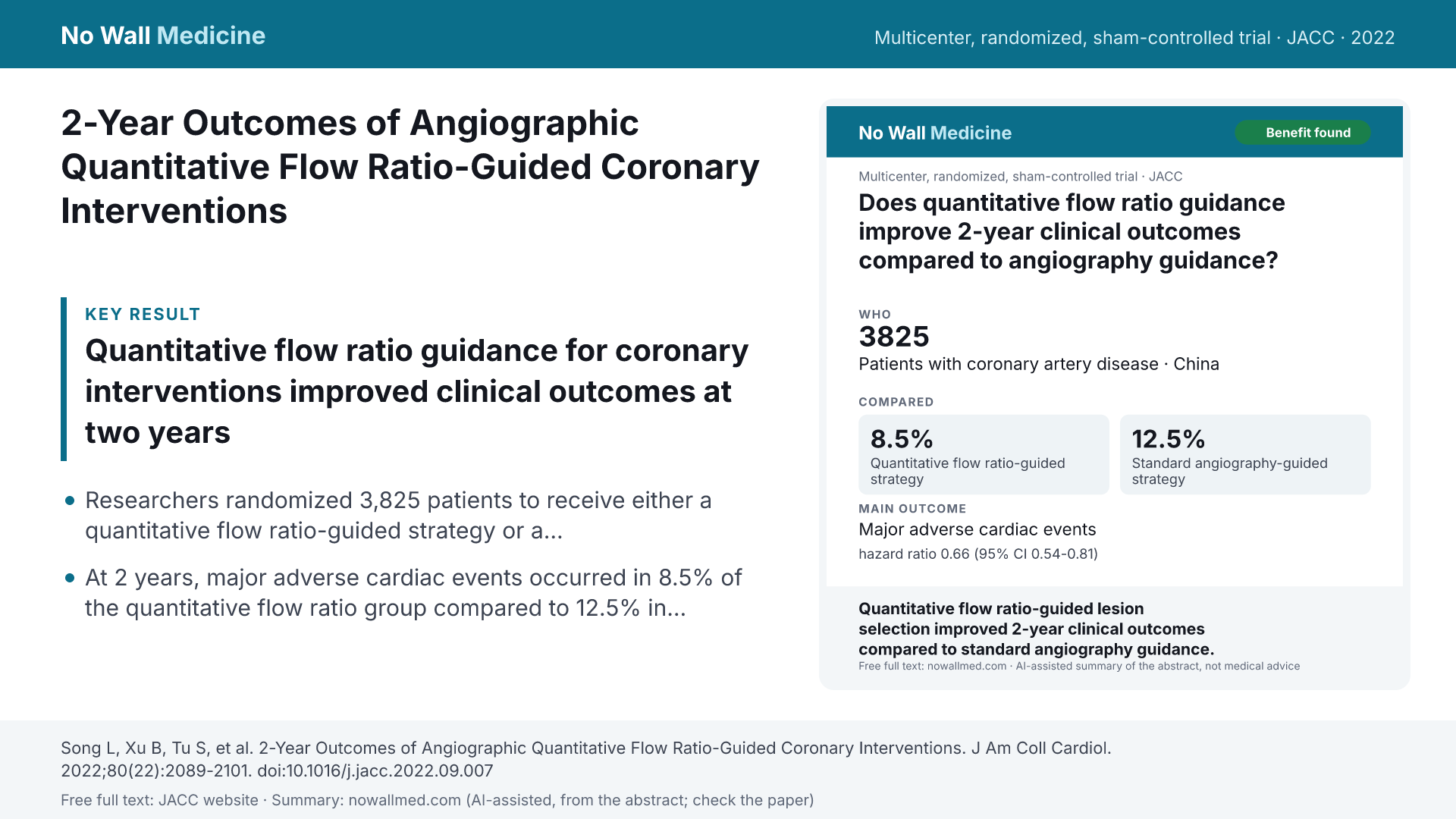
Key result: Quantitative flow ratio guidance for coronary interventions improved clinical outcomes at two years
Multicenter, randomized, sham-controlled trialBenefit found
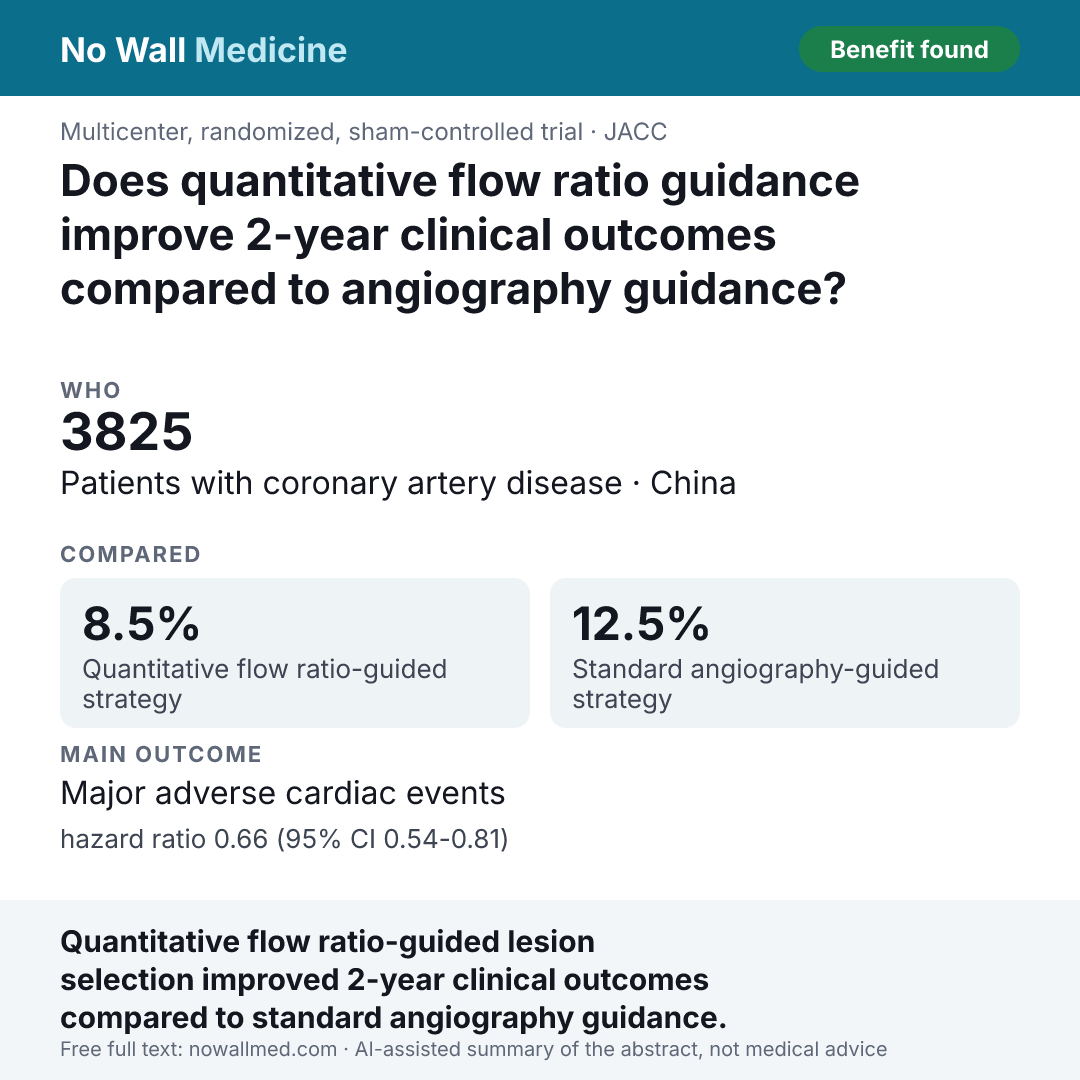
Does quantitative flow ratio guidance improve 2-year clinical outcomes compared to angiography guidance?
Who
3825
Patients with coronary artery disease · China
Compared
8.5%Quantitative flow ratio-guided strategy (161/1913)
12.5%Standard angiography-guided strategy (237/1912)
Main outcome
Major adverse cardiac events
Result: hazard ratio 0.66 (95% CI 0.54-0.81)
Bottom line: Quantitative flow ratio-guided lesion selection improved 2-year clinical outcomes compared to standard angiography guidance.
JACC · 2022-09-19 · Save PNG
Key points
- Researchers randomized 3,825 patients to receive either a quantitative flow ratio-guided strategy or a standard angiography-guided strategy for percutaneous coronary intervention.
- At 2 years, major adverse cardiac events occurred in 8.5% of the quantitative flow ratio group compared to 12.5% in the angiography group.
- The quantitative flow ratio group had lower rates of myocardial infarction at 4.0% versus 6.8% and lower ischemia-driven revascularization at 4.2% versus 5.8%.
Discussion prompts
- Would these patients look like yours? Who was left out?
- Is the main outcome one that matters to patients?
- Is the difference large enough to change what you do?
Cite: Song L, Xu B, Tu S, et al. 2-Year Outcomes of Angiographic Quantitative Flow Ratio-Guided Coronary Interventions. J Am Coll Cardiol. 2022;80(22):2089-2101. doi:10.1016/j.jacc.2022.09.007
Free full text: JACC website · Summary and visual abstract: nowallmed.com/a/2-year-outcomes-of-angiographic-quantitative-flow-ratio-guided-1qi4tdo/ (AI-assisted from the abstract; check the paper before relying on it).