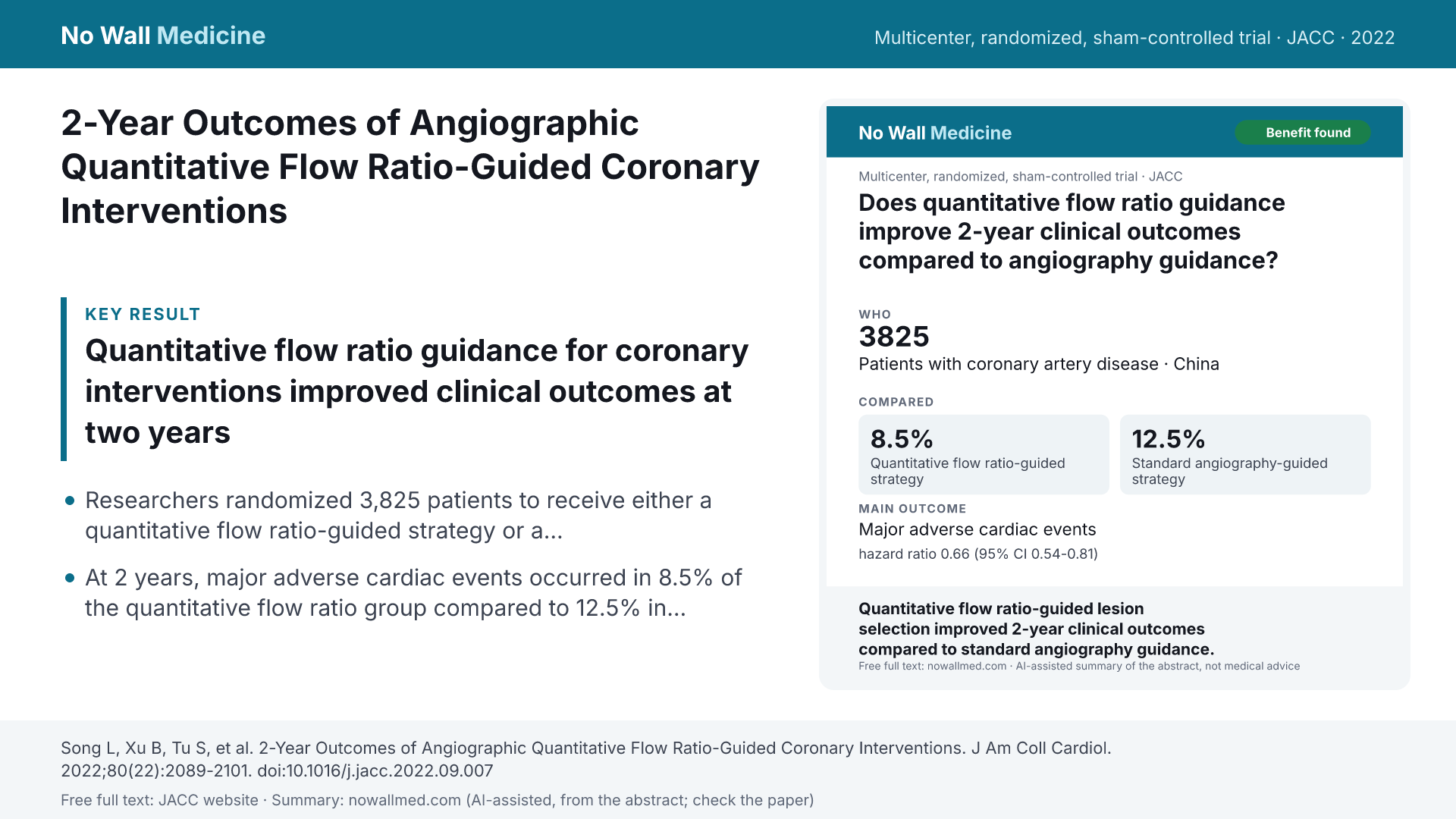
Quantitative flow ratio guidance for coronary interventions improved clinical outcomes at two years
2-Year Outcomes of Angiographic Quantitative Flow Ratio-Guided Coronary Interventions
Multicenter, randomized, sham-controlled trialBenefit found
Does quantitative flow ratio guidance improve 2-year clinical outcomes compared to angiography guidance?
Who
3825
Patients with coronary artery disease · China
Compared
8.5%Quantitative flow ratio-guided strategy (161/1913)
12.5%Standard angiography-guided strategy (237/1912)
Main outcome
Major adverse cardiac events
Result: hazard ratio 0.66 (95% CI 0.54-0.81)
Bottom line: Quantitative flow ratio-guided lesion selection improved 2-year clinical outcomes compared to standard angiography guidance.
JACC · 2022-09-19Download image
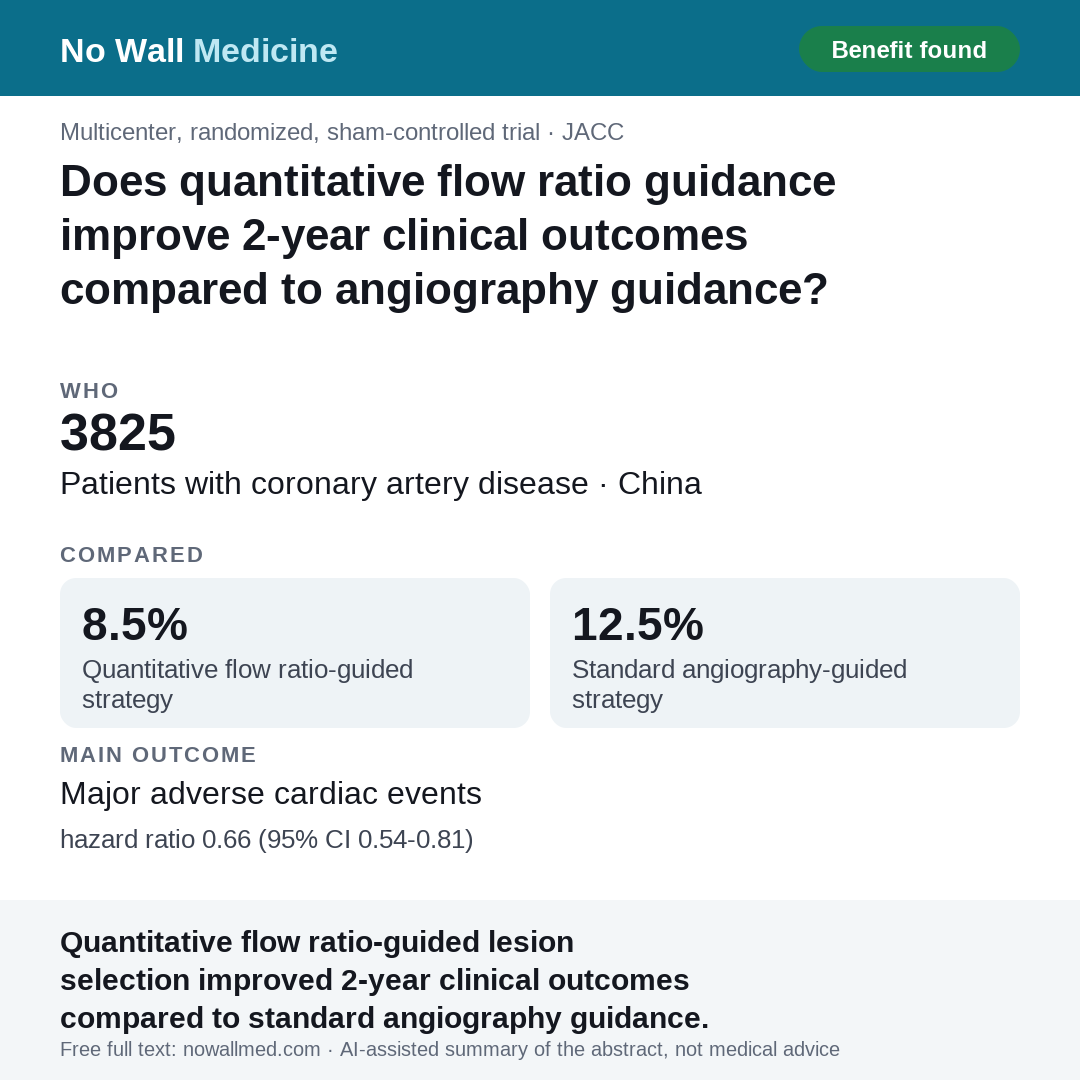
Clinical question: Does quantitative flow ratio guidance improve 2-year clinical outcomes compared to angiography guidance?
Why it matters: It was unknown whether the clinical benefits of using quantitative flow ratio to select lesions for coronary intervention persist for two years.
Key points
- Researchers randomized 3,825 patients to receive either a quantitative flow ratio-guided strategy or a standard angiography-guided strategy for percutaneous coronary intervention.
- At 2 years, major adverse cardiac events occurred in 8.5% of the quantitative flow ratio group compared to 12.5% in the angiography group.
- The quantitative flow ratio group had lower rates of myocardial infarction at 4.0% versus 6.8% and lower ischemia-driven revascularization at 4.2% versus 5.8%.
Headline and key points written with AI from the paper’s abstract, with every number checked against it. Read the paper before relying on them.
Was this summary helpful?
Subject terms
Cite this article
Song L, Xu B, Tu S, et al. 2-Year Outcomes of Angiographic Quantitative Flow Ratio-Guided Coronary Interventions. JACC. 2022. doi:10.1016/j.jacc.2022.09.007
Spotted a mistake? Suggest a correction