Fractional flow reserve guided stenting reduced death, heart attack, or repeat procedures after heart attack
Fractional flow reserve versus angiography-guided strategy in acute myocardial infarction with multivessel disease: a randomized trial
Randomized trialBenefit found
Is fractional flow reserve guided percutaneous coronary intervention superior to angiography guided strategy?
Who
562
Patients with acute myocardial infarction and multivessel coronary artery disease
Compared
7.4%Fractional flow reserve guided percutaneous coronary intervention
19.7%Angiography guided percutaneous coronary intervention
Main outcome
Composite of time to death, myocardial infarction, or repeat revascularization
Result: hazard ratio 0.43 (95% confidence interval, 0.25-0.75)
Bottom line: Fractional flow reserve guided decision-making is superior to angiography guided strategy for non-infarct-related artery lesions.
Eur Heart J · 2022-12-22Download image
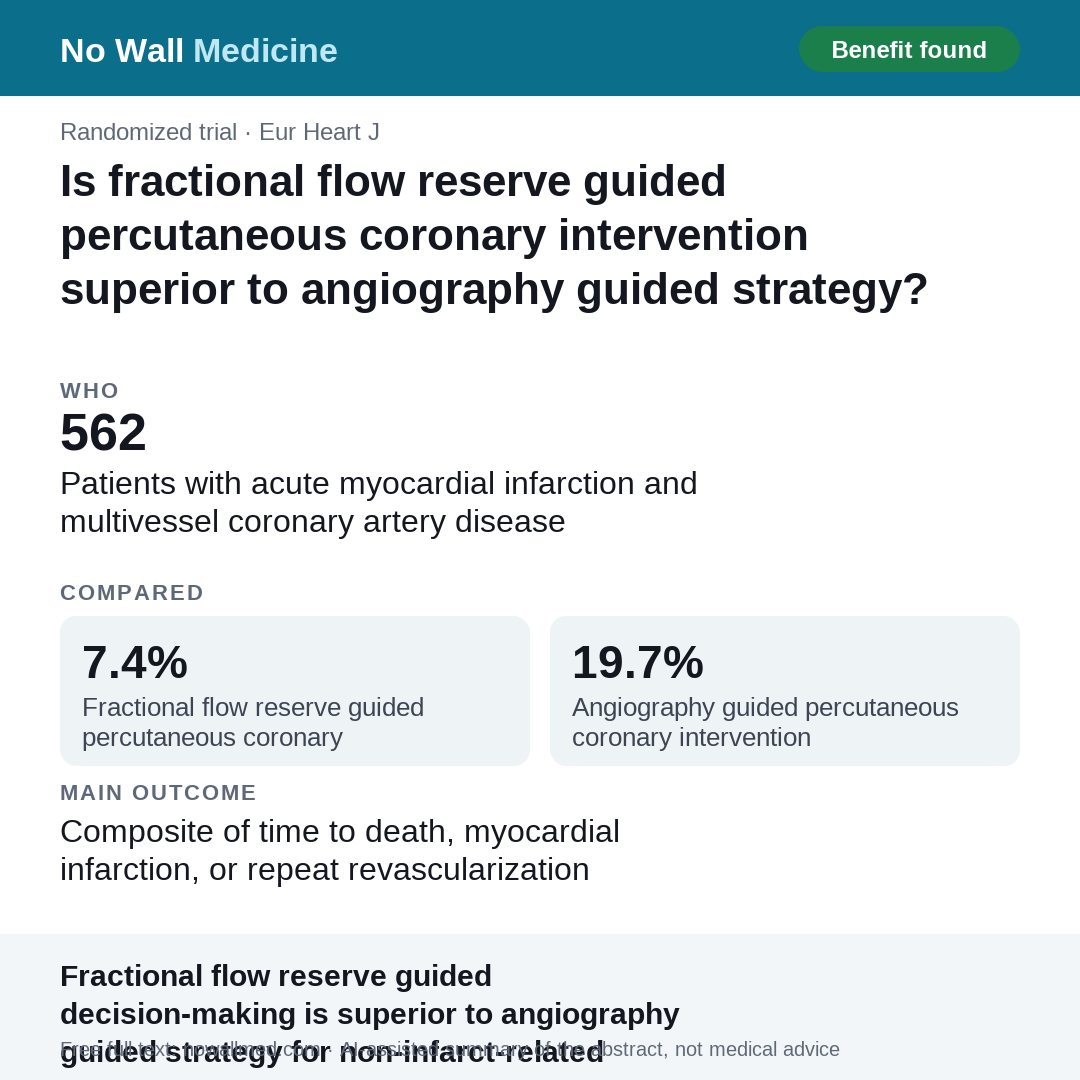
Clinical question: Is fractional flow reserve guided percutaneous coronary intervention superior to angiography guided strategy?
Why it matters: It is unclear if using fractional flow reserve to select lesions for stenting is better than routine stenting based on angiography alone in patients with multivessel disease.
Key points
- Researchers randomized 562 patients with acute myocardial infarction and multivessel disease to receive either fractional flow reserve guided percutaneous coronary intervention or angiography guided percutaneous coronary intervention.
- At a median follow-up of 3.5 years, the primary composite endpoint occurred in 7.4% of the fractional flow reserve group compared to 19.7% in the angiography group.
- The fractional flow reserve group used fewer stents on average, with 2.2 ± 1.1 compared to 2.5 ± 0.9 in the angiography group.
Headline and key points written with AI from the paper’s abstract, with every number checked against it. Read the paper before relying on them.
Was this summary helpful?
Subject terms
Cite this article
Lee JM, Kim HK, Park KH, Choo EH, Kim CJ, Lee SH. Fractional flow reserve versus angiography-guided strategy in acute myocardial infarction with multivessel disease: a randomized trial. Eur Heart J. 2022. doi:10.1093/eurheartj/ehac763
Spotted a mistake? Suggest a correction
Top studies every Monday
The week’s key trials and guidelines in your specialties, plus any topics you follow. By email, free.
Get the weekly digest