Quantitative flow ratio guidance did not significantly improve outcomes for patients with intermediate coronary lesions
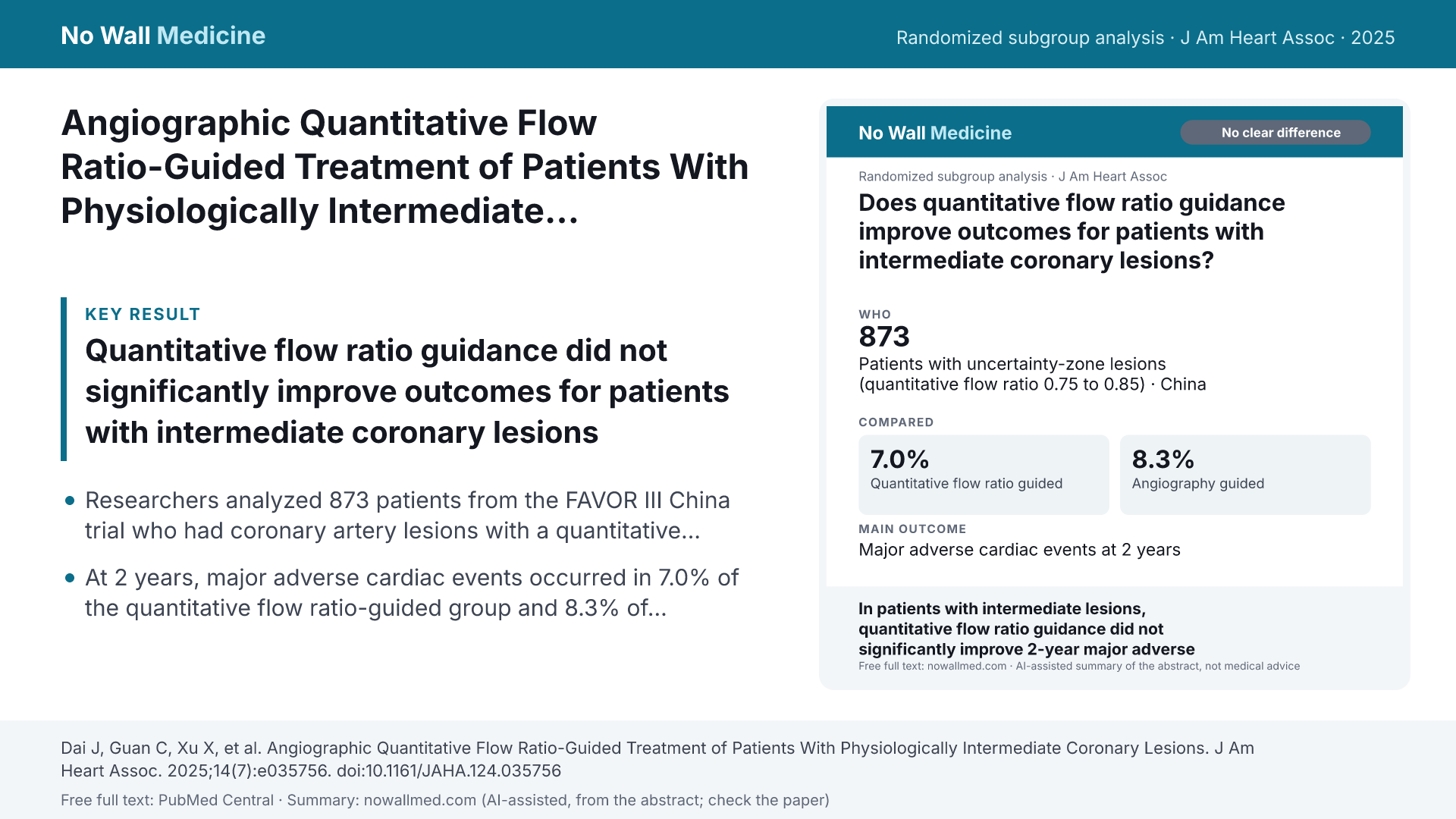
Angiographic Quantitative Flow Ratio-Guided Treatment of Patients With Physiologically Intermediate Coronary Lesions
Randomized subgroup analysisNo clear difference
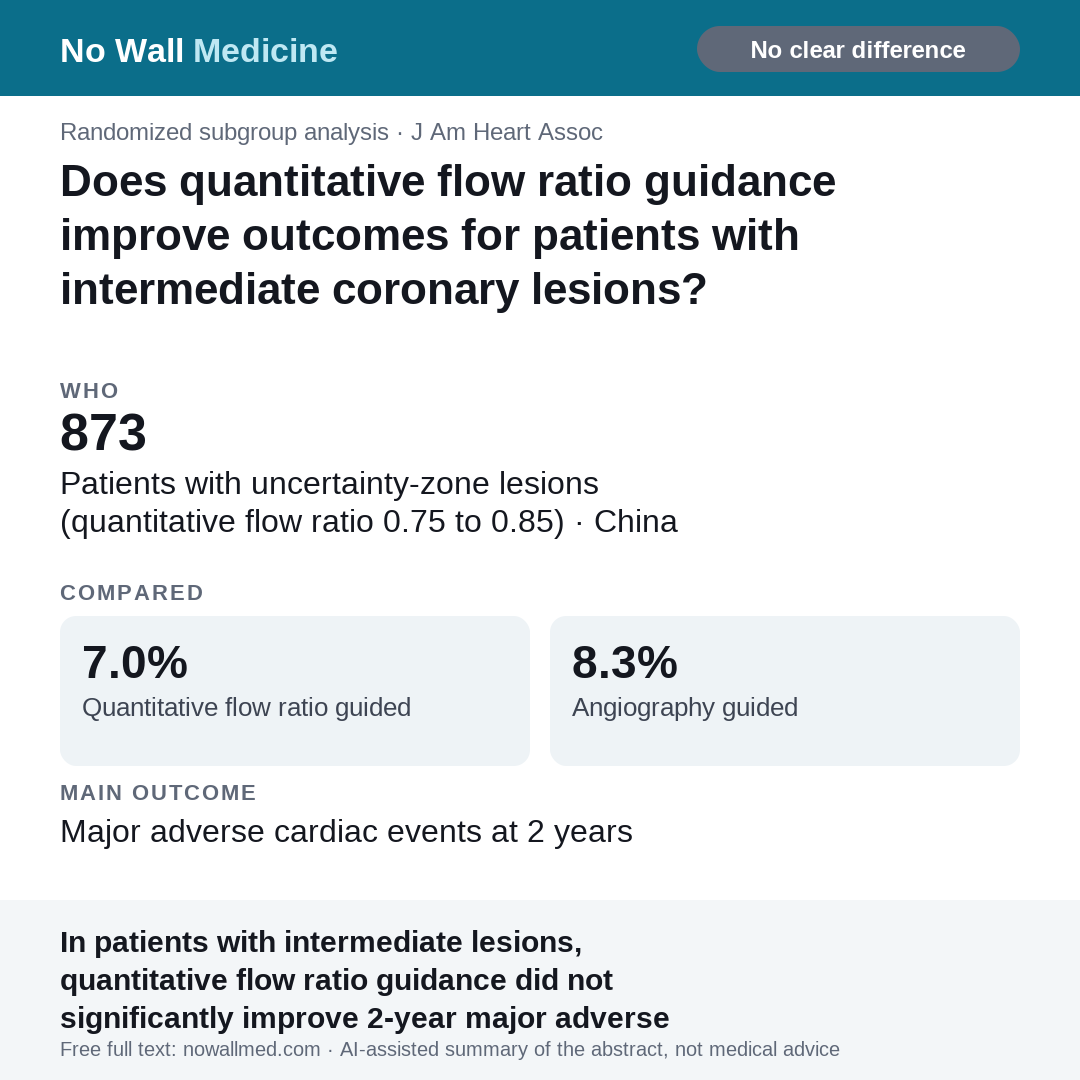
Does quantitative flow ratio guidance improve outcomes for patients with intermediate coronary lesions?
Who
873
Patients with uncertainty-zone lesions (quantitative flow ratio 0.75 to 0.85) · China
Compared
7.0%Quantitative flow ratio guided
8.3%Angiography guided
Main outcome
Major adverse cardiac events at 2 years
Result: hazard ratio 0.85 (95% CI 0.52-1.37)
Bottom line: In patients with intermediate lesions, quantitative flow ratio guidance did not significantly improve 2-year major adverse cardiac events.
J Am Heart Assoc · 2025-03-21Download image
Same trial (NCT03656848)
Papers we list that report this registered trial, oldest first. Read a secondary analysis alongside the main results.
- Longer follow-up Benefit found
Quantitative flow ratio guidance for coronary interventions improved clinical outcomes at two years JACC 2022-09 - Secondary analysis No clear difference
This paper J Am Heart Assoc 2025-03 - Secondary analysis No clear difference
High microcirculatory resistance after stenting linked to worse outcomes in specific patient subgroup J Am Heart Assoc 2026-04 - Secondary analysis Key finding
QFR-guided PCI linked to lower 3-year events in multivessel disease patients JAMA Netw Open 2026-10
Clinical question: Does quantitative flow ratio guidance improve outcomes for patients with intermediate coronary lesions?
Key points
- Researchers analyzed 873 patients from the FAVOR III China trial who had coronary artery lesions with a quantitative flow ratio—a measure of blood flow—between 0.75 and 0.85.
- At 2 years, major adverse cardiac events occurred in 7.0% of the quantitative flow ratio-guided group and 8.3% of the angiography-guided group, which was not a significant difference.
- A landmark analysis showed that after 1 year, the rate of major adverse cardiac events was 2.3% in the quantitative flow ratio-guided group compared to 5.5% in the angiography-guided group.
Headline and key points written with AI from the paper’s abstract, with every number checked against it. Read the paper before relying on them.
Was this summary helpful?
Subject terms
Headline, design, result, key points, caveat and citation as plain text.
Cite this article
Dai J, Guan C, Xu X, et al. Angiographic Quantitative Flow Ratio-Guided Treatment of Patients With Physiologically Intermediate Coronary Lesions. J Am Heart Assoc. 2025. doi:10.1161/JAHA.124.035756
Spotted a mistake? Suggest a correction