Angiographic Quantitative Flow Ratio-Guided Treatment of Patients With Physiologically Intermediate Coronary Lesions
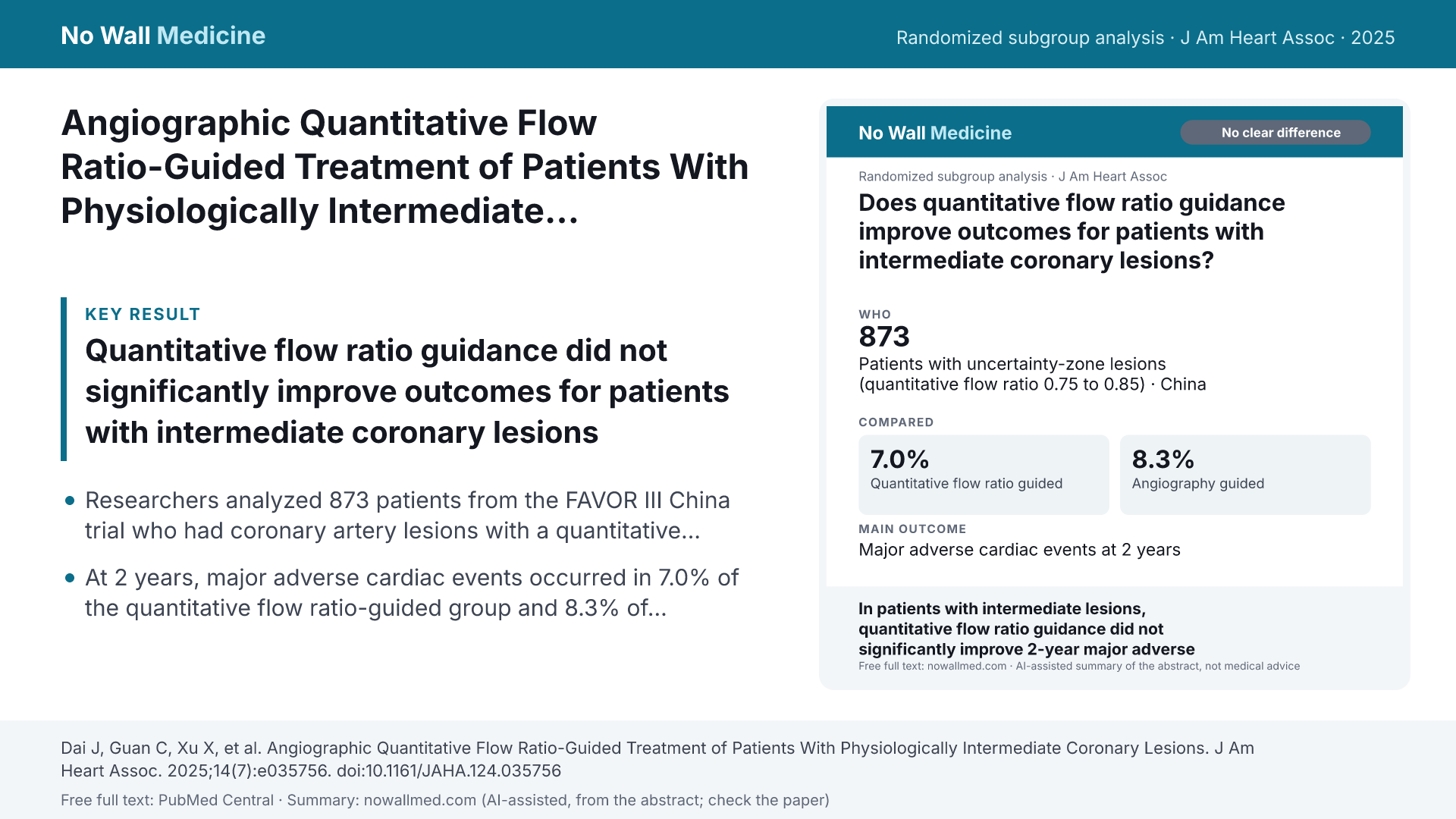
Key result: Quantitative flow ratio guidance did not significantly improve outcomes for patients with intermediate coronary lesions
Randomized subgroup analysisNo clear difference
Does quantitative flow ratio guidance improve outcomes for patients with intermediate coronary lesions?
Who
873
Patients with uncertainty-zone lesions (quantitative flow ratio 0.75 to 0.85) · China
Compared
7.0%Quantitative flow ratio guided
8.3%Angiography guided
Main outcome
Major adverse cardiac events at 2 years
Result: hazard ratio 0.85 (95% CI 0.52-1.37)
Bottom line: In patients with intermediate lesions, quantitative flow ratio guidance did not significantly improve 2-year major adverse cardiac events.
J Am Heart Assoc · 2025-03-21
Key points
- Researchers analyzed 873 patients from the FAVOR III China trial who had coronary artery lesions with a quantitative flow ratio—a measure of blood flow—between 0.75 and 0.85.
- At 2 years, major adverse cardiac events occurred in 7.0% of the quantitative flow ratio-guided group and 8.3% of the angiography-guided group, which was not a significant difference.
- A landmark analysis showed that after 1 year, the rate of major adverse cardiac events was 2.3% in the quantitative flow ratio-guided group compared to 5.5% in the angiography-guided group.
Discussion prompts
- Would these patients look like yours? Who was left out?
- Is the main outcome one that matters to patients?
- Is the difference large enough to change what you do?
Cite: Dai J, Guan C, Xu X, et al. Angiographic Quantitative Flow Ratio-Guided Treatment of Patients With Physiologically Intermediate Coronary Lesions. J Am Heart Assoc. 2025;14(7):e035756. doi:10.1161/JAHA.124.035756
Free full text: PubMed Central · Summary and visual abstract: nowallmed.com/a/angiographic-quantitative-flow-ratio-guided-treatment-of-patients-19hewyt/ (AI-assisted from the abstract; check the paper before relying on it).