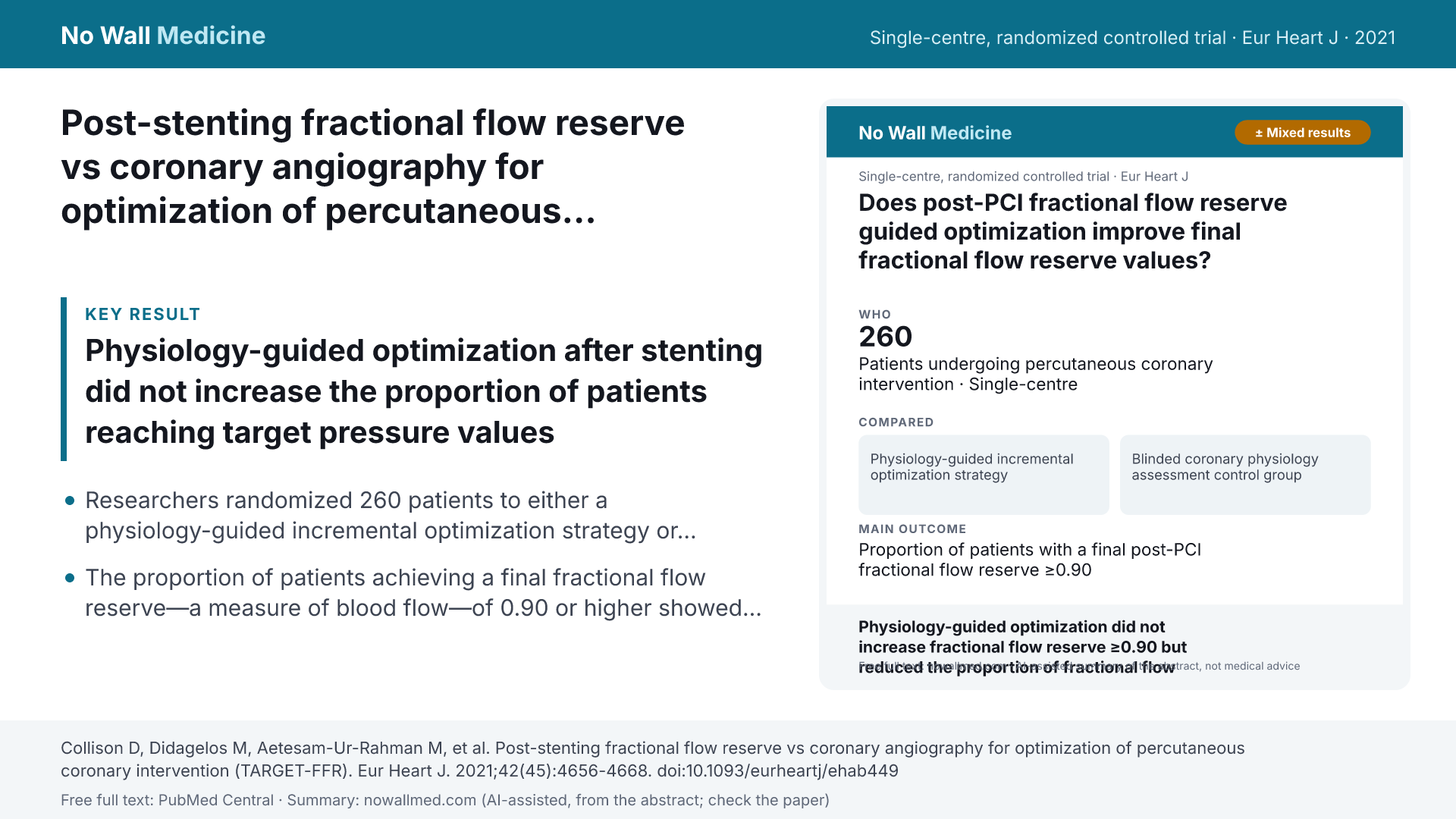
Physiology-guided optimization after stenting did not increase the proportion of patients reaching target pressure values
Post-stenting fractional flow reserve vs coronary angiography for optimization of percutaneous coronary intervention (TARGET-FFR)
Single-centre, randomized controlled trialMixed results
Does post-PCI fractional flow reserve guided optimization improve final fractional flow reserve values?
Who
260
Patients undergoing percutaneous coronary intervention · Single-centre
Compared
Physiology-guided incremental optimization strategy
Blinded coronary physiology assessment control group
Main outcome
Proportion of patients with a final post-PCI fractional flow reserve ≥0.90
Result: PIOS minus control 10%, 95% confidence interval -1.84 to 21.91
Bottom line: Physiology-guided optimization did not increase fractional flow reserve ≥0.90 but reduced the proportion of fractional flow reserve ≤0.80.
Eur Heart J · 2021-07-20Download image
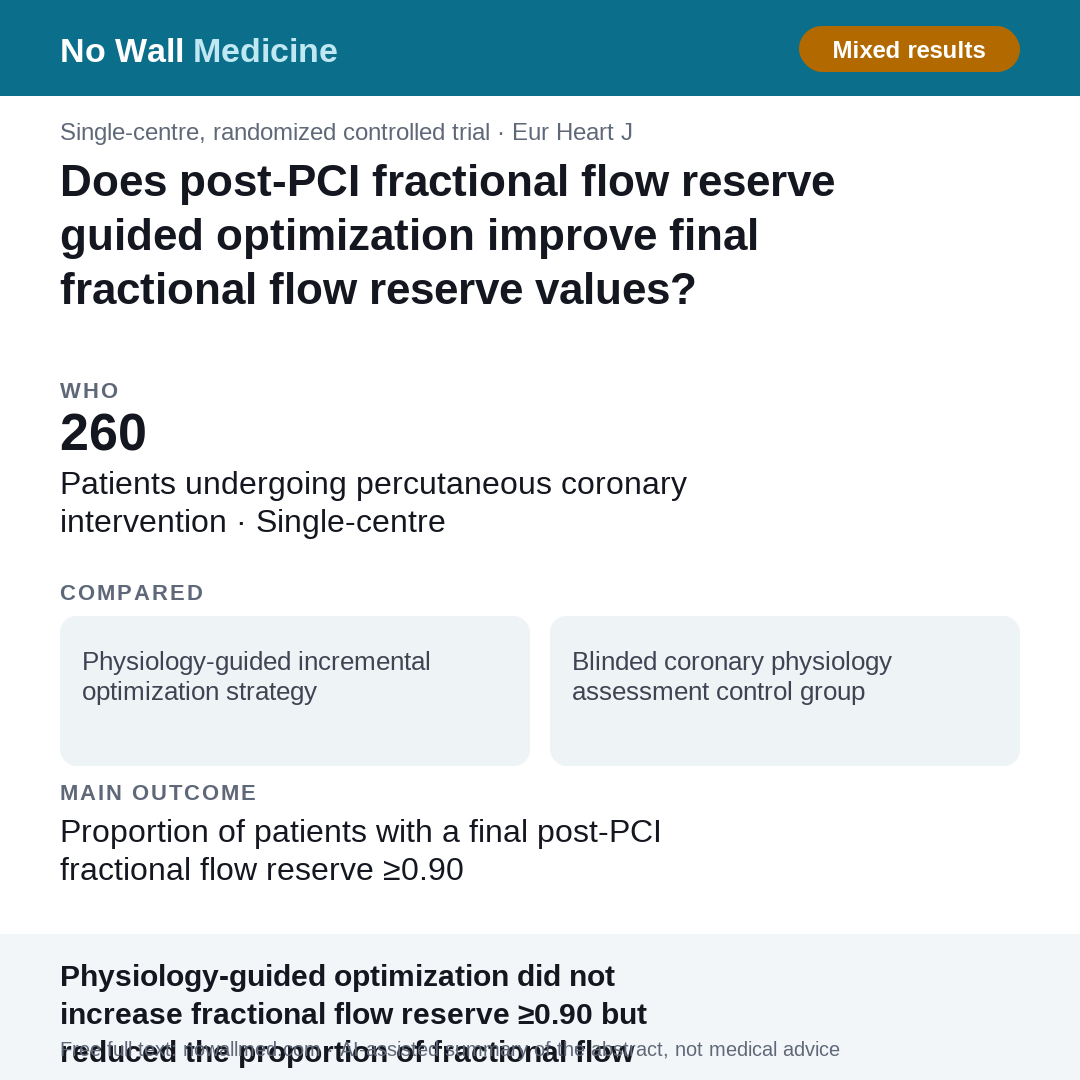
Clinical question: Does post-PCI fractional flow reserve guided optimization improve final fractional flow reserve values?
Why it matters: It was unknown if using fractional flow reserve to guide additional interventions after stenting would increase the number of patients achieving optimal blood flow measurements.
Key points
- Researchers randomized 260 patients to either a physiology-guided incremental optimization strategy or a blinded coronary physiology assessment after heart stent placement.
- The proportion of patients achieving a final fractional flow reserve—a measure of blood flow—of 0.90 or higher showed no significant difference between groups.
- The physiology-guided group had a significantly lower proportion of patients with a final fractional flow reserve of 0.80 or less compared to the control group.
Limitation the authors note: This was a single-centre, investigator-initiated, randomized controlled trial.
Headline and key points written with AI from the paper’s abstract, with every number checked against it. Read the paper before relying on them.
Was this summary helpful?
Subject terms
Cite this article
Collison D, Didagelos M, Aetesam-Ur-Rahman M, et al. Post-stenting fractional flow reserve vs coronary angiography for optimization of percutaneous coronary intervention (TARGET-FFR). Eur Heart J. 2021. doi:10.1093/eurheartj/ehab449
Spotted a mistake? Suggest a correction