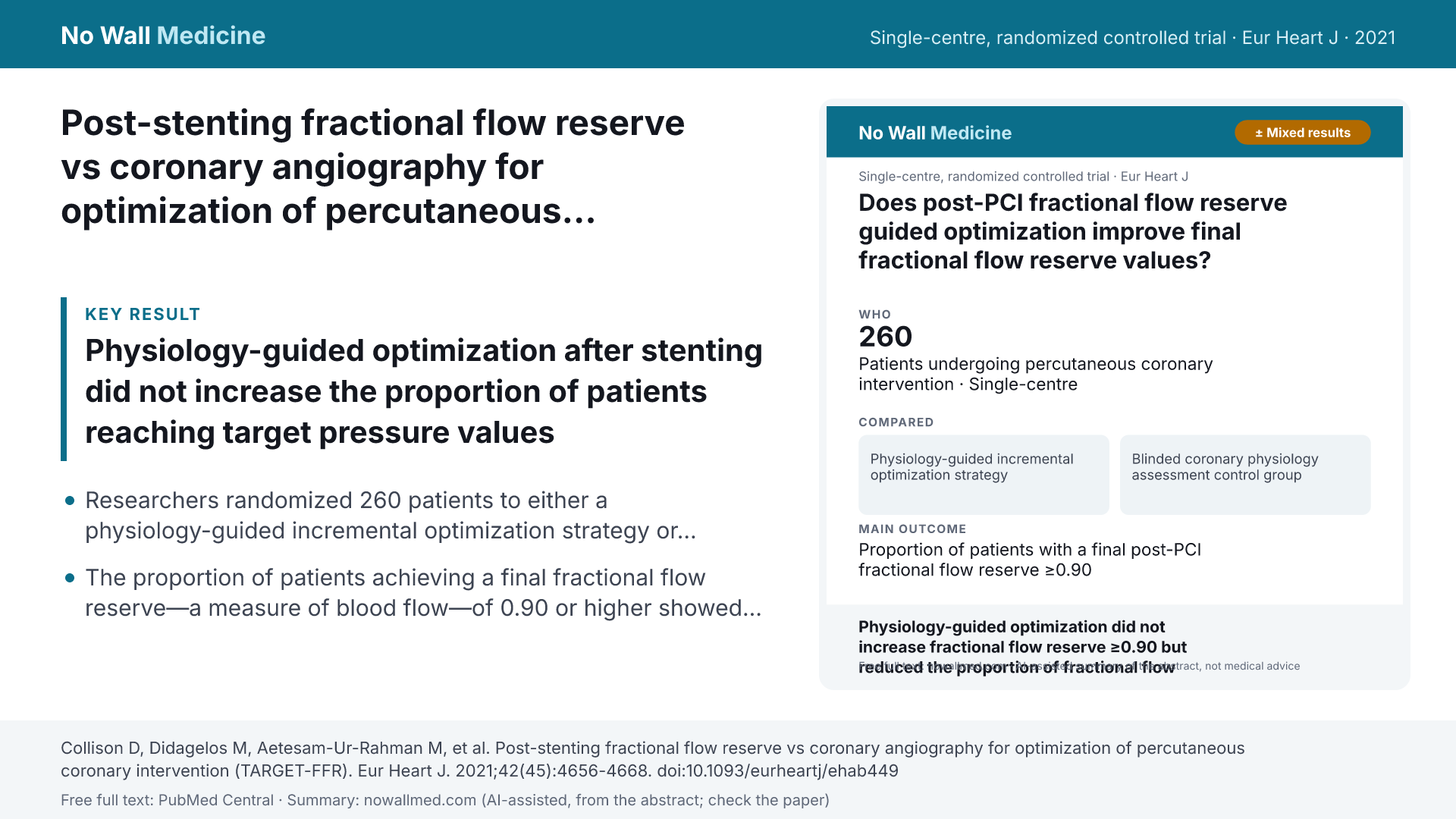
Post-stenting fractional flow reserve vs coronary angiography for optimization of percutaneous coronary intervention (TARGET-FFR)
Key result: Physiology-guided optimization after stenting did not increase the proportion of patients reaching target pressure values
Single-centre, randomized controlled trialMixed results
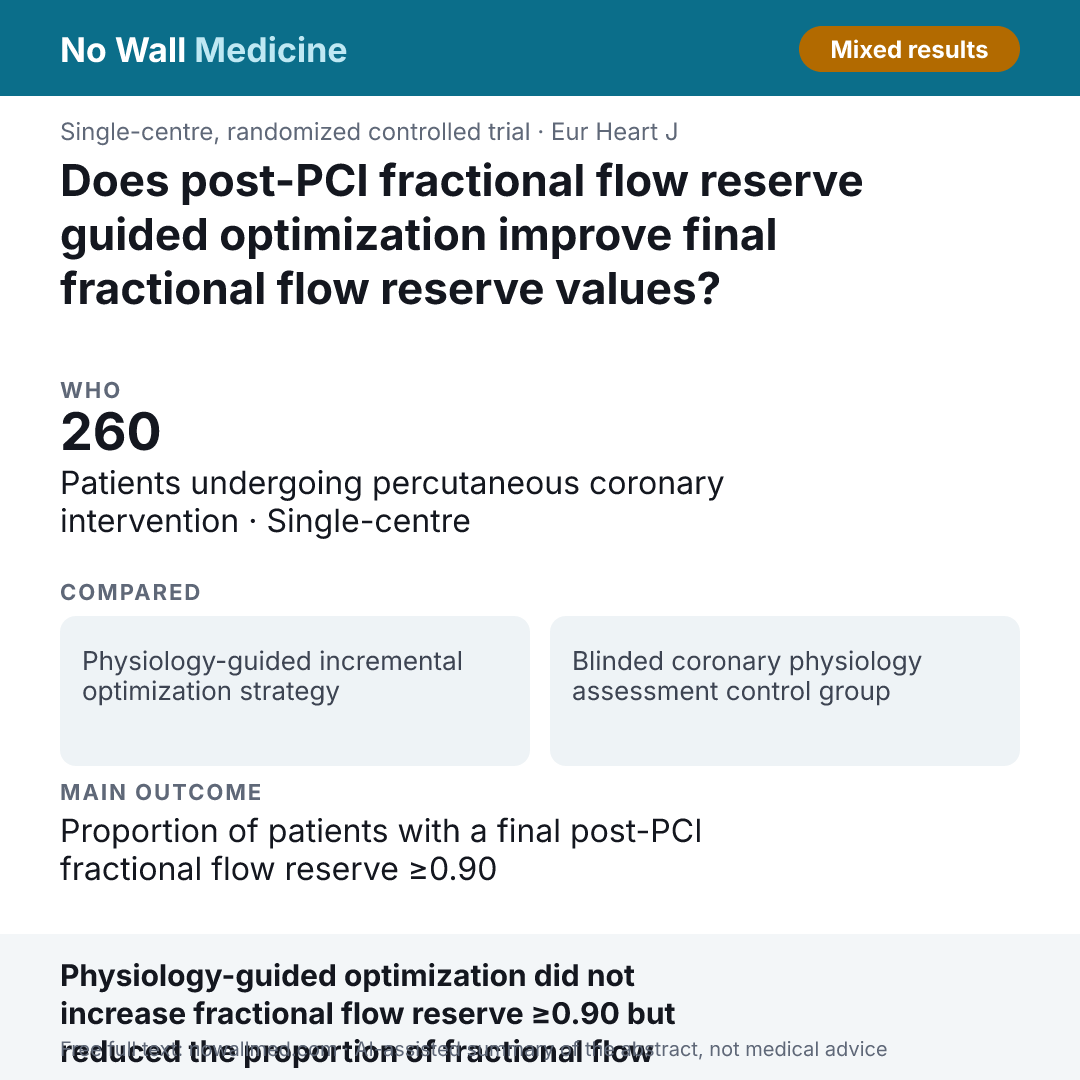
Does post-PCI fractional flow reserve guided optimization improve final fractional flow reserve values?
Who
260
Patients undergoing percutaneous coronary intervention · Single-centre
Compared
Physiology-guided incremental optimization strategy
Blinded coronary physiology assessment control group
Main outcome
Proportion of patients with a final post-PCI fractional flow reserve ≥0.90
Result: PIOS minus control 10%, 95% confidence interval -1.84 to 21.91
Bottom line: Physiology-guided optimization did not increase fractional flow reserve ≥0.90 but reduced the proportion of fractional flow reserve ≤0.80.
Eur Heart J · 2021-07-20 · Save PNG
Key points
- Researchers randomized 260 patients to either a physiology-guided incremental optimization strategy or a blinded coronary physiology assessment after heart stent placement.
- The proportion of patients achieving a final fractional flow reserve—a measure of blood flow—of 0.90 or higher showed no significant difference between groups.
- The physiology-guided group had a significantly lower proportion of patients with a final fractional flow reserve of 0.80 or less compared to the control group.
Limitation the authors note: This was a single-centre, investigator-initiated, randomized controlled trial.
Discussion prompts
- Would these patients look like yours? Who was left out?
- Is the main outcome one that matters to patients?
- Is the difference large enough to change what you do?
Cite: Collison D, Didagelos M, Aetesam-Ur-Rahman M, et al. Post-stenting fractional flow reserve vs coronary angiography for optimization of percutaneous coronary intervention (TARGET-FFR). Eur Heart J. 2021;42(45):4656-4668. doi:10.1093/eurheartj/ehab449
Free full text: PubMed Central · Summary and visual abstract: nowallmed.com/a/post-stenting-fractional-flow-reserve-vs-coronary-angiography-for-s7hb20/ (AI-assisted from the abstract; check the paper before relying on it).