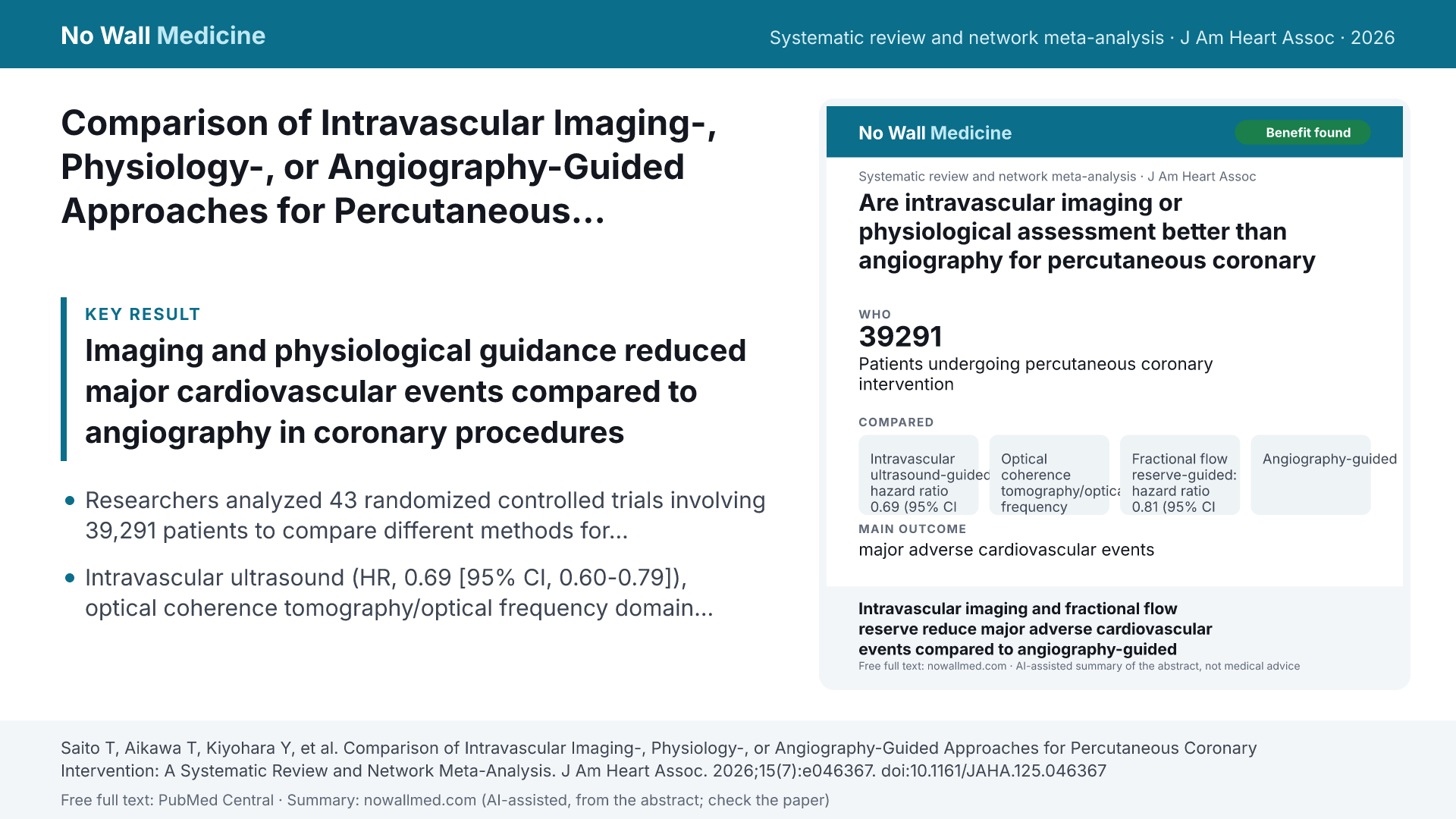
Imaging and physiological guidance reduced major cardiovascular events compared to angiography in coronary procedures
Comparison of Intravascular Imaging-, Physiology-, or Angiography-Guided Approaches for Percutaneous Coronary Intervention: A Systematic Review and Network Meta-Analysis
Systematic review and network meta-analysisBenefit found
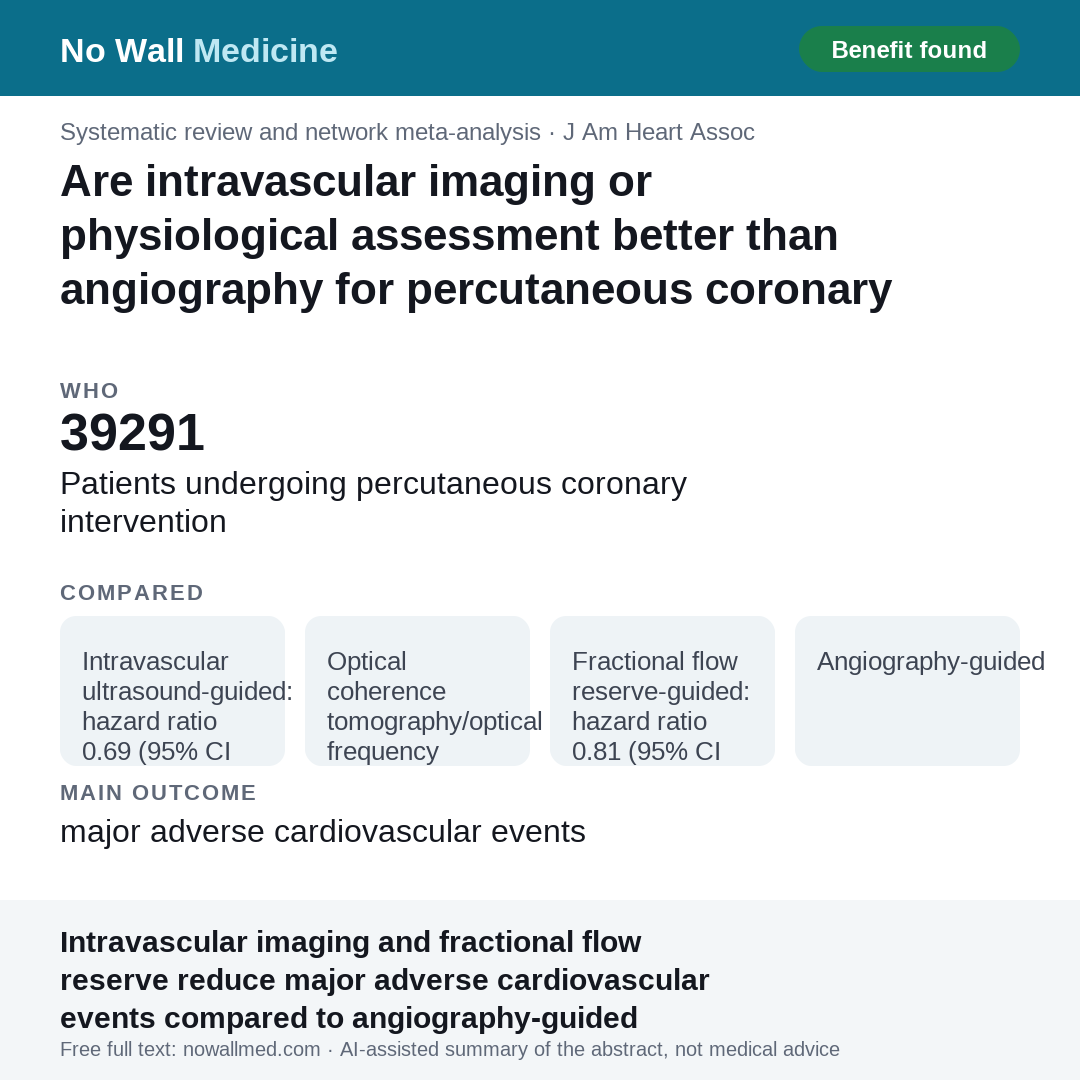
Are intravascular imaging or physiological assessment better than angiography for percutaneous coronary intervention?
Who
39291
Patients undergoing percutaneous coronary intervention
Compared
Intravascular ultrasound-guided: hazard ratio 0.69 (95% CI 0.60-0.79)
Optical coherence tomography/optical frequency domain imaging-guided: hazard ratio 0.75 (95% CI 0.63-0.90)
Fractional flow reserve-guided: hazard ratio 0.81 (95% CI 0.70-0.95)
Angiography-guided
Main outcome
major adverse cardiovascular events
Result: hazard ratio 0.69 (95% CI 0.60-0.79) for IVUS vs angiography
Bottom line: Intravascular imaging and fractional flow reserve reduce major adverse cardiovascular events compared to angiography-guided percutaneous coronary intervention.
J Am Heart Assoc · 2026-03-29Download image
Clinical question: Are intravascular imaging or physiological assessment better than angiography for percutaneous coronary intervention?
Key points
- Researchers analyzed 43 randomized controlled trials involving 39,291 patients to compare different methods for guiding percutaneous coronary intervention.
- Intravascular ultrasound (HR, 0.69 [95% CI, 0.60-0.79]), optical coherence tomography/optical frequency domain imaging (HR, 0.75 [95% CI, 0.63-0.90]), and fractional flow reserve (HR, 0.81 [95% CI, 0.70-0.95]) reduced major adverse cardiovascular events compared to angiography.
- Intravascular ultrasound guidance was associated with a lower risk of major adverse cardiovascular events compared to instantaneous wave-free ratio guidance (HR, 0.74 [95% CI, 0.55-1.00]).
Headline and key points written with AI from the paper’s abstract, with every number checked against it. Read the paper before relying on them.
Was this summary helpful?
Subject terms
Headline, design, result, key points, caveat and citation as plain text.
Cite this article
Saito T, Aikawa T, Kiyohara Y, et al. Comparison of Intravascular Imaging-, Physiology-, or Angiography-Guided Approaches for Percutaneous Coronary Intervention: A Systematic Review and Network Meta-Analysis. J Am Heart Assoc. 2026. doi:10.1161/JAHA.125.046367
Spotted a mistake? Suggest a correction