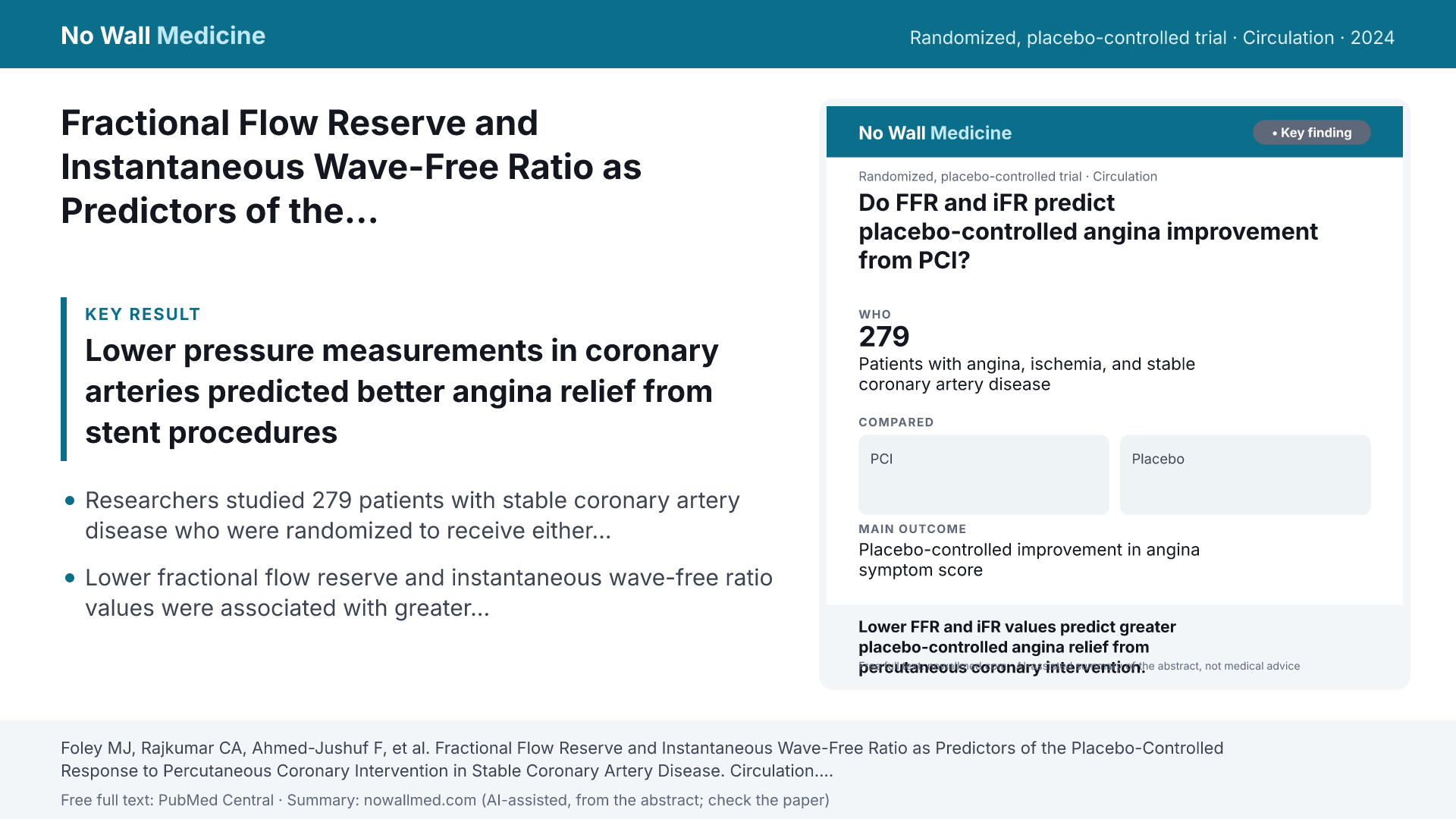
Lower pressure measurements in coronary arteries predicted better angina relief from stent procedures
Fractional Flow Reserve and Instantaneous Wave-Free Ratio as Predictors of the Placebo-Controlled Response to Percutaneous Coronary Intervention in Stable Coronary Artery Disease
Randomized, placebo-controlled trialKey finding
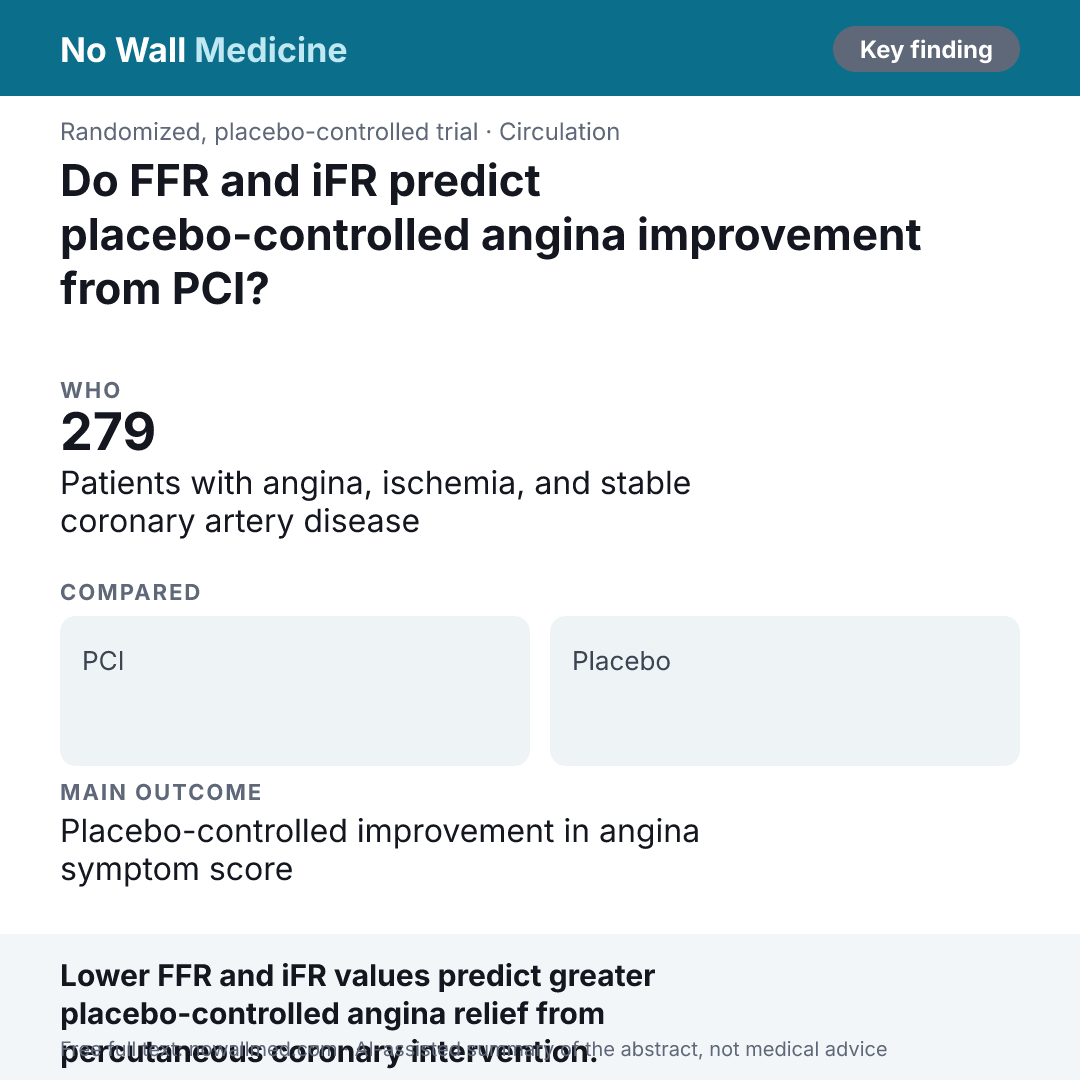
Do FFR and iFR predict placebo-controlled angina improvement from PCI?
Who
279
Patients with angina, ischemia, and stable coronary artery disease
Compared
PCI
Placebo
Main outcome
Placebo-controlled improvement in angina symptom score
Result: odds ratio 2.01 (95% credible interval 1.79-2.26) for FFR
Bottom line: Lower FFR and iFR values predict greater placebo-controlled angina relief from percutaneous coronary intervention.
Circulation · 2024-10-27 · Save PNG
Same trial (NCT03742050)
Papers we list that report this registered trial, oldest first. Read a secondary analysis alongside the main results.
- Main results Benefit found
Percutaneous coronary intervention resulted in lower angina symptom scores than a placebo procedure NEJM 2023-11 - Related analysis Key finding
This paper Circulation 2024-10
Clinical question: Do FFR and iFR predict placebo-controlled angina improvement from PCI?
Key points
- Researchers studied 279 patients with stable coronary artery disease who were randomized to receive either percutaneous coronary intervention (stenting) or a placebo.
- Lower fractional flow reserve and instantaneous wave-free ratio values were associated with greater placebo-controlled improvement in angina symptom scores.
- Patients in the lower quartile for fractional flow reserve had an odds ratio of 2.01 for symptom improvement compared to those in the upper quartile.
Headline and key points written with AI from the paper’s abstract, with every number checked against it. Read the paper before relying on them.
Was this summary helpful?
Subject terms
Headline, design, result, key points, caveat and citation as plain text.
Cite this article
Foley MJ, Rajkumar CA, Ahmed-Jushuf F, et al. Fractional Flow Reserve and Instantaneous Wave-Free Ratio as Predictors of the Placebo-Controlled Response to Percutaneous Coronary Intervention in Stable Coronary Artery Disease. Circulation. 2025;151(3):202-214. doi:10.1161/CIRCULATIONAHA.124.072281
Spotted a mistake? Suggest a correction