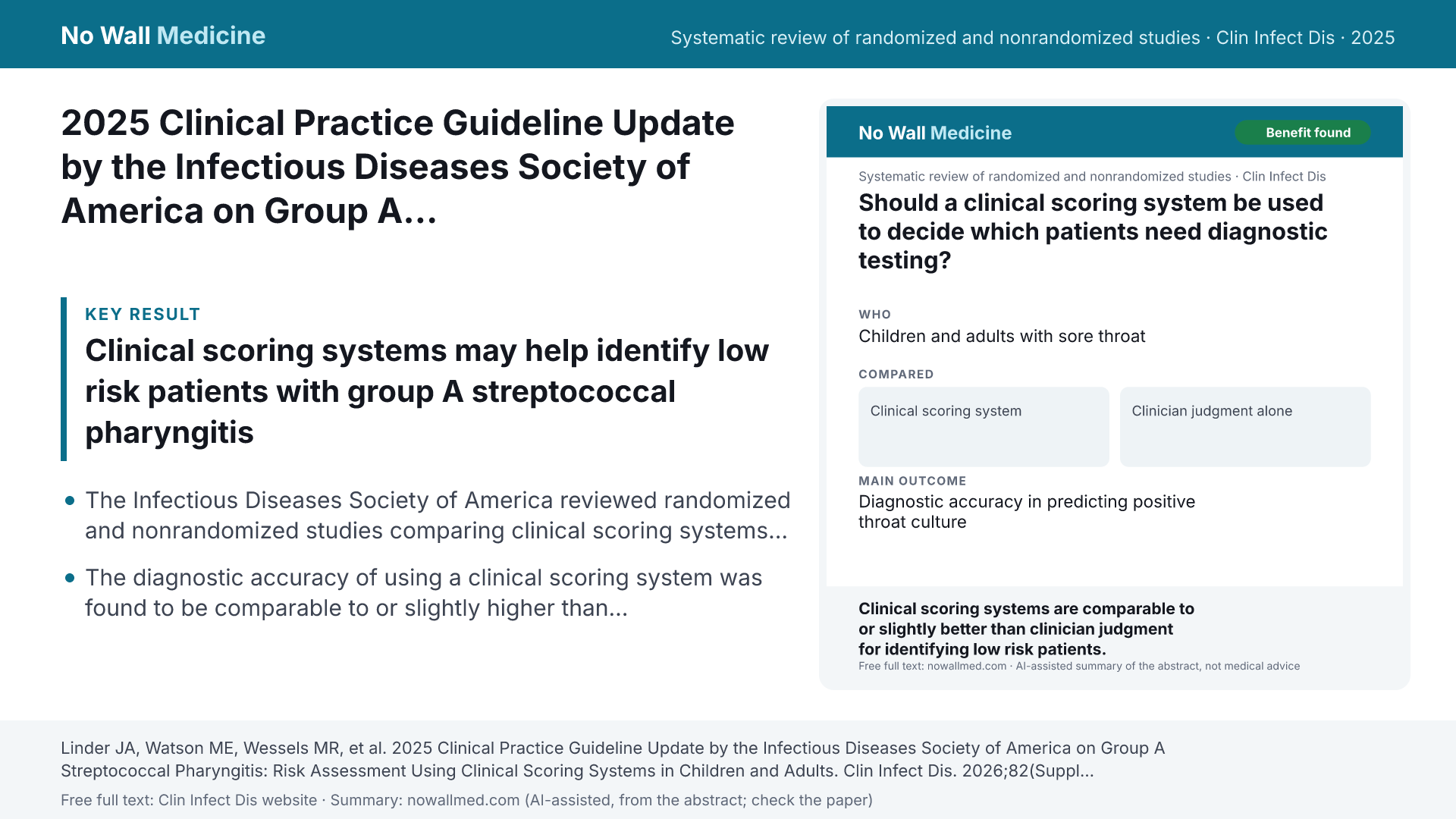
Clinical scoring systems may help identify low risk patients with group A streptococcal pharyngitis
2025 Clinical Practice Guideline Update by the Infectious Diseases Society of America on Group A Streptococcal Pharyngitis: Risk Assessment Using Clinical Scoring Systems in Children and Adults
Systematic review of randomized and nonrandomized studiesBenefit found
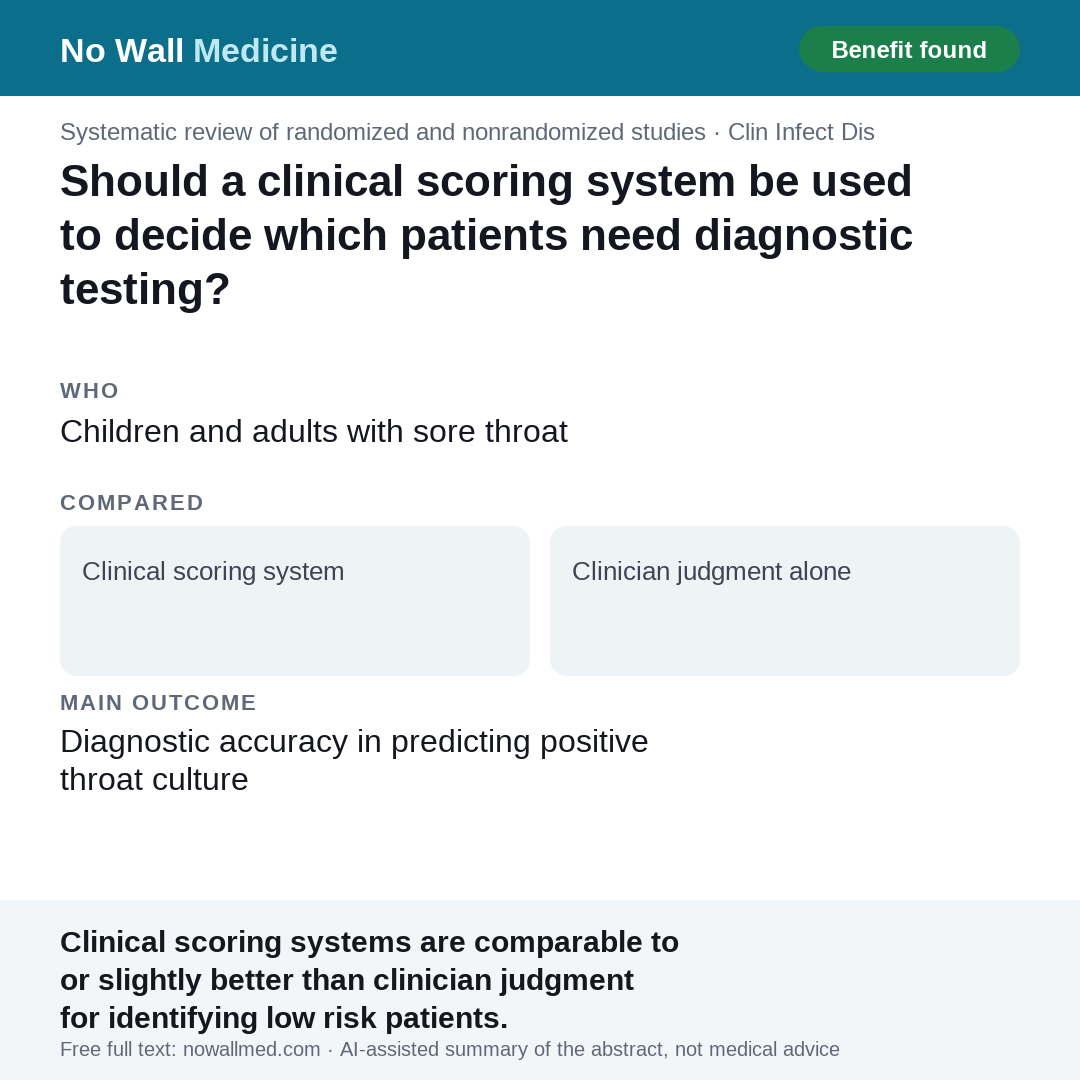
Should a clinical scoring system be used to decide which patients need diagnostic testing?
Who
Children and adults with sore throat
Compared
Clinical scoring system
Clinician judgment alone
Main outcome
Diagnostic accuracy in predicting positive throat culture
Bottom line: Clinical scoring systems are comparable to or slightly better than clinician judgment for identifying low risk patients.
Limitation: Small study size, lack of uniformity in outcome measures, and incomplete data.
Clin Infect Dis · 2025-12-04Download image
Clinical question: Should a clinical scoring system be used to decide which patients need diagnostic testing?
Why it matters: Clinician judgment alone is unreliable for diagnosing group A streptococcal pharyngitis, while unselective testing can lead to unnecessary costs and inconvenience.
Key points
- The Infectious Diseases Society of America reviewed randomized and nonrandomized studies comparing clinical scoring systems to clinician judgment for predicting group A streptococcal throat culture results.
- The diagnostic accuracy of using a clinical scoring system was found to be comparable to or slightly higher than using clinician judgment alone.
- Using these scoring systems is associated with identifying patients with a low probability of infection and reducing unnecessary diagnostic testing.
Limitation the authors note: The studies reviewed were limited by small size, lack of uniformity in outcome measures, and incomplete data.
Headline and key points written with AI from the paper’s abstract, with every number checked against it. Read the paper before relying on them.
Was this summary helpful?
Subject terms
Cite this article
Linder JA, Watson ME, Wessels MR, et al. 2025 Clinical Practice Guideline Update by the Infectious Diseases Society of America on Group A Streptococcal Pharyngitis: Risk Assessment Using Clinical Scoring Systems in Children and Adults. Clin Infect Dis. 2025. doi:10.1093/cid/ciaf668
Spotted a mistake? Suggest a correction