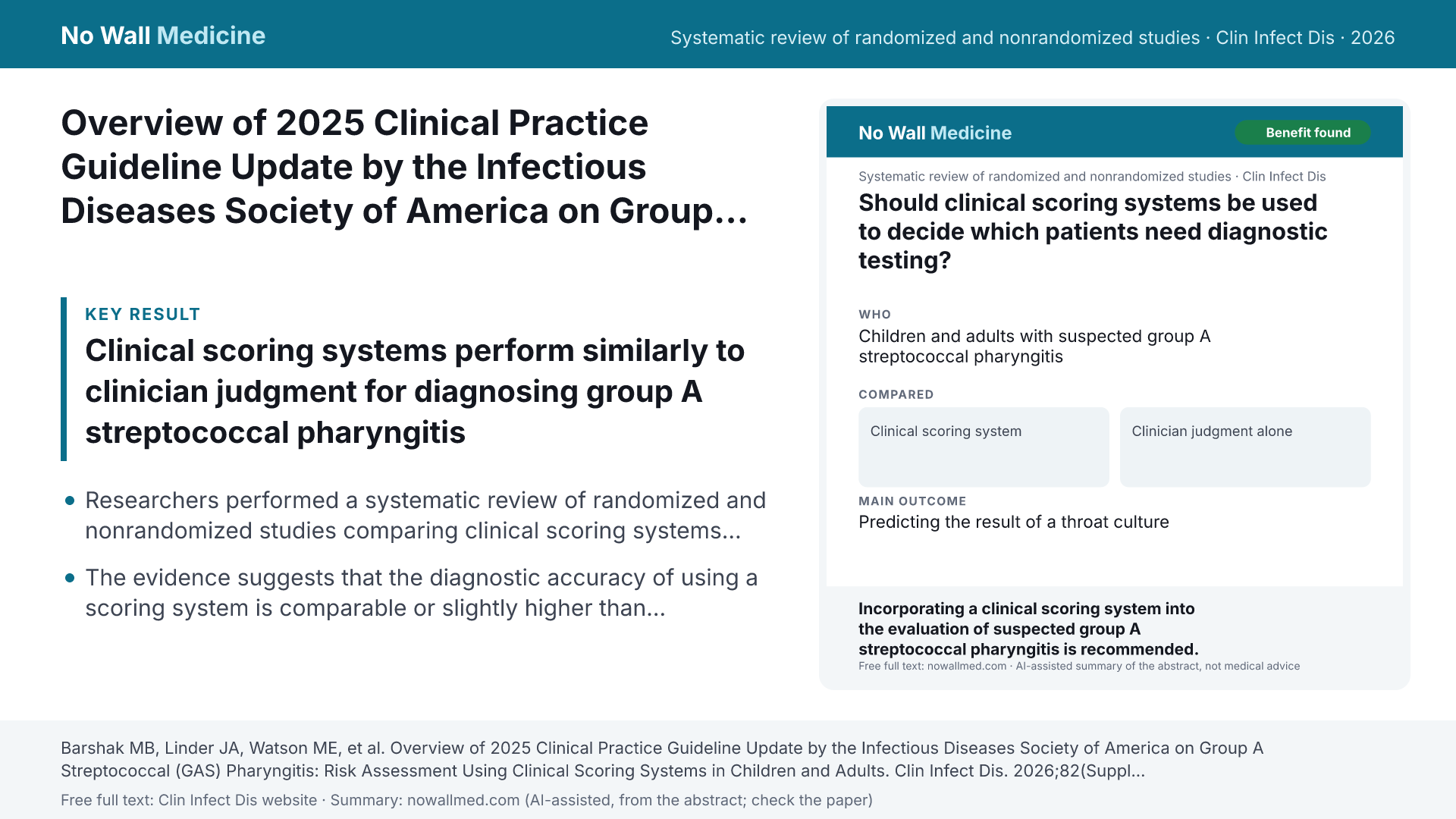
Clinical scoring systems perform similarly to clinician judgment for diagnosing group A streptococcal pharyngitis
Overview of 2025 Clinical Practice Guideline Update by the Infectious Diseases Society of America on Group A Streptococcal (GAS) Pharyngitis: Risk Assessment Using Clinical Scoring Systems in Children and Adults
Systematic review of randomized and nonrandomized studiesBenefit found
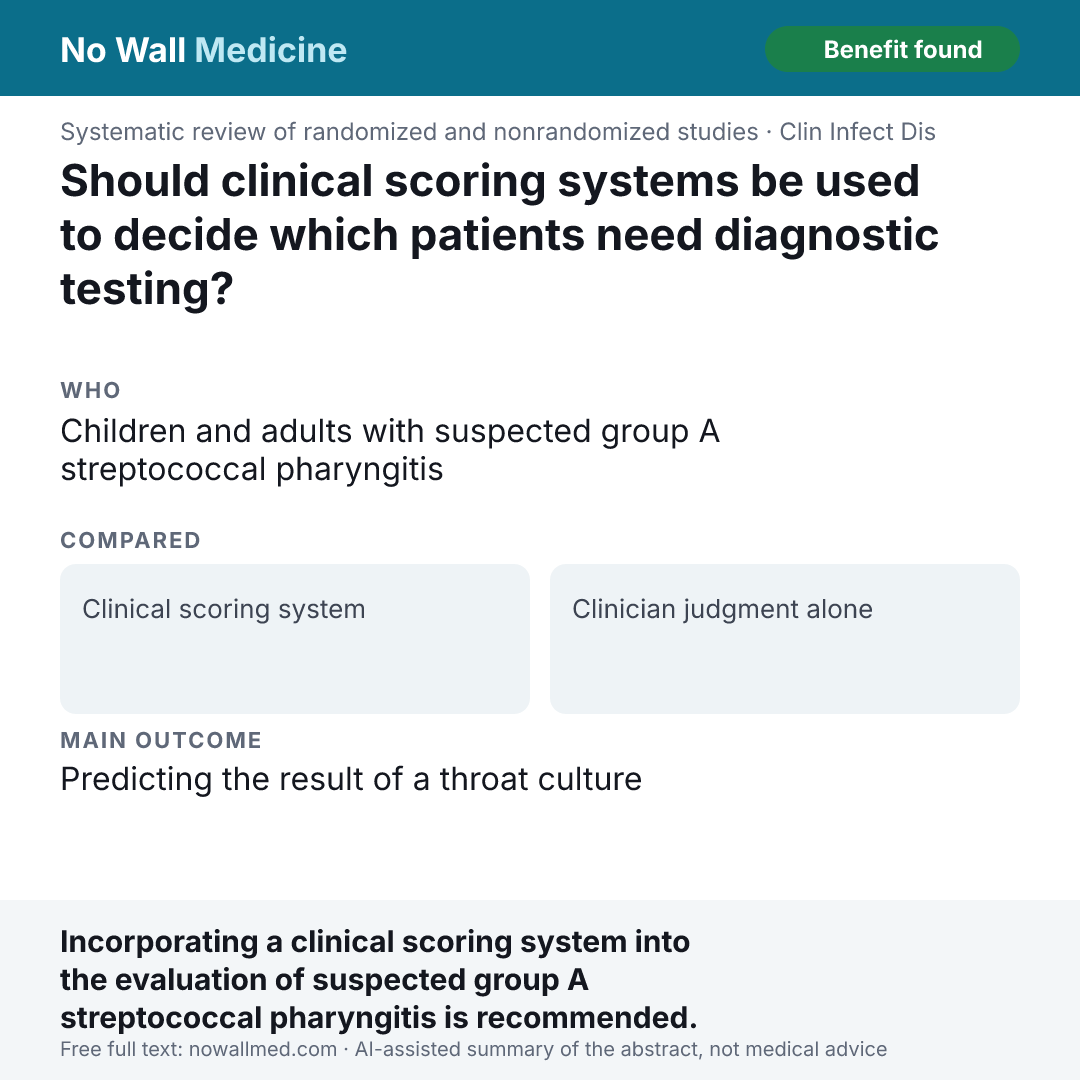
Should clinical scoring systems be used to decide which patients need diagnostic testing?
Who
Children and adults with suspected group A streptococcal pharyngitis
Compared
Clinical scoring system
Clinician judgment alone
Main outcome
Predicting the result of a throat culture
Bottom line: Incorporating a clinical scoring system into the evaluation of suspected group A streptococcal pharyngitis is recommended.
Limitation: Small study size, lack of uniformity in outcome measures, and incomplete data.
Clin Infect Dis · 2026-02-16 · Save PNG
Clinical question: Should clinical scoring systems be used to decide which patients need diagnostic testing?
Why it matters: Clinician judgment alone is unreliable for diagnosing group A streptococcal pharyngitis, while universal testing can cause unnecessary costs and inconvenience for low-risk patients.
Key points
- Researchers performed a systematic review of randomized and nonrandomized studies comparing clinical scoring systems to clinician judgment for predicting positive throat culture results.
- The evidence suggests that the diagnostic accuracy of using a scoring system is comparable or slightly higher than using clinician judgment alone.
- The panel consensus suggests that the balance of benefits and harms favors using a scoring system when evaluating patients with suspected group A streptococcal pharyngitis.
Limitation the authors note: The studies were limited by small size, a lack of uniformity in outcome measures, and incomplete data.
Headline and key points written with AI from the paper’s abstract, with every number checked against it. Read the paper before relying on them.
Was this summary helpful?
Subject terms
Headline, design, result, key points, caveat and citation as plain text.
Cite this article
Barshak MB, Linder JA, Watson ME, et al. Overview of 2025 Clinical Practice Guideline Update by the Infectious Diseases Society of America on Group A Streptococcal (GAS) Pharyngitis: Risk Assessment Using Clinical Scoring Systems in Children and Adults. Clin Infect Dis. 2026;82(Suppl 3):i92-i96. doi:10.1093/cid/ciag098
Spotted a mistake? Suggest a correction