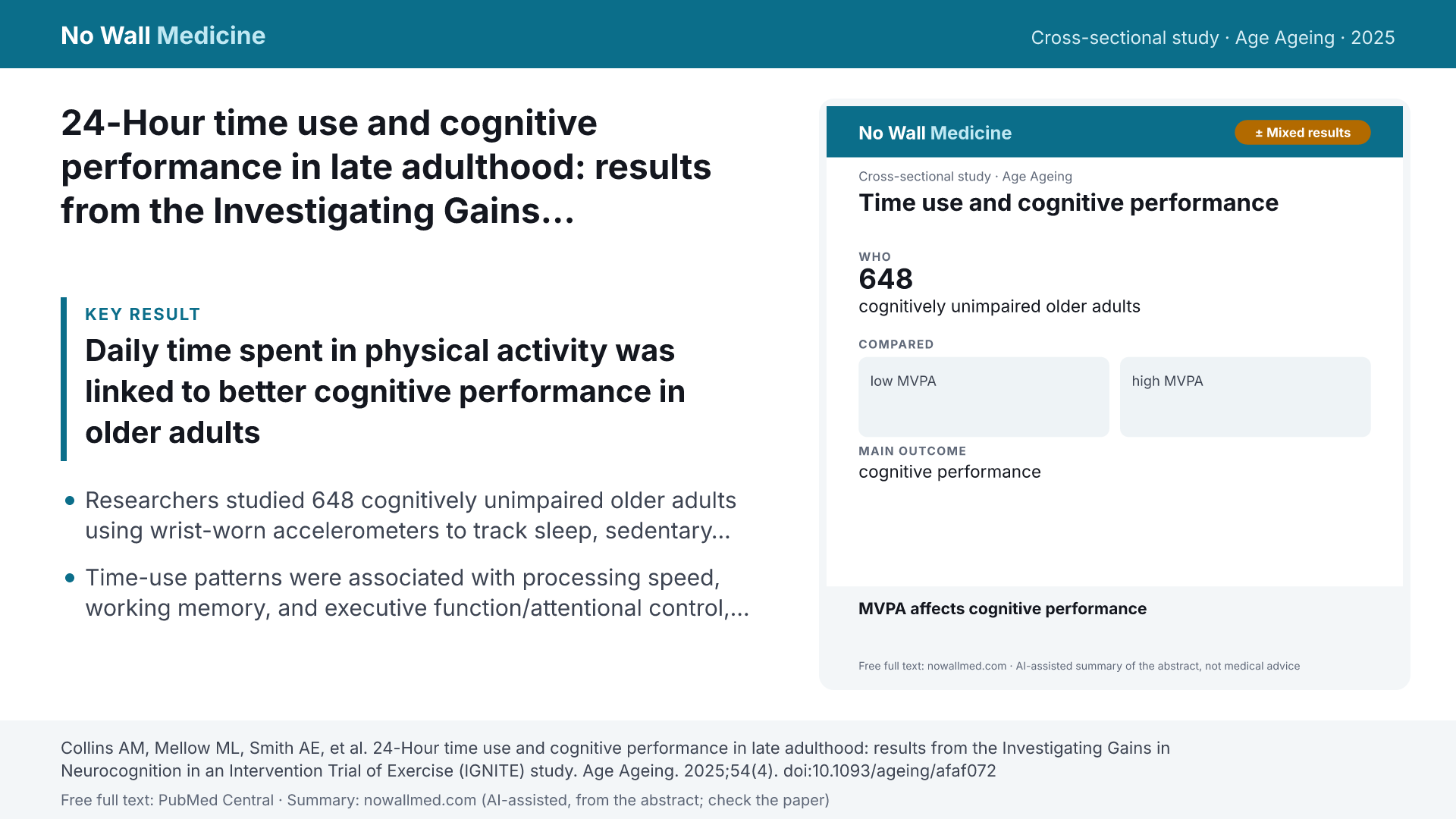
Daily time spent in physical activity was linked to better cognitive performance in older adults
24-Hour time use and cognitive performance in late adulthood: results from the Investigating Gains in Neurocognition in an Intervention Trial of Exercise (IGNITE) study
Cross-sectional studyMixed results
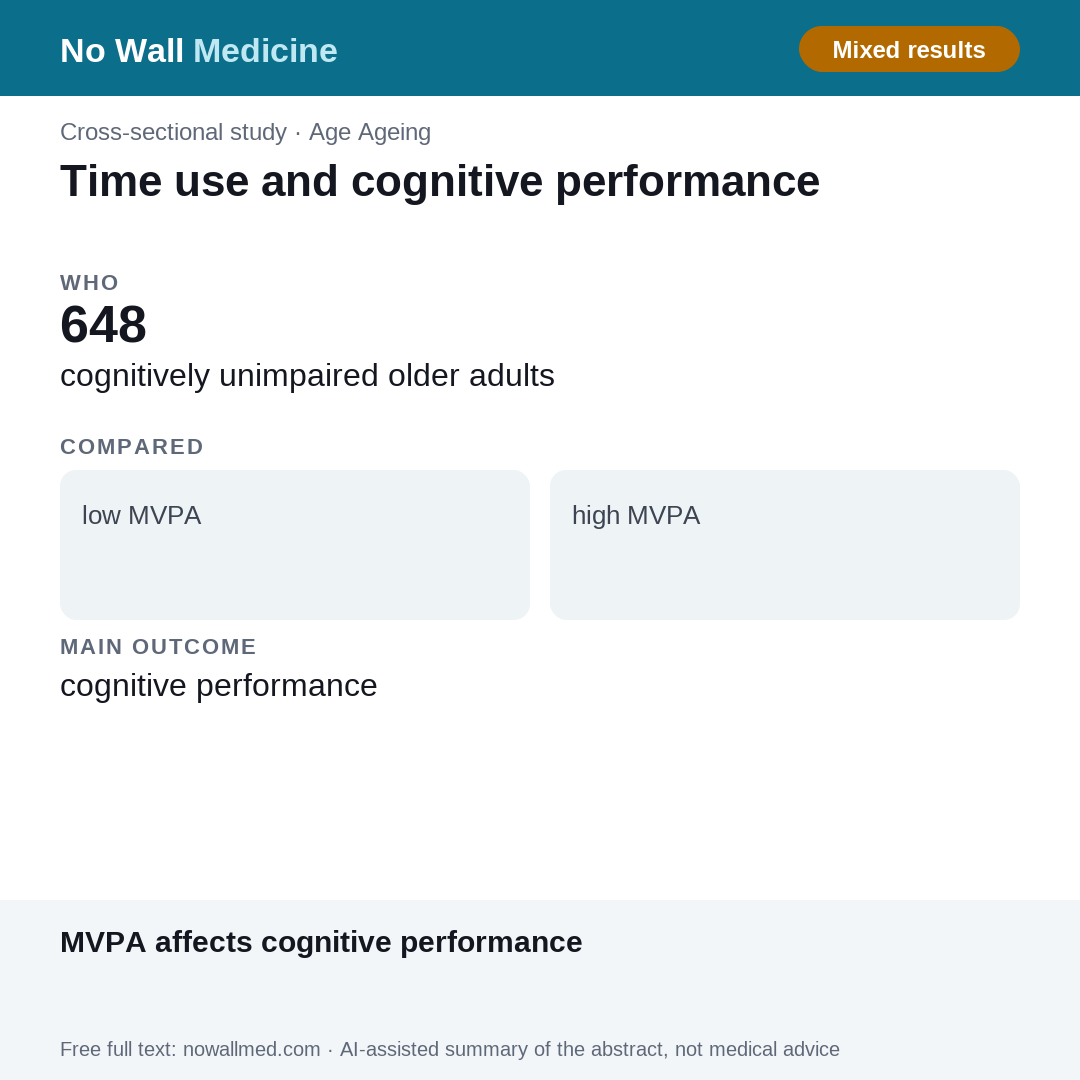
Time use and cognitive performance
Who
648
cognitively unimpaired older adults
Compared
low MVPA
high MVPA
Main outcome
cognitive performance
Bottom line: MVPA affects cognitive performance
Age Ageing · 2025-04-04Download image
Why it matters: It was unknown how the specific composition of 24-hour time use, including sleep and activity levels, relates to different domains of cognitive performance in older adults.
Key points
- Researchers studied 648 cognitively unimpaired older adults using wrist-worn accelerometers to track sleep, sedentary time, and physical activity.
- Time-use patterns were associated with processing speed, working memory, and executive function/attentional control, but not episodic memory or visuospatial function.
- Lower amounts of moderate-to-vigorous physical activity were associated with poorer cognitive performance in this group.
Headline and key points written with AI from the paper’s abstract, with every number checked against it. Read the paper before relying on them.
Was this summary helpful?
Subject terms
Cite this article
Collins AM, Mellow ML, Smith AE, et al. 24-Hour time use and cognitive performance in late adulthood: results from the Investigating Gains in Neurocognition in an Intervention Trial of Exercise (IGNITE) study. Age Ageing. 2025. doi:10.1093/ageing/afaf072
Spotted a mistake? Suggest a correction