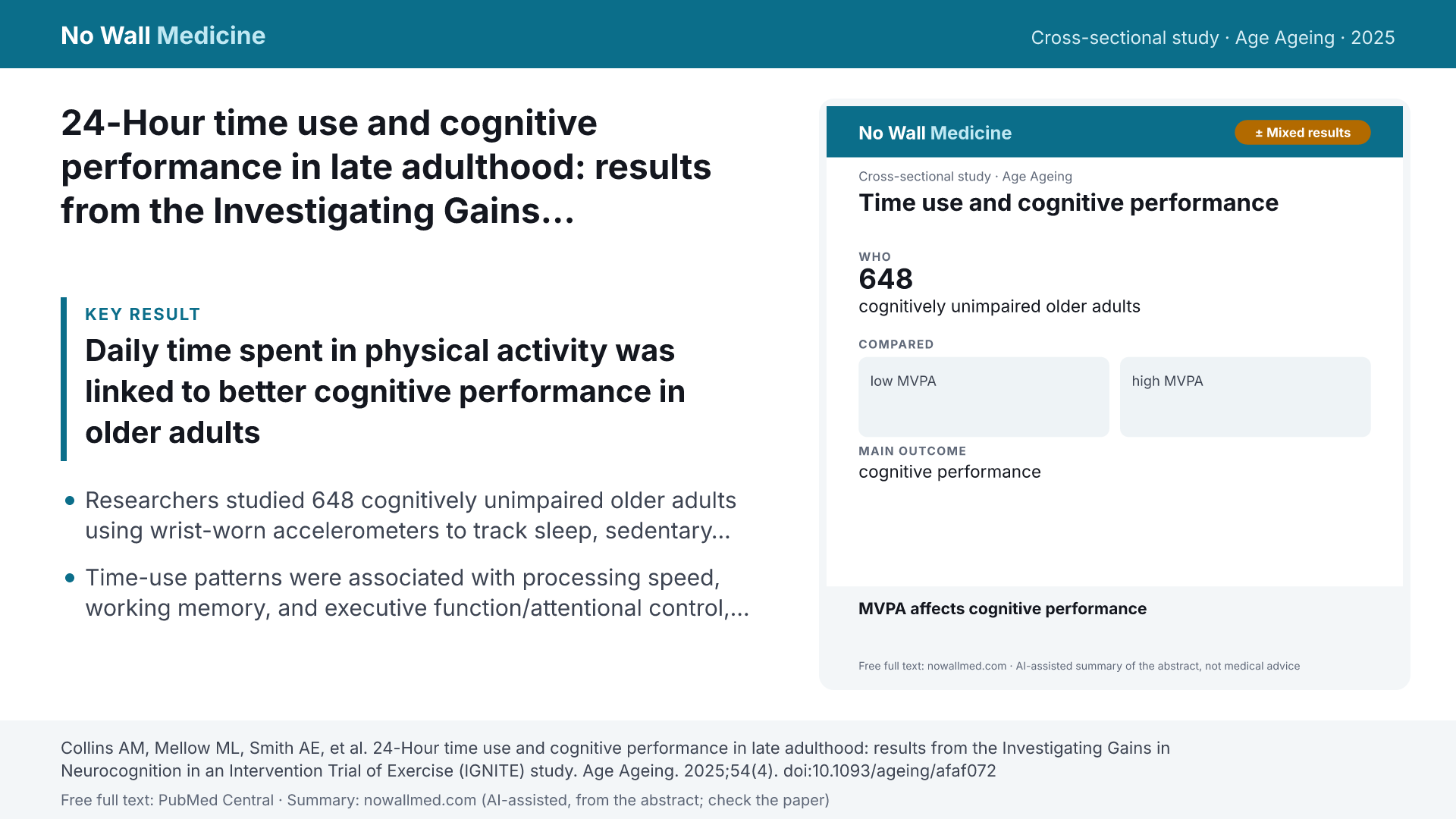
24-Hour time use and cognitive performance in late adulthood: results from the Investigating Gains in Neurocognition in an Intervention Trial of Exercise (IGNITE) study
Key result: Daily time spent in physical activity was linked to better cognitive performance in older adults
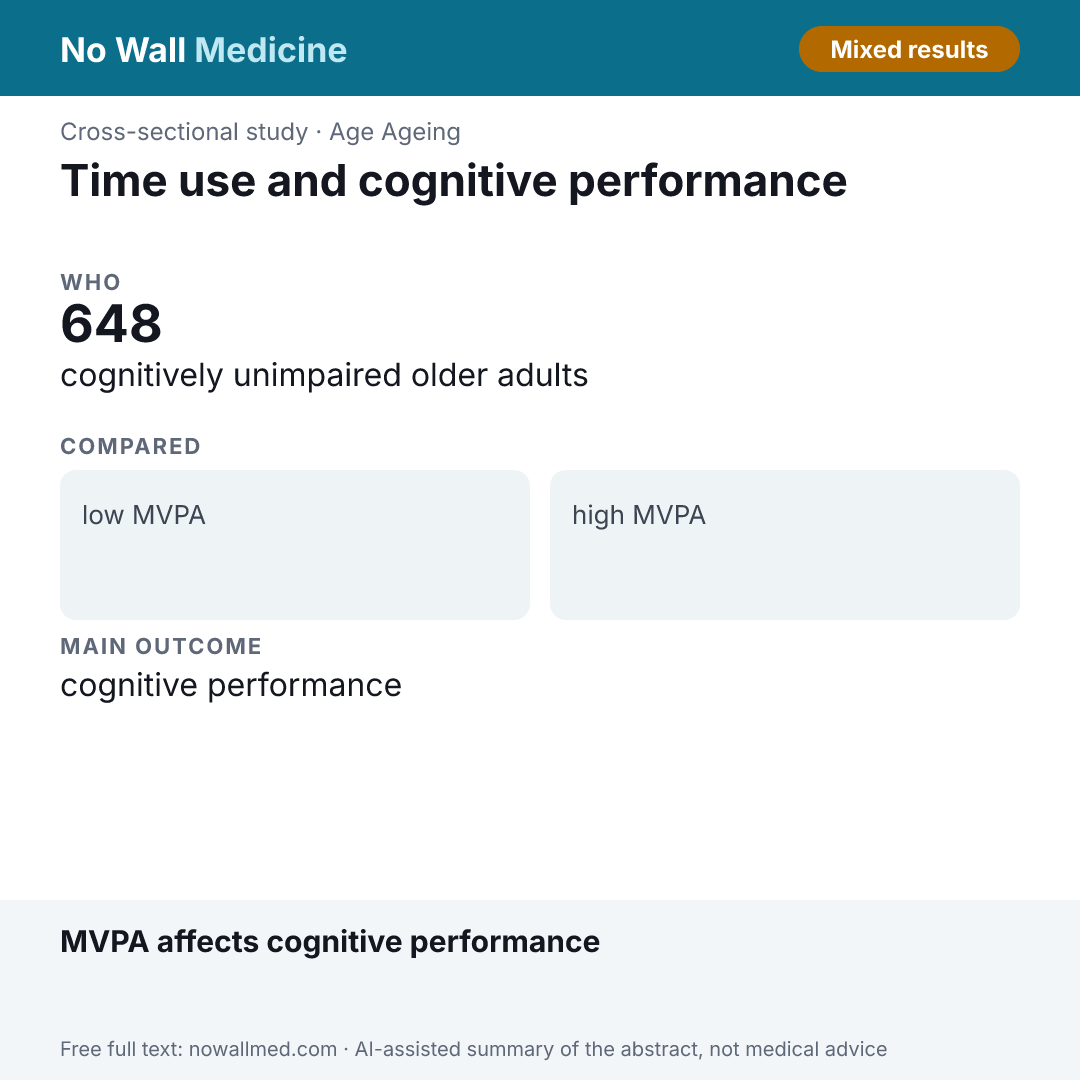
Cross-sectional studyMixed results
Time use and cognitive performance
Who
648
cognitively unimpaired older adults
Compared
low MVPA
high MVPA
Main outcome
cognitive performance
Bottom line: MVPA affects cognitive performance
Age Ageing · 2025-04-04 · Save PNG
Key points
- Researchers studied 648 cognitively unimpaired older adults using wrist-worn accelerometers to track sleep, sedentary time, and physical activity.
- Time-use patterns were associated with processing speed, working memory, and executive function/attentional control, but not episodic memory or visuospatial function.
- Lower amounts of moderate-to-vigorous physical activity were associated with poorer cognitive performance in this group.
Discussion prompts
- Would these patients look like yours? Who was left out?
- Is the main outcome one that matters to patients?
- Is the difference large enough to change what you do?
Cite: Collins AM, Mellow ML, Smith AE, et al. 24-Hour time use and cognitive performance in late adulthood: results from the Investigating Gains in Neurocognition in an Intervention Trial of Exercise (IGNITE) study. Age Ageing. 2025;54(4). doi:10.1093/ageing/afaf072
Free full text: PubMed Central · Summary and visual abstract: nowallmed.com/a/24-hour-time-use-and-cognitive-performance-in-late-adulthood-results-1vo3aqv/ (AI-assisted from the abstract; check the paper before relying on it).