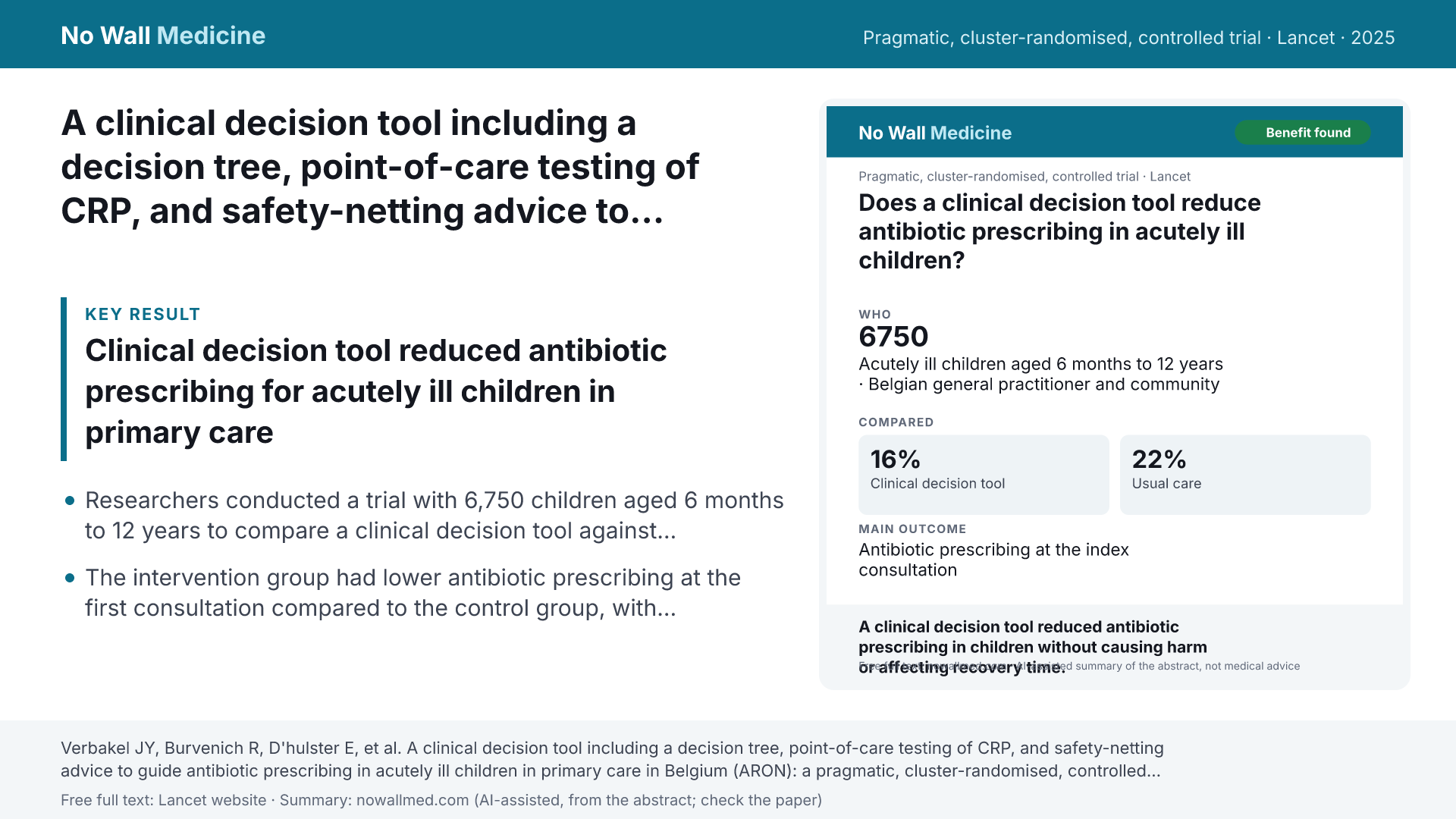
A clinical decision tool including a decision tree, point-of-care testing of CRP, and safety-netting advice to guide antibiotic prescribing in acutely ill children in primary care in Belgium (ARON): a pragmatic, cluster-randomised, controlled trial
Key result: Clinical decision tool reduced antibiotic prescribing for acutely ill children in primary care
Key points
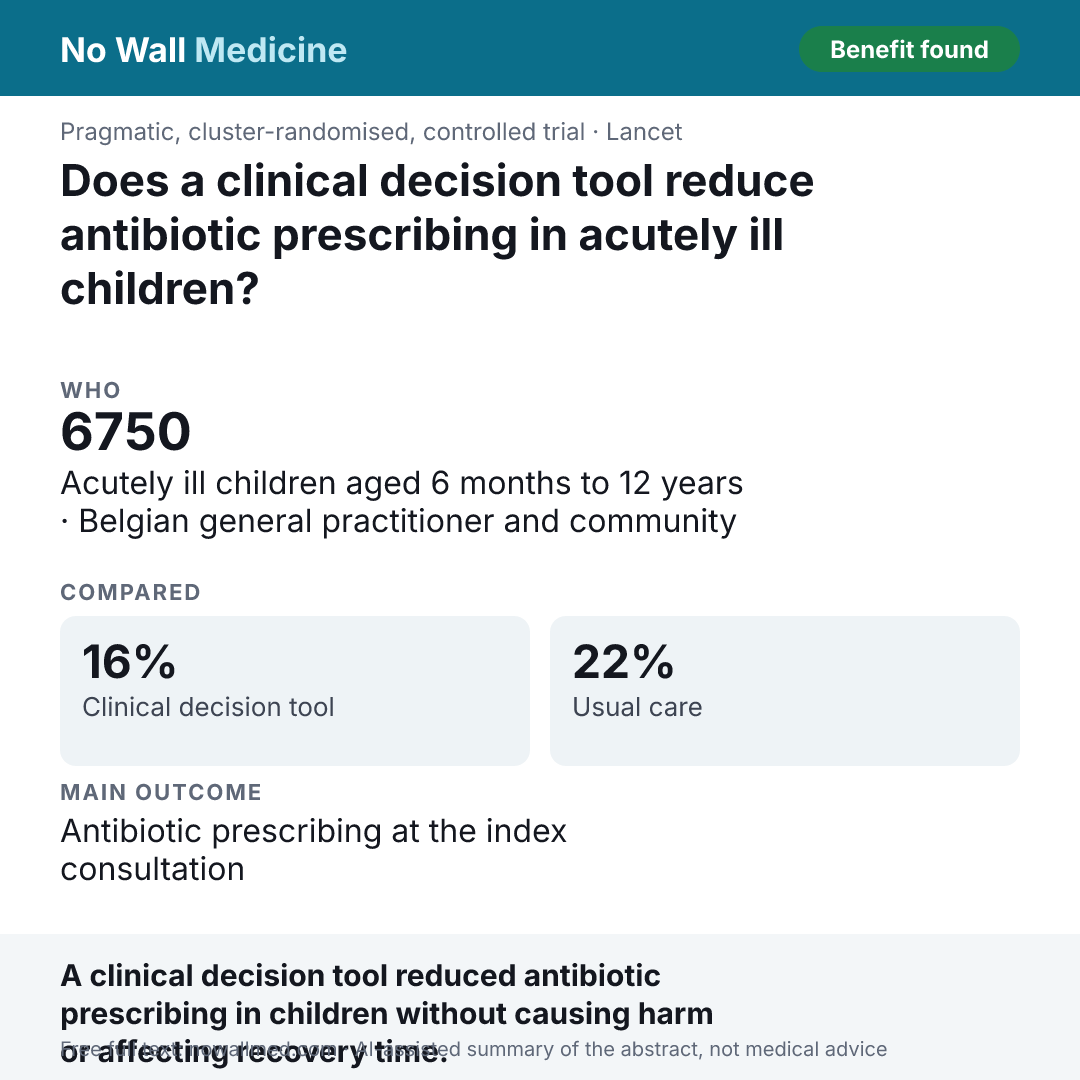
- Researchers conducted a trial with 6,750 children aged 6 months to 12 years to compare a clinical decision tool against usual care.
- The intervention group had lower antibiotic prescribing at the first consultation compared to the control group, with 16% versus 22% (p=0.017).
- The tool was non-inferior regarding recovery time, additional testing, follow-up visits, and antibiotic prescribing after the first consultation.
Why it matters: Many children with acute illness in ambulatory care are unnecessarily prescribed antibiotics, contributing to the global threat of antimicrobial resistance.
Discussion prompts
- Would these patients look like yours? Who was left out?
- Is the main outcome one that matters to patients?
- Is the difference large enough to change what you do?
Cite: Verbakel JY, Burvenich R, D'hulster E, et al. A clinical decision tool including a decision tree, point-of-care testing of CRP, and safety-netting advice to guide antibiotic prescribing in acutely ill children in primary care in Belgium (ARON): a pragmatic, cluster-randomised, controlled trial. Lancet. 2025;406(10512):1599-1610. doi:10.1016/S0140-6736(25)01239-5
Free full text: Lancet website · Summary and visual abstract: nowallmed.com/a/a-clinical-decision-tool-including-a-decision-tree-point-of-care-17soryj/ (AI-assisted from the abstract; check the paper before relying on it).