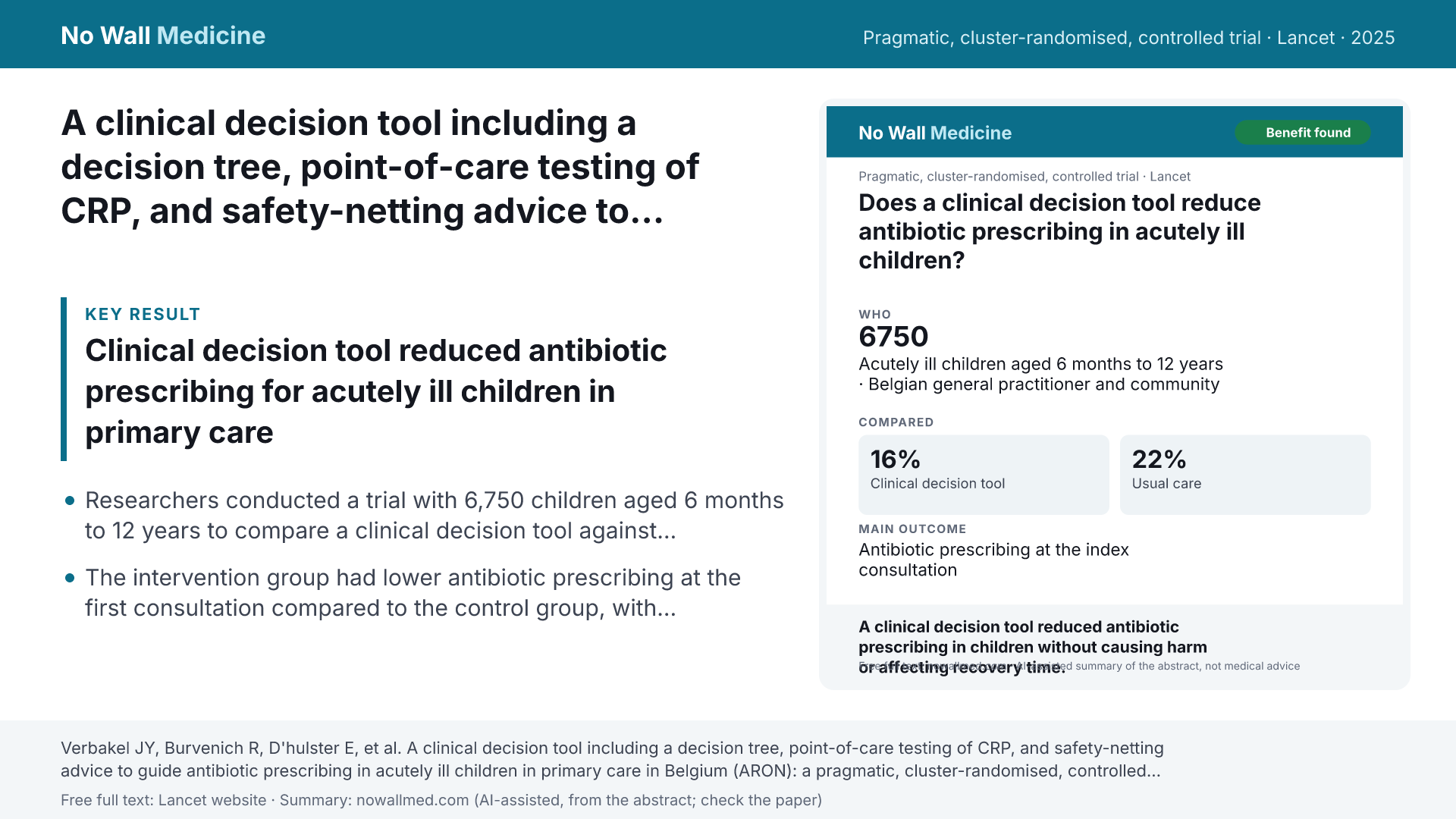
Clinical decision tool reduced antibiotic prescribing for acutely ill children in primary care
A clinical decision tool including a decision tree, point-of-care testing of CRP, and safety-netting advice to guide antibiotic prescribing in acutely ill children in primary care in Belgium (ARON): a pragmatic, cluster-randomised, controlled trial
Pragmatic, cluster-randomised, controlled trialBenefit found
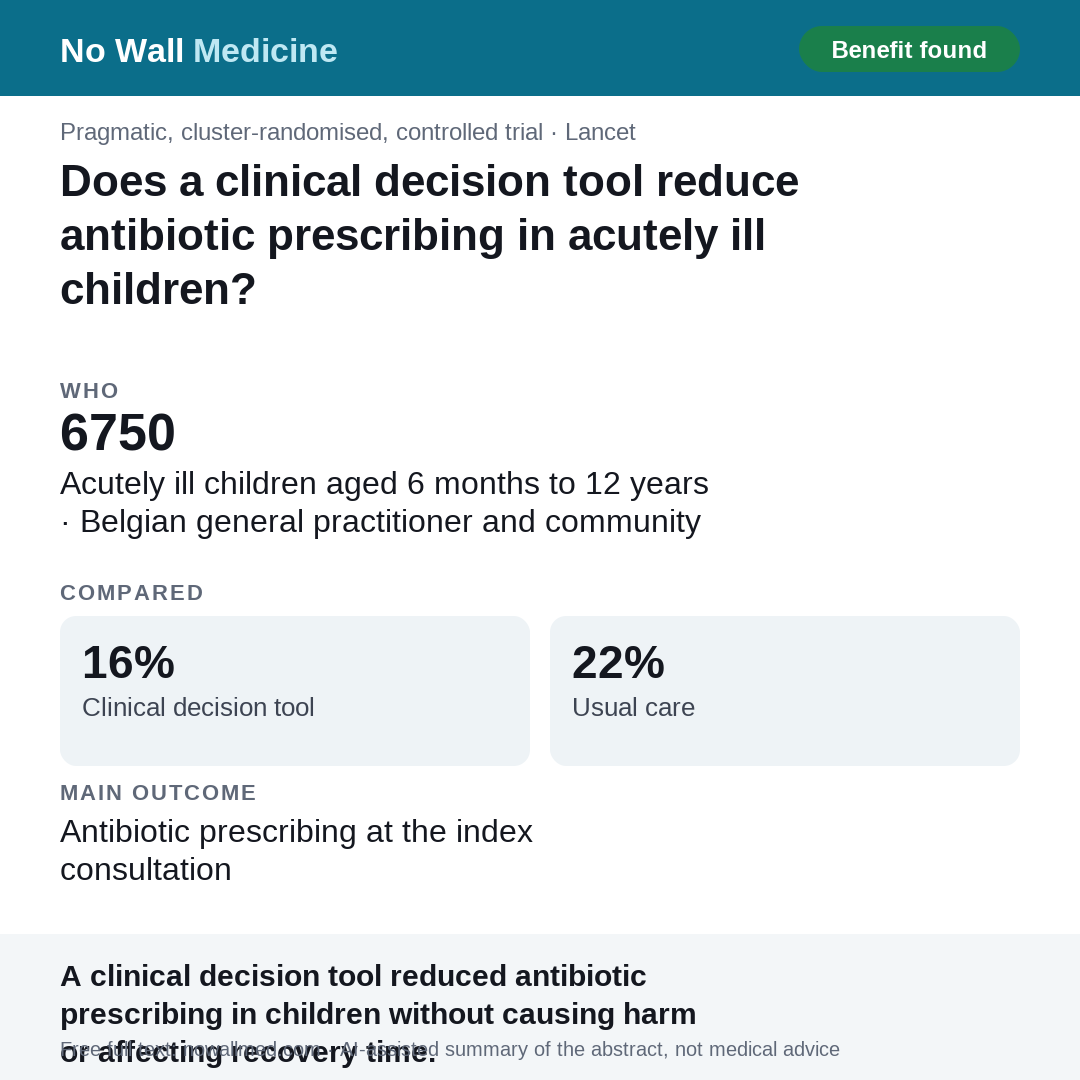
Does a clinical decision tool reduce antibiotic prescribing in acutely ill children?
Who
6750
Acutely ill children aged 6 months to 12 years · Belgian general practitioner and community paediatrician practices
Compared
16%Clinical decision tool
22%Usual care
Main outcome
Antibiotic prescribing at the index consultation
Result: adjusted odds ratio 0·72 (95% CI 0·55-0·94)
Bottom line: A clinical decision tool reduced antibiotic prescribing in children without causing harm or affecting recovery time.
Funded by: Belgian Health Care Knowledge Centre
Lancet · 2025-09-25Download image
Clinical question: Does a clinical decision tool reduce antibiotic prescribing in acutely ill children?
Why it matters: Many children with acute illness in ambulatory care are unnecessarily prescribed antibiotics, contributing to the global threat of antimicrobial resistance.
Key points
- Researchers conducted a trial with 6,750 children aged 6 months to 12 years to compare a clinical decision tool against usual care.
- The intervention group had lower antibiotic prescribing at the first consultation compared to the control group, with 16% versus 22% (p=0.017).
- The tool was non-inferior regarding recovery time, additional testing, follow-up visits, and antibiotic prescribing after the first consultation.
Headline and key points written with AI from the paper’s abstract, with every number checked against it. Read the paper before relying on them.
Was this summary helpful?
Subject terms
Cite this article
Verbakel JY, Burvenich R, D'hulster E, et al. A clinical decision tool including a decision tree, point-of-care testing of CRP, and safety-netting advice to guide antibiotic prescribing in acutely ill children in primary care in Belgium (ARON): a pragmatic, cluster-randomised, controlled trial. Lancet. 2025. doi:10.1016/S0140-6736(25)01239-5
Spotted a mistake? Suggest a correction