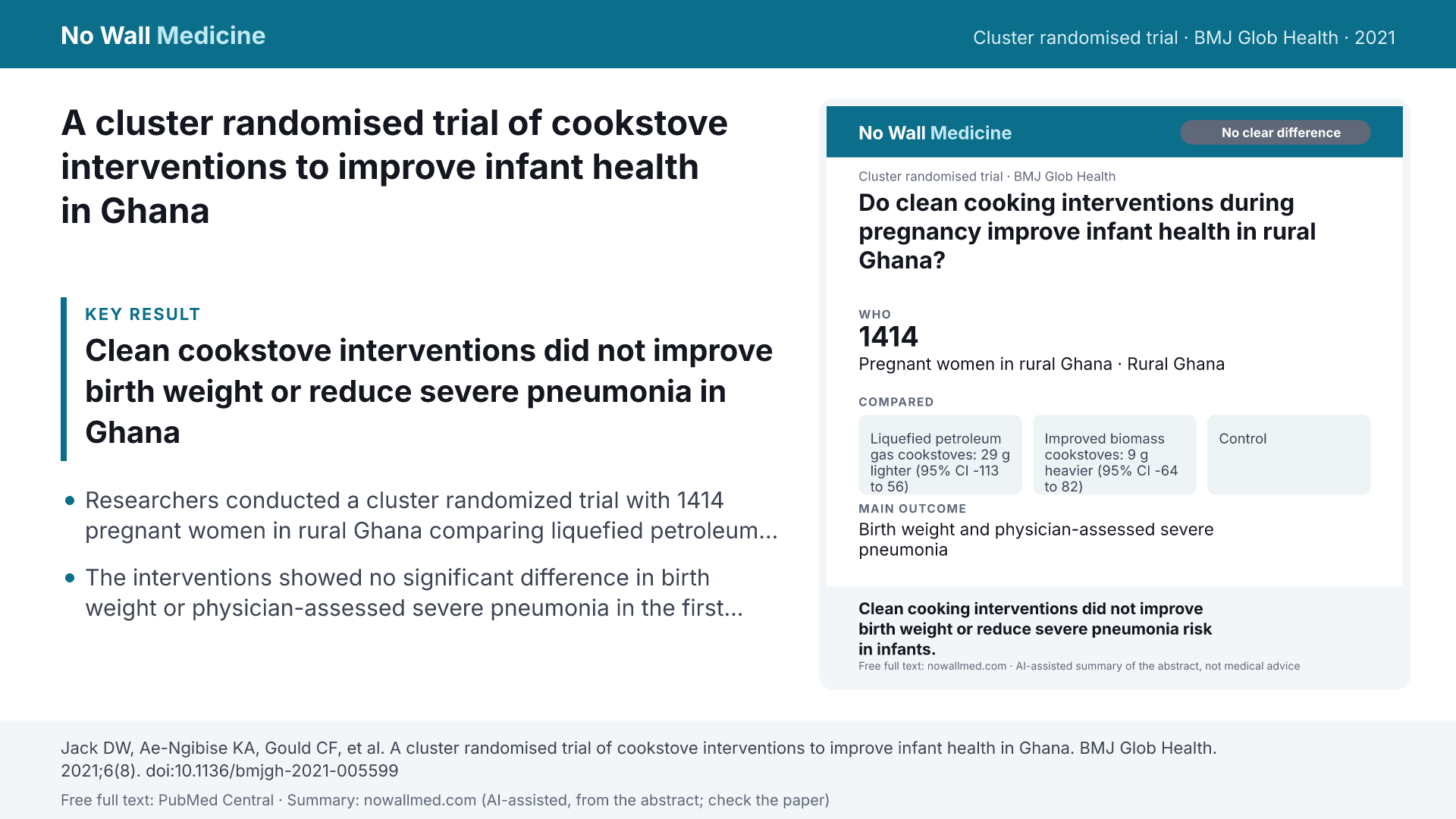
Clean cookstove interventions did not improve birth weight or reduce severe pneumonia in Ghana
A cluster randomised trial of cookstove interventions to improve infant health in Ghana
Cluster randomised trialNo clear difference
Do clean cooking interventions during pregnancy improve infant health in rural Ghana?
Who
1414
Pregnant women in rural Ghana · Rural Ghana
Compared
Liquefied petroleum gas cookstoves: 29 g lighter (95% CI -113 to 56)
Improved biomass cookstoves: 9 g heavier (95% CI -64 to 82)
Control
Main outcome
Birth weight and physician-assessed severe pneumonia
Result: rate ratio 0.98 (95% CI 0.58 to 1.70) for LPG arm
Bottom line: Clean cooking interventions did not improve birth weight or reduce severe pneumonia risk in infants.
BMJ Glob Health · 2021-08-28Download image
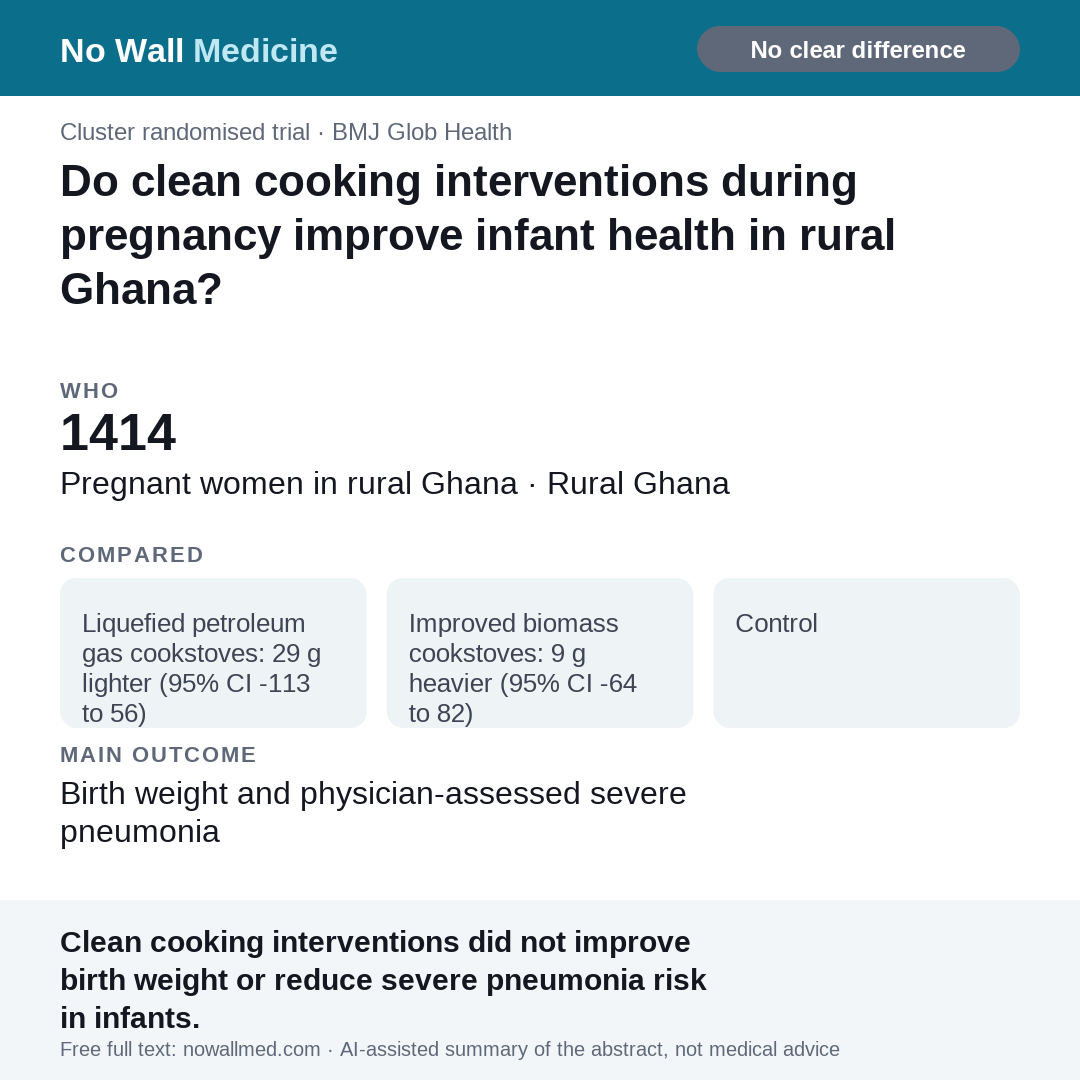
Clinical question: Do clean cooking interventions during pregnancy improve infant health in rural Ghana?
Why it matters: It was unknown if providing clean cooking interventions during pregnancy could reduce pollution exposure and improve infant health outcomes.
Key points
- Researchers conducted a cluster randomized trial with 1414 pregnant women in rural Ghana comparing liquefied petroleum gas stoves, improved biomass stoves, and traditional stoves.
- The interventions showed no significant difference in birth weight or physician-assessed severe pneumonia in the first 12 months of life.
- Air pollution exposure in the liquefied petroleum gas group remained above World Health Organization health-based targets with a median fine particulate matter of 45 µg/m³.
Headline and key points written with AI from the paper’s abstract, with every number checked against it. Read the paper before relying on them.
Was this summary helpful?
Abstract
Introduction
Household air pollution from solid fuel combustion for cooking and heating is a leading cause of childhood morbidity and mortality worldwide. We hypothesised that clean cooking interventions delivered during pregnancy would improve child health. Methods
We conducted a cluster randomised trial in rural Ghana to test whether providing pregnant women liquefied petroleum gas (LPG) cookstoves or improved biomass cookstoves would reduce personal carbon monoxide and fine particulate pollution exposure, increase birth weight and reduce physician-assessed severe pneumonia in the first 12 months of life, compared with control participants who continued to cook with traditional stoves. Primary analyses were intention-to-treat. The trial was registered with ClinicalTrials.gov and follow-up is complete. Results
Enrolment began on 14 April 2014, and ended on 20 August 2015. We enrolled 1414 pregnant women; 361 in the LPG arm, 527 in the improved biomass cookstove arm and 526 controls. We saw no improvement in birth weight (the difference in mean birth weight for LPG arm births was 29 g lighter (95% CI -113 to 56, p=0.51) and for improved biomass arm births was 9 g heavier (95% CI -64 to 82, p=0.81), compared with control newborns) nor severe child pneumonia (the rate ratio for pneumonia in the LPG arm was 0.98 (95% CI 0.58 to 1.70; p=0.95) and for the improved biomass arm was 1.21 (95% CI 0.78 to 1.90; p=0.52), compared with the control arm). Air pollution exposures in the LPG arm remained above WHO health-based targets (LPG median particulate matter less than 2.5 microns in diameter (PM2.5) 45 µg/m³; IQR 32-65 vs control median PM2.5 67 µg/m³, IQR 46-97). Conclusions
Neither prenatally-introduced LPG nor improved biomass cookstoves improved birth weight or reduced severe pneumonia risk in the first 12 months of life. We hypothesise that this is due to lower-than-expected exposure reductions in the intervention arms. Trial registration number
NCT01335490.
Abstract reproduced under the article’s CC BY NC licence.
Subject terms
Cite this article
Jack DW, Ae-Ngibise KA, Gould CF, Boamah-Kaali E, Lee AG, Mujtaba MN. A cluster randomised trial of cookstove interventions to improve infant health in Ghana. BMJ Glob Health. 2021. doi:10.1136/bmjgh-2021-005599
Spotted a mistake? Suggest a correction