A cluster randomised trial of cookstove interventions to improve infant health in Ghana
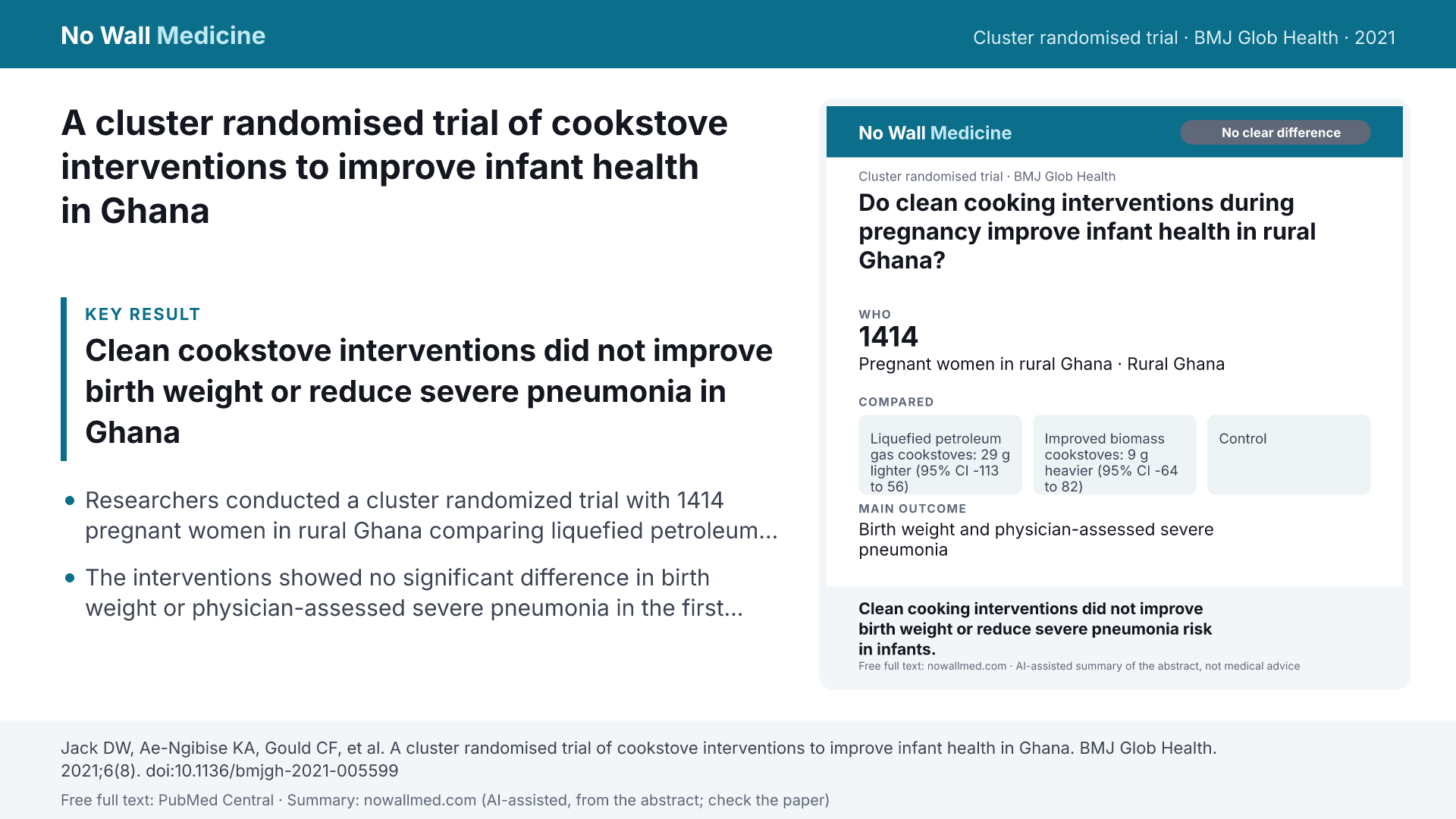
Key result: Clean cookstove interventions did not improve birth weight or reduce severe pneumonia in Ghana
Cluster randomised trialNo clear difference
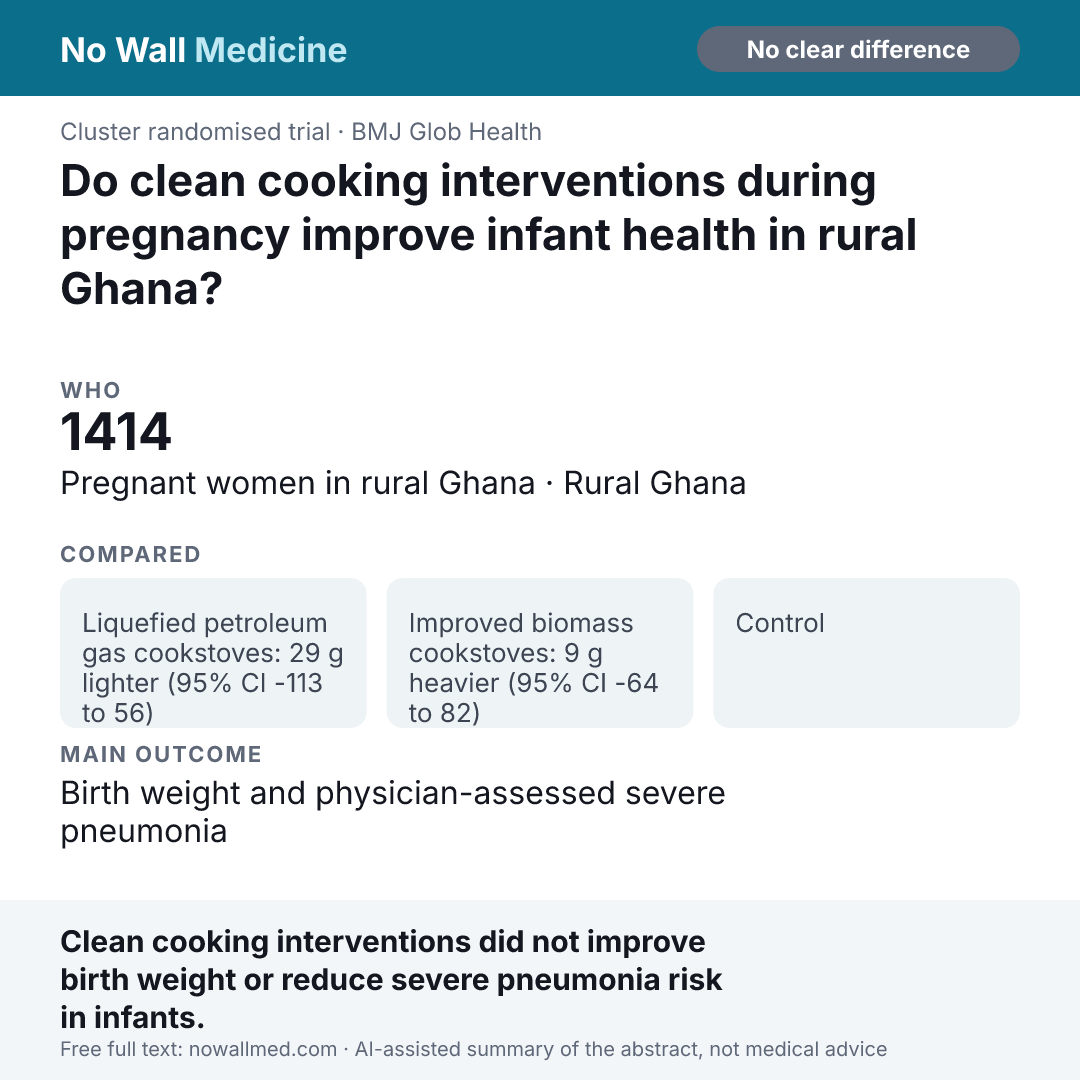
Do clean cooking interventions during pregnancy improve infant health in rural Ghana?
Who
1414
Pregnant women in rural Ghana · Rural Ghana
Compared
Liquefied petroleum gas cookstoves: 29 g lighter (95% CI -113 to 56)
Improved biomass cookstoves: 9 g heavier (95% CI -64 to 82)
Control
Main outcome
Birth weight and physician-assessed severe pneumonia
Result: rate ratio 0.98 (95% CI 0.58 to 1.70) for LPG arm
Bottom line: Clean cooking interventions did not improve birth weight or reduce severe pneumonia risk in infants.
BMJ Glob Health · 2021-08-28 · Save PNG
Key points
- Researchers conducted a cluster randomized trial with 1414 pregnant women in rural Ghana comparing liquefied petroleum gas stoves, improved biomass stoves, and traditional stoves.
- The interventions showed no significant difference in birth weight or physician-assessed severe pneumonia in the first 12 months of life.
- Air pollution exposure in the liquefied petroleum gas group remained above World Health Organization health-based targets with a median fine particulate matter of 45 µg/m³.
Discussion prompts
- Would these patients look like yours? Who was left out?
- Is the main outcome one that matters to patients?
- Is the difference large enough to change what you do?
Cite: Jack DW, Ae-Ngibise KA, Gould CF, et al. A cluster randomised trial of cookstove interventions to improve infant health in Ghana. BMJ Glob Health. 2021;6(8). doi:10.1136/bmjgh-2021-005599
Free full text: PubMed Central · Summary and visual abstract: nowallmed.com/a/a-cluster-randomised-trial-of-cookstove-interventions-to-improve-1jq4ccf/ (AI-assisted from the abstract; check the paper before relying on it).