A Cognitive Biotype of Depression and Symptoms, Behavior Measures, Neural Circuits, and Differential Treatment Outcomes: A Prespecified Secondary Analysis of a Randomized Clinical Trial
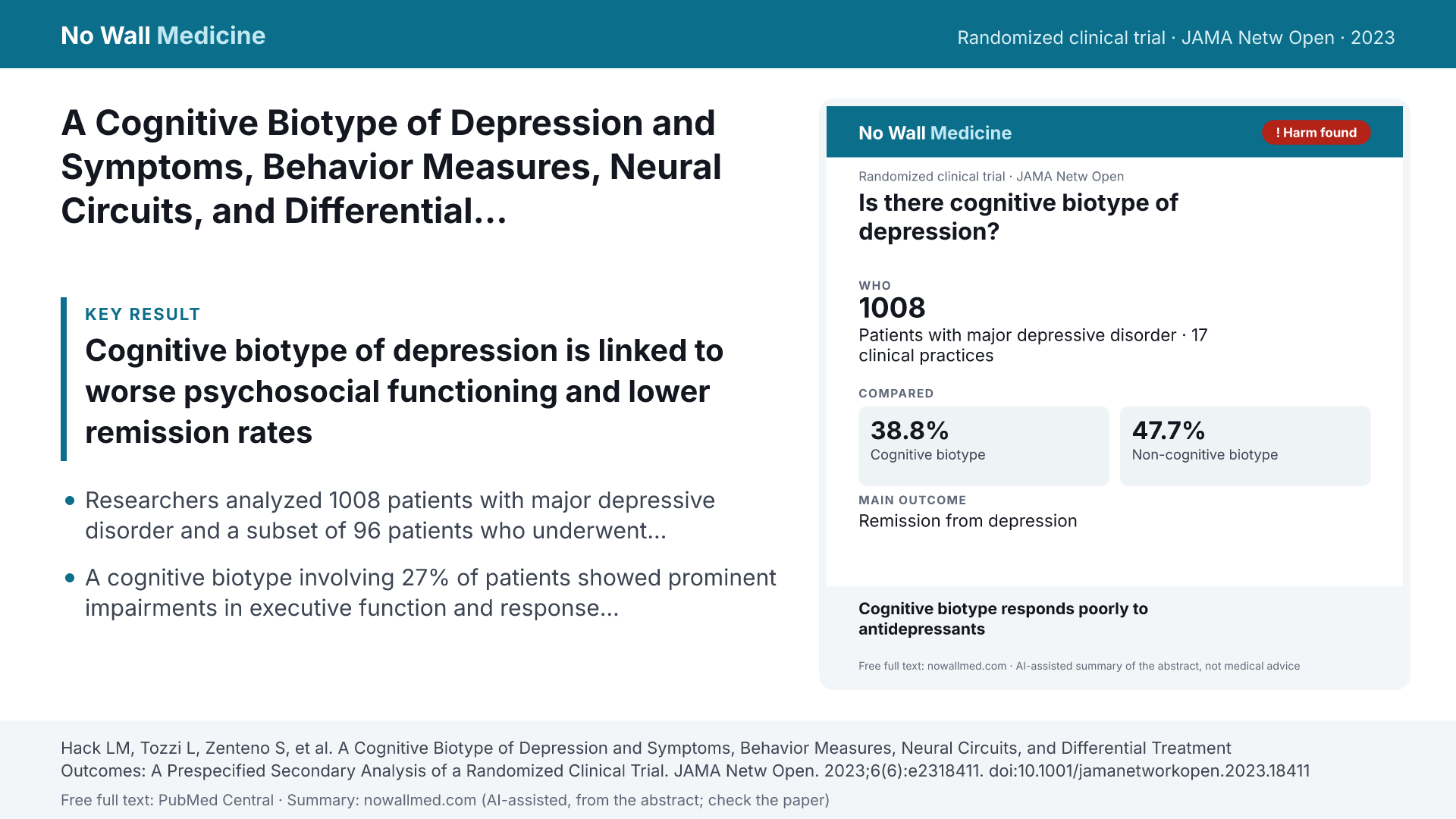
Key result: Cognitive biotype of depression is linked to worse psychosocial functioning and lower remission rates
Secondary analysis of a trialHarm found
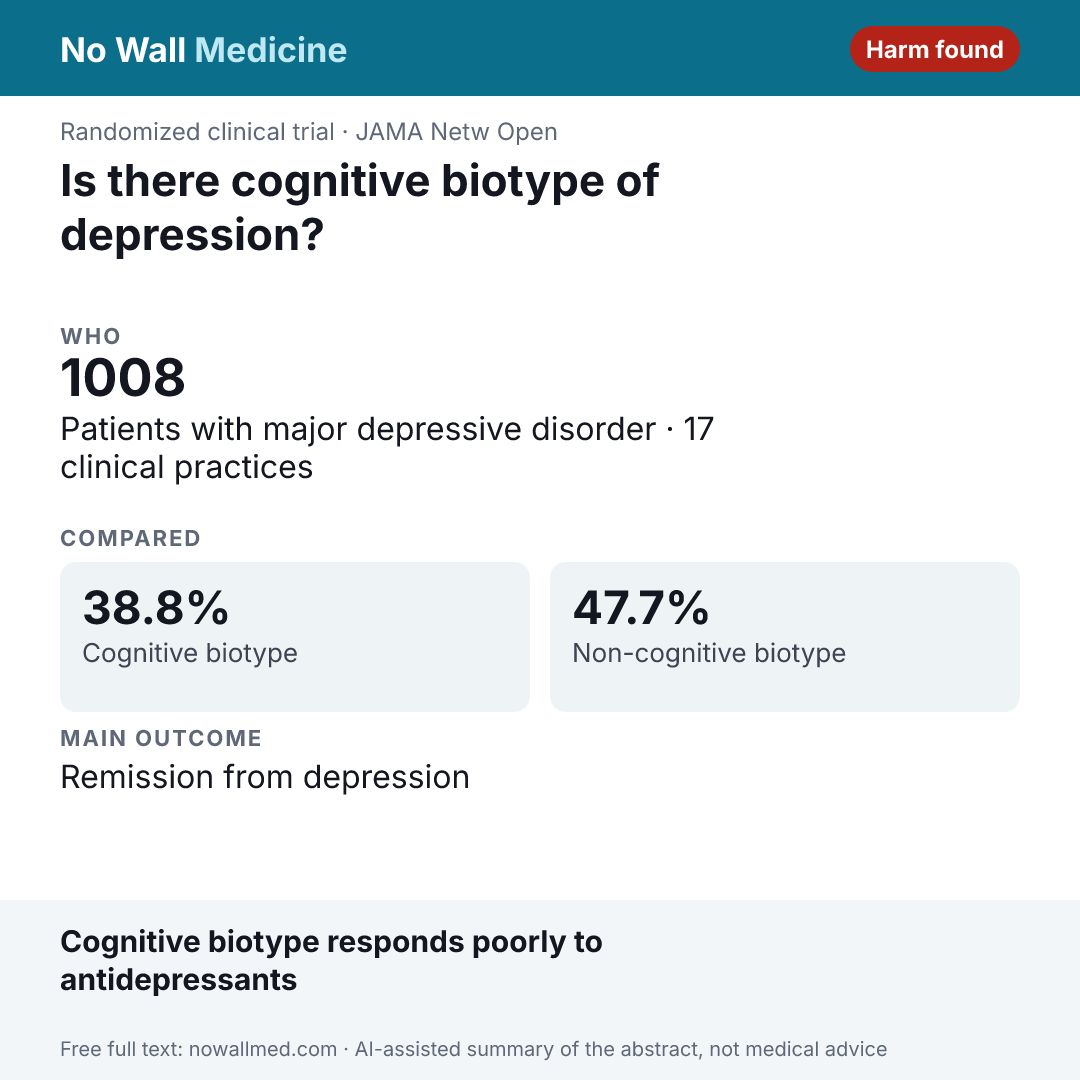
Is there cognitive biotype of depression?
Who
1008
Patients with major depressive disorder · 17 clinical practices
Compared
38.8%Cognitive biotype (73/188)
47.7%Non-cognitive biotype (250/524)
Main outcome
Remission from depression
Bottom line: Cognitive biotype responds poorly to antidepressants
JAMA Netw Open · 2023-06-01 · Save PNG
Key points
- Researchers analyzed 1008 patients with major depressive disorder and a subset of 96 patients who underwent functional magnetic resonance imaging.
- A cognitive biotype involving 27% of patients showed prominent impairments in executive function and response inhibition, lower remission rates (38.8% vs 47.7%), and reduced activation in the right dorsolateral prefrontal cortex.
- Changes in cognition mediated the extent of symptom and functional change, but changes in symptoms did not mediate changes in cognition.
Discussion prompts
- Would these patients look like yours? Who was left out?
- Is the main outcome one that matters to patients?
- Is the difference large enough to change what you do?
Cite: Hack LM, Tozzi L, Zenteno S, et al. A Cognitive Biotype of Depression and Symptoms, Behavior Measures, Neural Circuits, and Differential Treatment Outcomes: A Prespecified Secondary Analysis of a Randomized Clinical Trial. JAMA Netw Open. 2023;6(6):e2318411. doi:10.1001/jamanetworkopen.2023.18411
Free full text: PubMed Central · Summary and visual abstract: nowallmed.com/a/a-cognitive-biotype-of-depression-and-symptoms-behavior-measures-1w1z0tk/ (AI-assisted from the abstract; check the paper before relying on it).