Community case detection tool was associated with increased mental health service use among refugee children
A community case detection tool to promote help-seeking for mental health care among children and adolescents in Ugandan refugee settlements: a stepped wedge cluster randomised trial
Stepped wedge cluster randomised trialBenefit found
Does a community case detection tool increase mental health care help-seeking?
Who
Children and adolescents in Ugandan refugee settlements · Five refugee settlements in Uganda
Compared
Standard awareness raising
Community case detection tool: 16.89-fold increase (95% CI 8.15-34.99)
Main outcome
Mental health-care service use by children and adolescents
Result: incidence rate ratio 16.89 (95% CI 8.15 to 34.99)
Bottom line: The community case detection tool significantly increased mental health-care service use among children and adolescents in refugee settlements.
Funded by: Sint Antonius Stichting Projects
Lancet Child Adolesc Health · 2024-07-19Download image
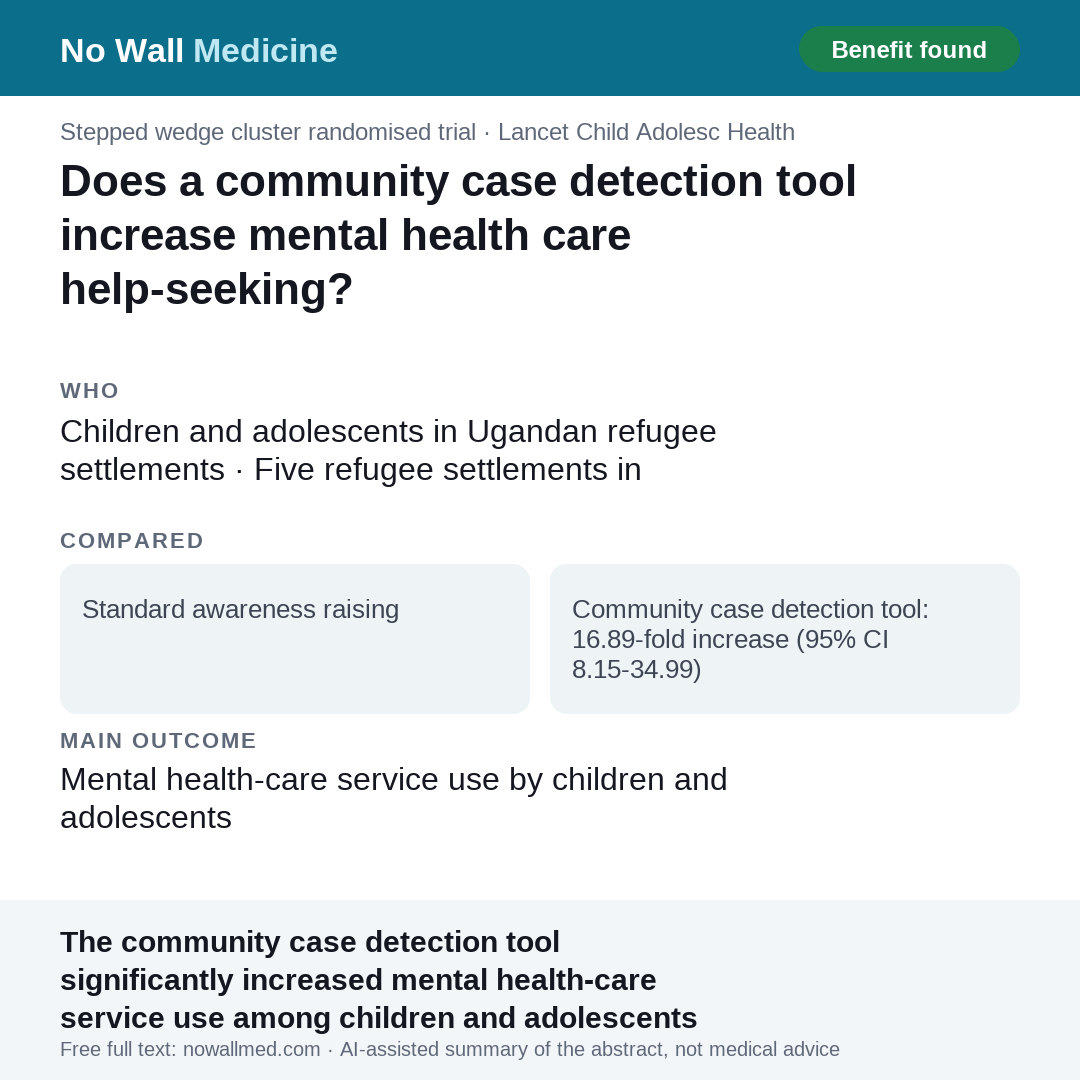
Clinical question: Does a community case detection tool increase mental health care help-seeking?
Why it matters: Strategies to promote mental health care help-seeking among children are needed in complex settings like low-income and middle-income countries.
Key points
- Researchers conducted a stepped wedge cluster randomized trial in five Ugandan refugee settlements involving 177 trained community gatekeepers.
- Implementation of the community case detection tool was associated with a 20.91-fold change in mental health-care service use in the first month compared to standard awareness activities.
- The tool was associated with a time-average 16.89-fold increase in mental health service use despite a slight decline in use over time in both groups.
Headline and key points written with AI from the paper’s abstract, with every number checked against it. Read the paper before relying on them.
Topics
Cite this article
van den Broek M, Agondeze S, Greene MC, Kasujja R, Guevara AF, Kisakye Tukahiirwa R. A community case detection tool to promote help-seeking for mental health care among children and adolescents in Ugandan refugee settlements: a stepped wedge cluster randomised trial. Lancet Child Adolesc Health. 2024. doi:10.1016/S2352-4642(24)00130-5
Spotted a mistake? Suggest a correction
Top studies every Monday
The week’s key trials and guidelines in your specialties, plus any topics you follow. By email, free.
Get the weekly digest