Review of 23 studies shows artificial intelligence applications for refugee mental health care
AI-Based Approaches to Refugee Mental Health Care: Systematic Integrative Review
Systematic integrative reviewUnclear result
How is artificial intelligence used in refugee mental health research and care?
Who
23
Refugee and forcibly displaced populations
Compared
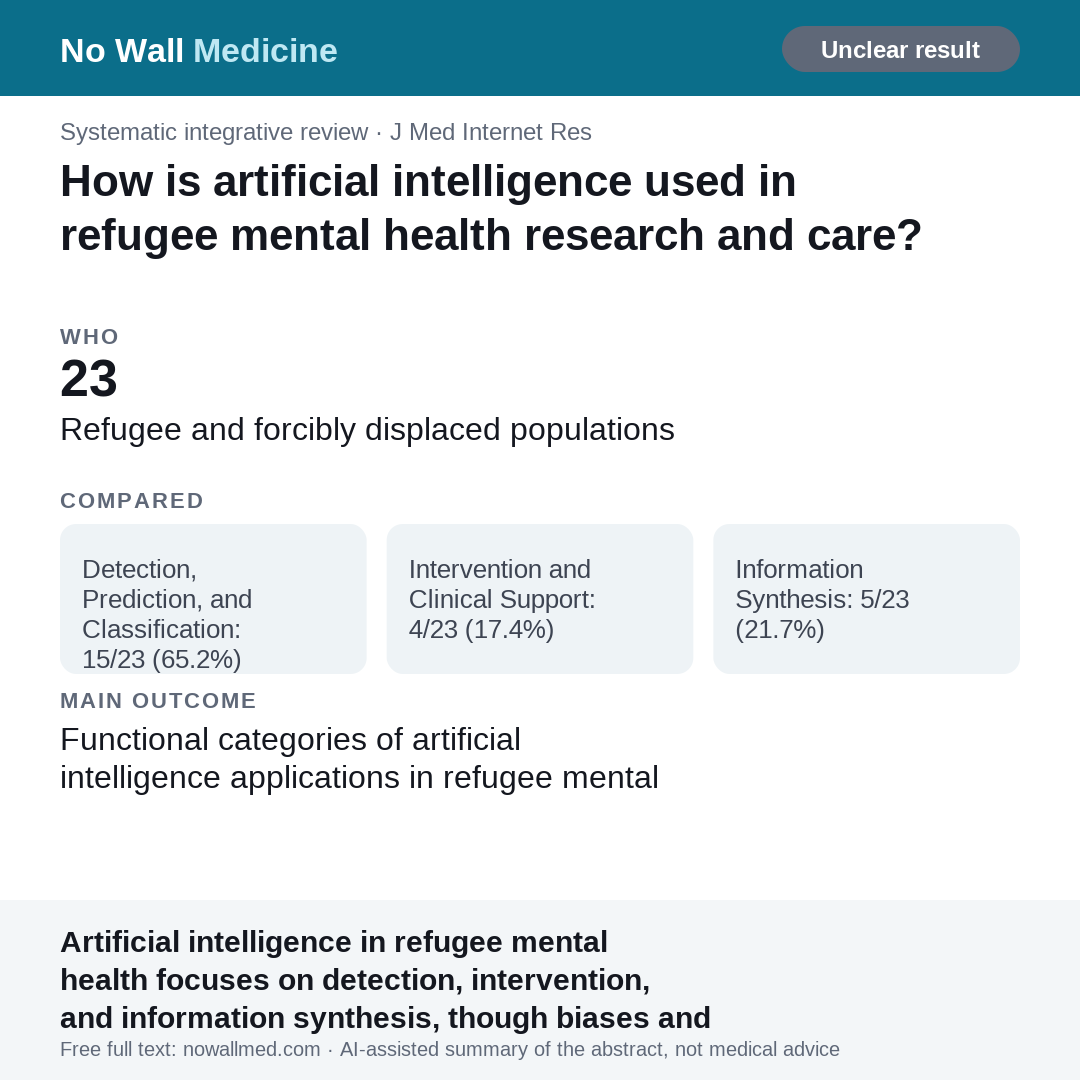
Detection, Prediction, and Classification: 15/23 (65.2%)
Intervention and Clinical Support: 4/23 (17.4%)
Information Synthesis: 5/23 (21.7%)
Main outcome
Functional categories of artificial intelligence applications in refugee mental health
Bottom line: Artificial intelligence in refugee mental health focuses on detection, intervention, and information synthesis, though biases and access barriers remain.
Limitation: Potential biases, lack of contextual understanding, and structural barriers in technology access.
J Med Internet Res · 2026-08-26Download image
Clinical question: How is artificial intelligence used in refugee mental health research and care?
Why it matters: Refugees face high rates of depression and anxiety but encounter significant barriers when trying to access mental health care.
Key points
- Researchers reviewed 23 studies to examine how artificial intelligence is used for mental health detection, intervention, and decision support in refugee populations.
- Most studies, 15 out of 23 or 65.2%, focused on the detection, prediction, and classification of mental health conditions.
- Reported limitations of these technologies included potential biases, a lack of contextual understanding, and structural barriers to accessing technology.
Limitation the authors note: The included studies were characterized by heterogeneity, meaning they varied significantly in their methods and focus.
Headline and key points written with AI from the paper’s abstract, with every number checked against it. Read the paper before relying on them.
Topics
Cite this article
Kang H, Park S, Kim J, Kim O, Kim H, Choi J. AI-Based Approaches to Refugee Mental Health Care: Systematic Integrative Review. J Med Internet Res. 2026. doi:10.2196/101857
Spotted a mistake? Suggest a correction