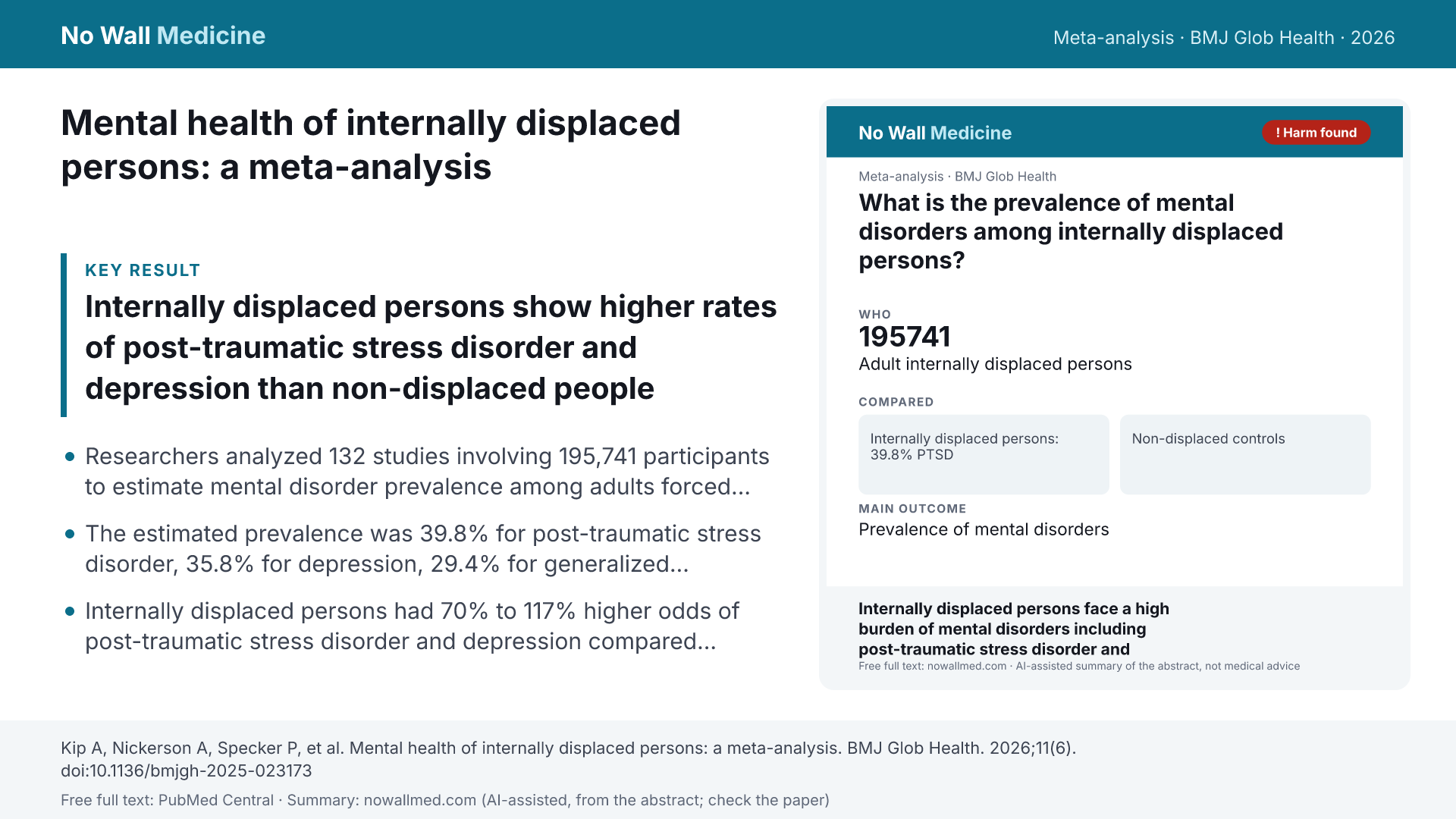
Internally displaced persons show higher rates of post-traumatic stress disorder and depression than non-displaced people
Mental health of internally displaced persons: a meta-analysis
Meta-analysisHarm found
What is the prevalence of mental disorders among internally displaced persons?
Who
195741
Adult internally displaced persons
Compared
Internally displaced persons: 39.8% PTSD
Non-displaced controls
Main outcome
Prevalence of mental disorders
Bottom line: Internally displaced persons face a high burden of mental disorders including post-traumatic stress disorder and depression.
Limitation: High risk of selection and outcome measurement bias was observed.
BMJ Glob Health · 2026-06-04 · Save PNG
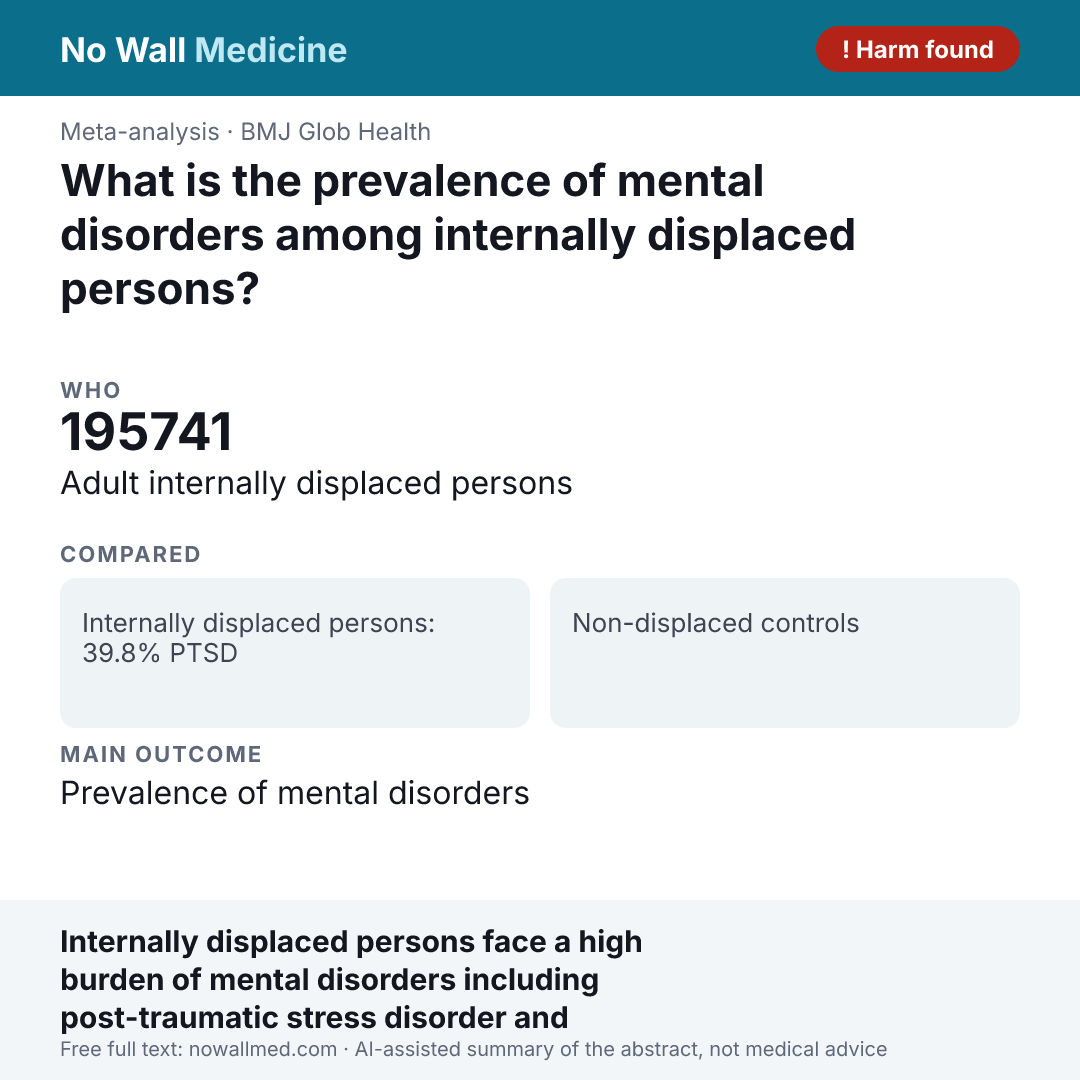
Clinical question: What is the prevalence of mental disorders among internally displaced persons?
Why it matters: Internally displaced persons remain under-represented in mental health research despite most forcibly displaced individuals staying within their country of origin.
Key points
- Researchers analyzed 132 studies involving 195,741 participants to estimate mental disorder prevalence among adults forced to flee their homes within their own country.
- The estimated prevalence was 39.8% for post-traumatic stress disorder, 35.8% for depression, 29.4% for generalized anxiety disorder, and 38.6% for insomnia.
- Internally displaced persons had 70% to 117% higher odds of post-traumatic stress disorder and depression compared to non-displaced control groups.
Limitation the authors note: The authors observed a high risk of selection and outcome measurement bias and noted that displacement cause and socioeconomic conditions insufficiently explained the large heterogeneity.
Headline and key points written with AI from the paper’s abstract, with every number checked against it. Read the paper before relying on them.
Was this summary helpful?
Abstract
Introduction
Although most forcibly displaced individuals remain within their country of origin, internally displaced persons (IDPs) remain under-represented in mental health research. We estimated the prevalence of mental disorders among IDPs and compared prevalence and psychosocial functioning with non-displaced controls. Methods
We searched MEDLINE, PsycINFO and Web of Science for peer-reviewed reports published until 20 June 2025 in any language. We included studies on point prevalence of mental disorders in adult IDPs as assessed with validated measurements based on the International Classification of Diseases or Diagnostic and Statistical Manual of Mental Disorders. Studies had to assess mental disorders in at least 100 participants at least 1 month postdisplacement. For studies that included non-displaced control groups, we also assessed other mental-health-related outcomes. All analyses used a random effects model. The protocol was registered with PROSPERO, CRD42024596202. Results
We identified 20774 unique study reports, of which 132 (124 independent datasets and 195 741 participants, with 61.3% female IDPs) met our inclusion criteria. The estimated pooled prevalence of current post-traumatic stress disorder (PTSD) was 39.8% (95% CI 34.9% to 44.8%; I²=98.9%), depression 35.8% (95% CI 27.0% to 45.8%; I²=99.3%), generalised anxiety disorder 29.4% (95% CI 20.3% to 40.5%; I²=99.4%), insomnia 38.6% (95% CI 33.2% to 44.2%; I²=95.5%), panic disorder 6.0% (95% CI 2.7% to 12.9%; I²=95.9%), alcohol use disorder 2.2% (95% CI 0.1% to 6.2%; I²=97.3%) and suicidality 9.2% (95% CI 1.3% to 44.1%; I²=99.2%). The odds of PTSD and depression compared with non-displaced controls were increased by 70%-117% and IDPs reported significantly higher somatic complaints and general distress and lower psychosocial well-being. Displacement cause and socioeconomic conditions in the affected countries insufficiently explained the large heterogeneity in findings. High risk of selection and outcome measurement bias was observed. Conclusions
The results highlight the mental health burden in IDPs, which calls for scalable and sustainable interventions. The findings further indicate that estimates vary substantially across contexts.
Abstract reproduced under the article’s CC BY licence.
Subject terms
Headline, design, result, key points, caveat and citation as plain text.
Cite this article
Kip A, Nickerson A, Specker P, et al. Mental health of internally displaced persons: a meta-analysis. BMJ Glob Health. 2026;11(6). doi:10.1136/bmjgh-2025-023173
Spotted a mistake? Suggest a correction