Thoracic paravertebral block may be more effective than other regional anesthesia for thoracic surgery
A comparison of regional anesthesia techniques in patients undergoing video-assisted thoracic surgery: A network meta-analysis
Network meta-analysis of 38 randomized controlled trialsBenefit found
Which regional anesthesia techniques are most effective for video-assisted thoracic surgery?
Who
2224
Patients undergoing video-assisted thoracoscopic surgery
Compared
Thoracic paravertebral block: less demand for morphine than intercostal nerve block and erector spinae plane block
Other regional analgesia techniques
Main outcome
Opioid consumption during the first 24 hours postoperatively
Bottom line: Thoracic paravertebral block is a superior option for analgesia compared to other regional anesthesia methods.
Limitation: Findings can only provide objective evidence.
Int J Surg · 2022-08-24Download image
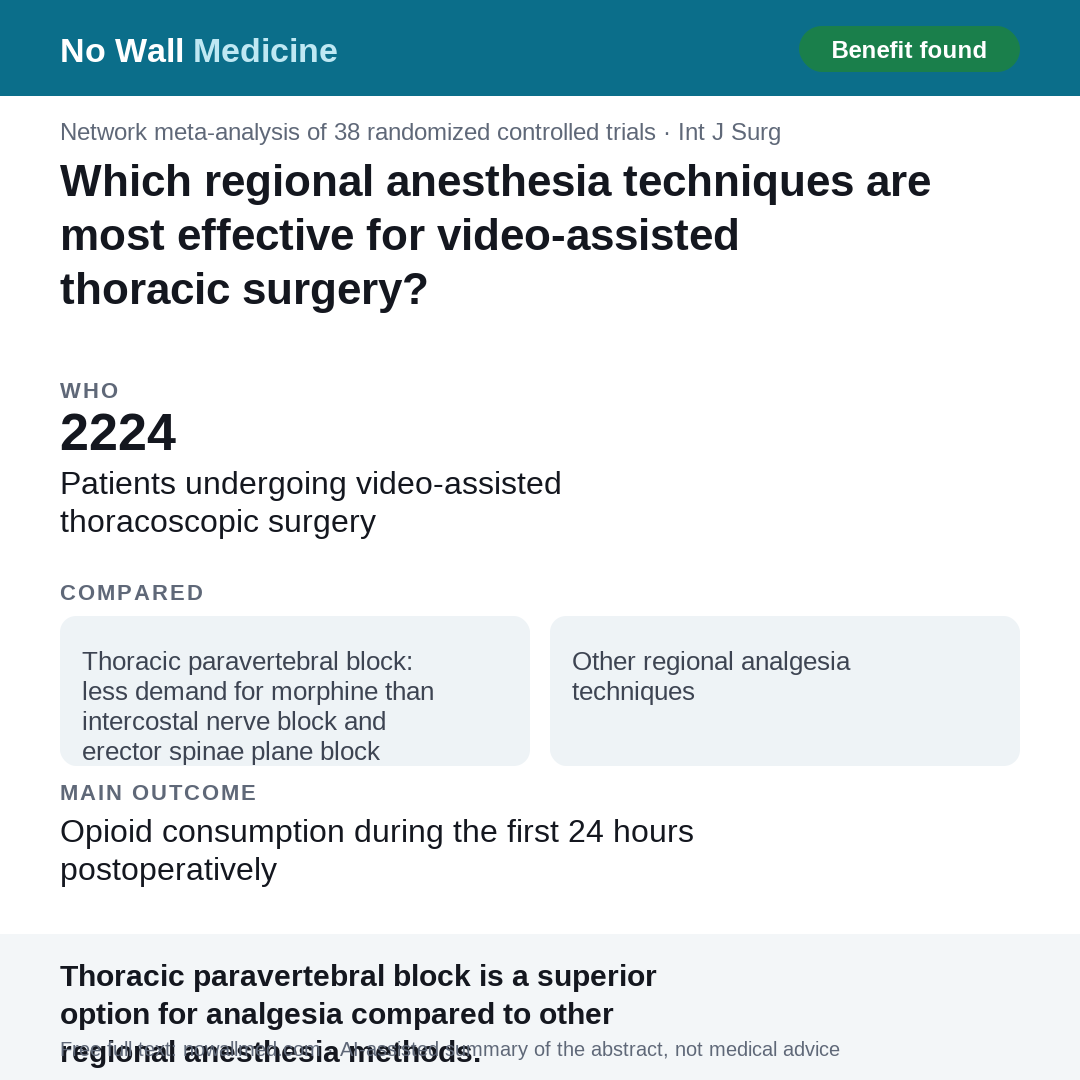
Clinical question: Which regional anesthesia techniques are most effective for video-assisted thoracic surgery?
Why it matters: The relative efficacy of different regional anesthesia interventions for managing pain after video-assisted thoracoscopic surgery is not clearly established.
Key points
- Researchers analyzed 38 randomized controlled trials involving 2224 patients to compare different regional anesthesia techniques for video-assisted thoracoscopic surgery.
- Thoracic paravertebral block was associated with lower morphine consumption at 24 h and 48 h compared to intercostal nerve block and erector spinae plane block.
- Serratus anterior plane block was associated with a lower incidence of postoperative nausea and vomiting compared to local infiltration analgesia.
Headline and key points written with AI from the paper’s abstract, with every number checked against it. Read the paper before relying on them.
Was this summary helpful?
Subject terms
Cite this article
Sandeep B, Huang X, Li Y, Xiong D, Zhu B, Xiao Z. A comparison of regional anesthesia techniques in patients undergoing video-assisted thoracic surgery: A network meta-analysis. Int J Surg. 2022. doi:10.1016/j.ijsu.2022.106840
Spotted a mistake? Suggest a correction
Top studies every Monday
The week’s key trials and guidelines in your specialties, plus any topics you follow. By email, free.
Get the weekly digest