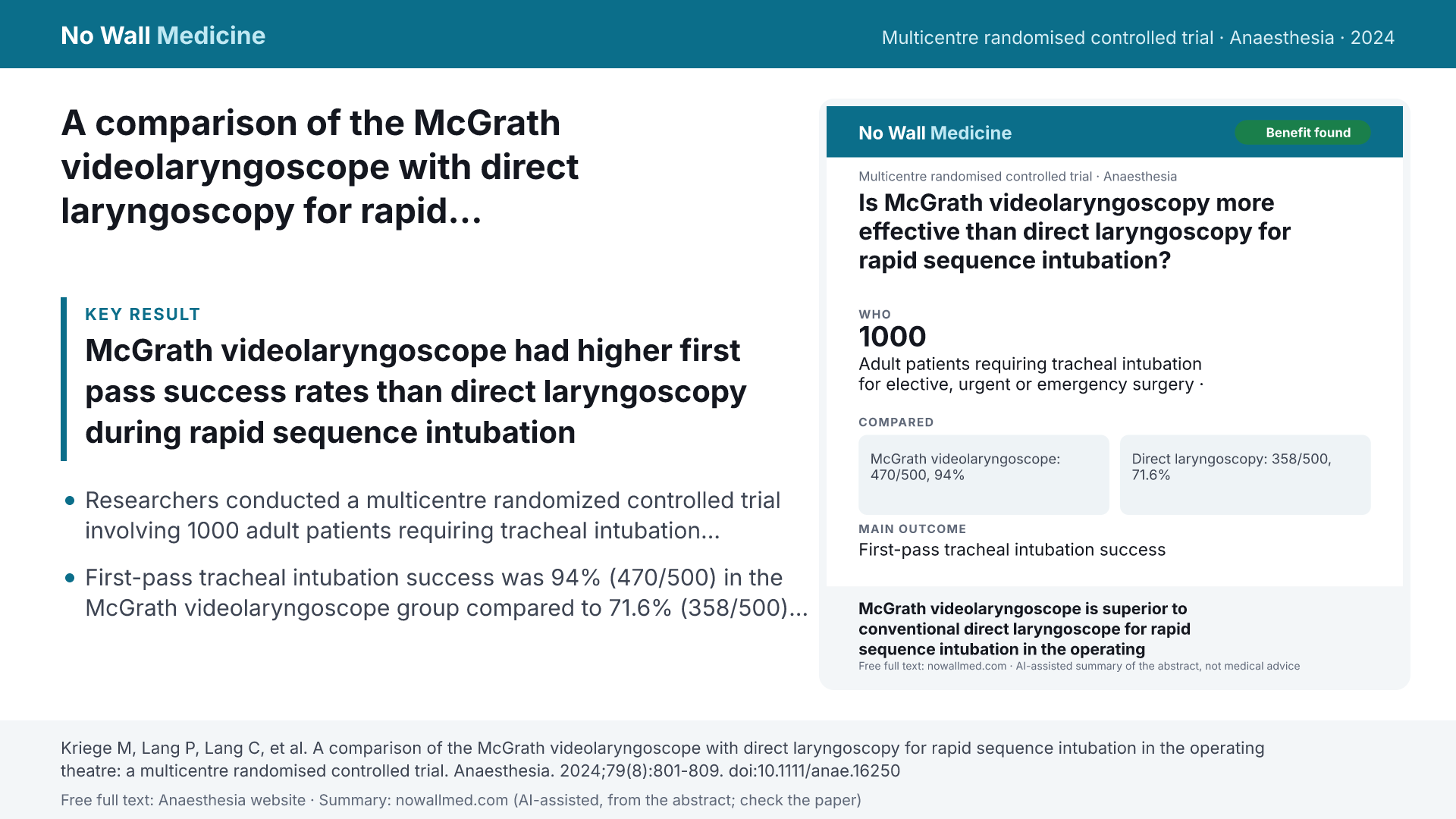
McGrath videolaryngoscope had higher first pass success rates than direct laryngoscopy during rapid sequence intubation
A comparison of the McGrath videolaryngoscope with direct laryngoscopy for rapid sequence intubation in the operating theatre: a multicentre randomised controlled trial
Multicentre randomised controlled trialBenefit found
Is McGrath videolaryngoscopy more effective than direct laryngoscopy for rapid sequence intubation?
Who
1000
Adult patients requiring tracheal intubation for elective, urgent or emergency surgery · Operating theatre
Compared
McGrath videolaryngoscope: 470/500, 94%
Direct laryngoscopy: 358/500, 71.6%
Main outcome
First-pass tracheal intubation success
Result: odds ratio 1.31 (95%CI 1.23-1.39)
Bottom line: McGrath videolaryngoscope is superior to conventional direct laryngoscope for rapid sequence intubation in the operating theatre.
Anaesthesia · 2024-02-12Download image
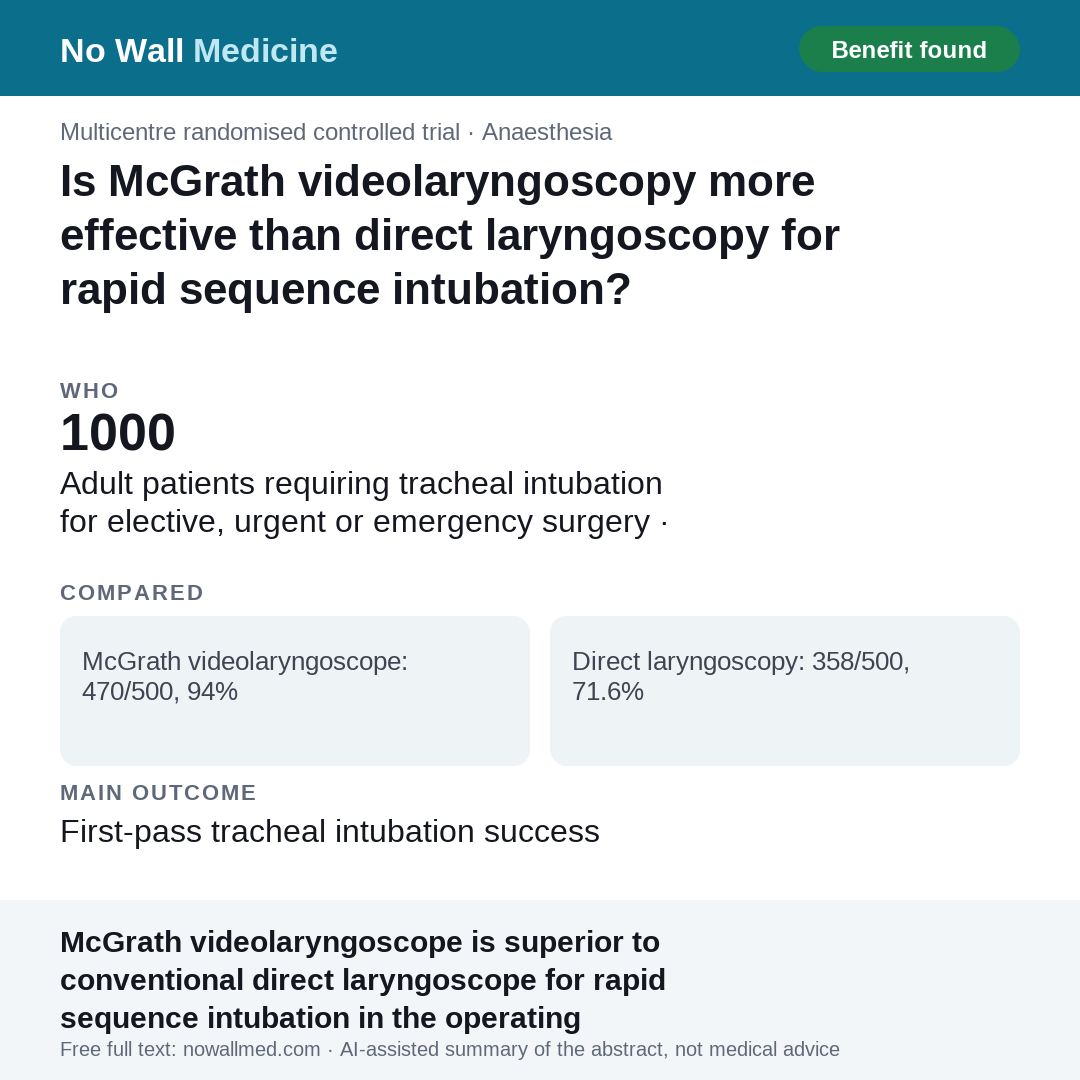
Clinical question: Is McGrath videolaryngoscopy more effective than direct laryngoscopy for rapid sequence intubation?
Why it matters: Clinical data was lacking regarding the effectiveness of videolaryngoscopy compared to direct laryngoscopy for rapid sequence intubation in the operating theatre.
Key points
- Researchers conducted a multicentre randomized controlled trial involving 1000 adult patients requiring tracheal intubation for elective, urgent, or emergency surgery.
- First-pass tracheal intubation success was 94% (470/500) in the McGrath videolaryngoscope group compared to 71.6% (358/500) in the direct laryngoscopy group.
- The McGrath videolaryngoscope group had fewer difficult airway views and a lower rate of adverse events at 2.6% (13/500) compared to 12.2% (61/500).
Headline and key points written with AI from the paper’s abstract, with every number checked against it. Read the paper before relying on them.
Was this summary helpful?
Subject terms
Cite this article
Kriege M, Lang P, Lang C, et al. A comparison of the McGrath videolaryngoscope with direct laryngoscopy for rapid sequence intubation in the operating theatre: a multicentre randomised controlled trial. Anaesthesia. 2024. doi:10.1111/anae.16250
Spotted a mistake? Suggest a correction