Nudge intervention to identify dying patients did not reduce hospital costs or intensive care use
A cost-consequence analysis of a nudge intervention to improve hospital care of older people at the end of life: results from a stepped-wedge cluster randomised trial
Stepped-wedge cluster randomised trialNo clear difference
Does the InterACT nudge intervention reduce hospital costs for older patients at end of life?
Who
Hospital patients at risk of imminent death or deterioration · Three large tertiary hospitals in Australia
Compared
Intervention phase
Control phase
Main outcome
Hospital admission costs and health service outcomes
Result: 95% CI: -$2264 to $3312
Bottom line: The nudge intervention did not reduce intensive care costs, length of stay, or in-hospital deaths.
Age Ageing · 2025-10-06Download image
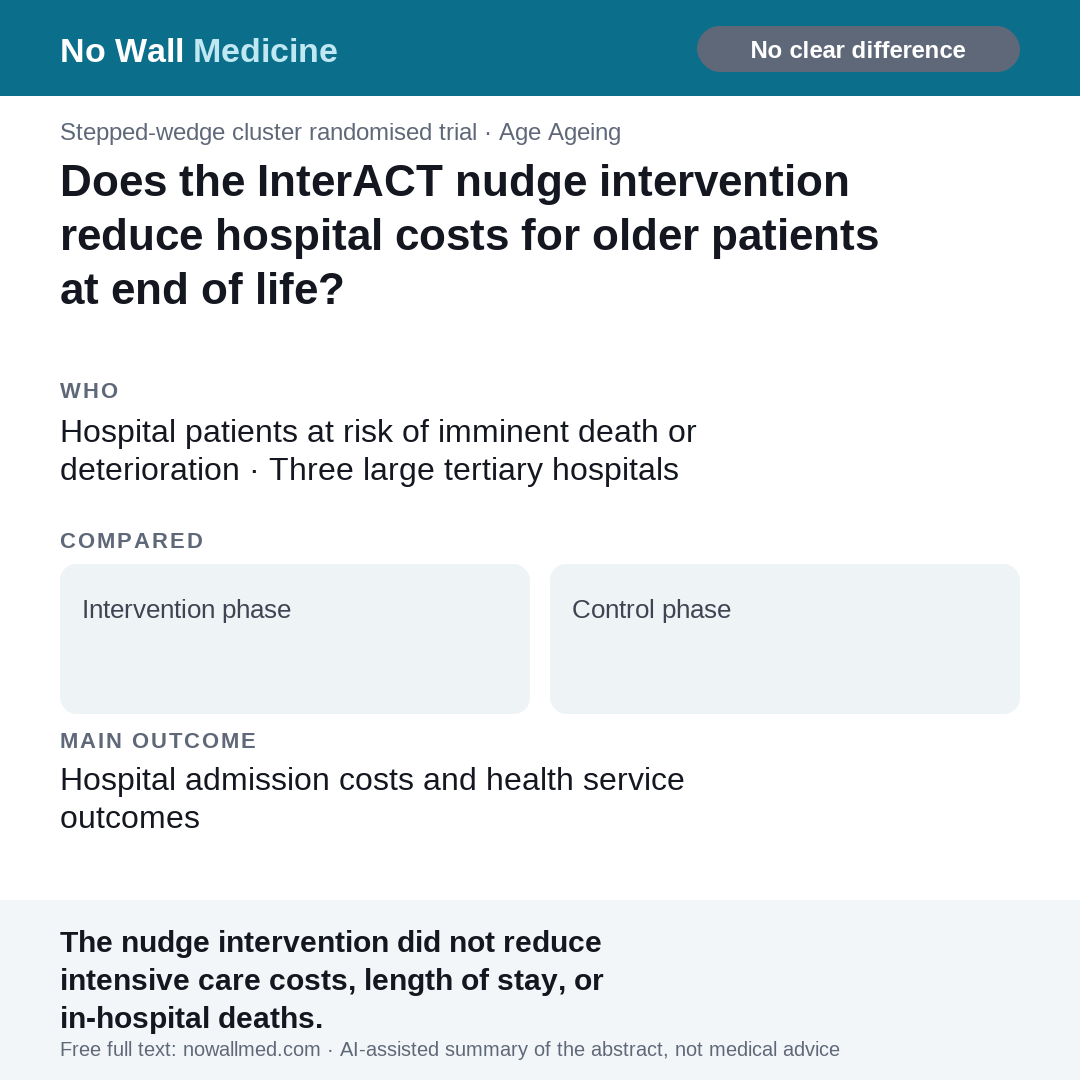
Clinical question: Does the InterACT nudge intervention reduce hospital costs for older patients at end of life?
Why it matters: It is unclear if a simple nudge intervention can impact health service resource use and costs in complex end-of-life settings.
Key points
- Researchers conducted a stepped-wedge cluster randomized trial across three large Australian hospitals to evaluate the cost-consequence of the InterACT nudge intervention.
- The mean intervention cost was $A 72 per at-risk patient admission, with additional site-level implementation costs between $21 373 to $34 867 per hospital.
- The intervention was not linked to reduced costs for intensive care unit admission, length of stay, medical emergency calls, or in-hospital deaths.
Headline and key points written with AI from the paper’s abstract, with every number checked against it. Read the paper before relying on them.
Topics
Cite this article
Carter HE, Donovan T, White NM, Lee XJ, Brown C, Graves N. A cost-consequence analysis of a nudge intervention to improve hospital care of older people at the end of life: results from a stepped-wedge cluster randomised trial. Age Ageing. 2025. doi:10.1093/ageing/afaf280
Spotted a mistake? Suggest a correction