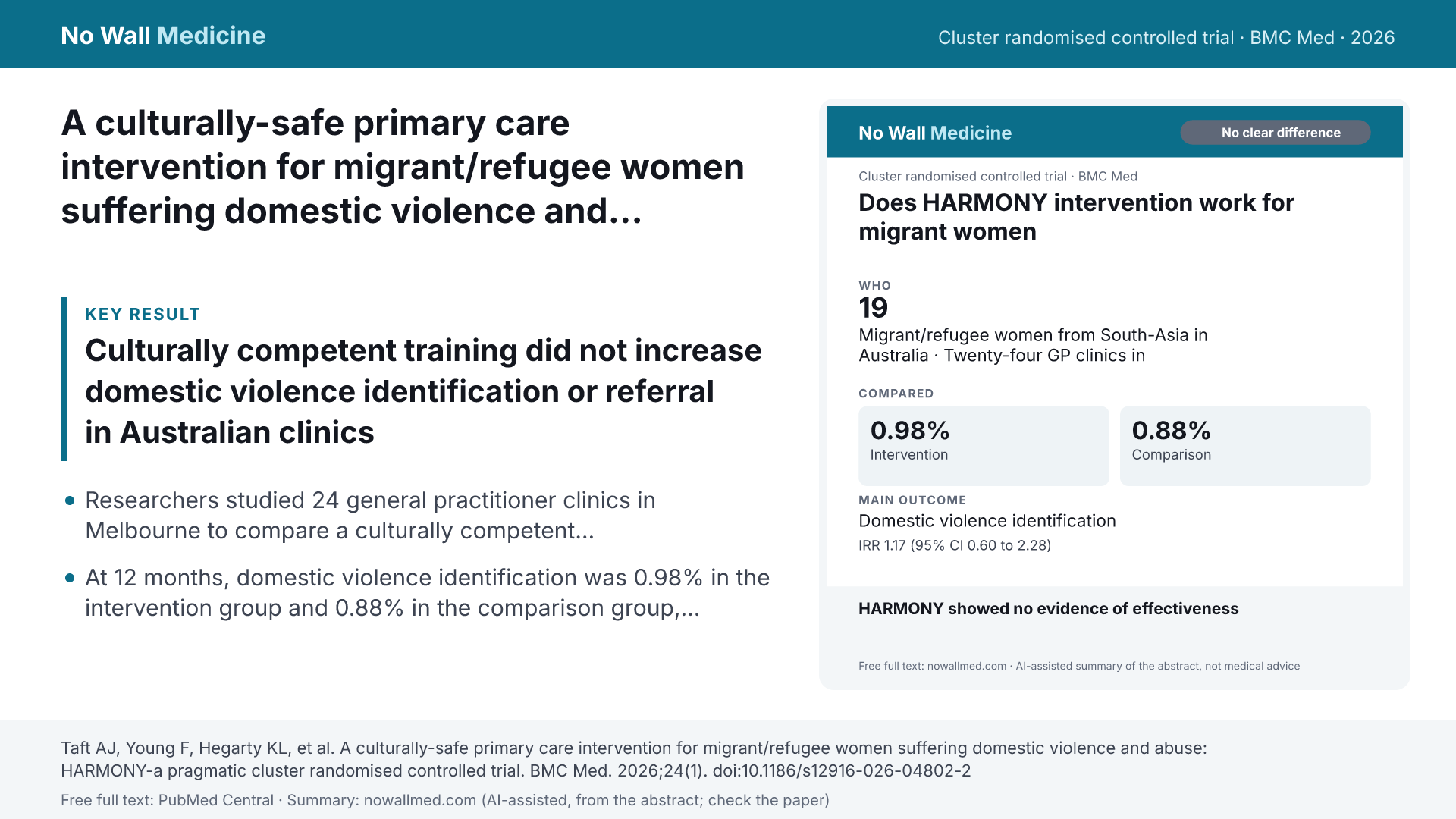
Culturally competent training did not increase domestic violence identification or referral in Australian clinics
A culturally-safe primary care intervention for migrant/refugee women suffering domestic violence and abuse: HARMONY-a pragmatic cluster randomised controlled trial
Cluster randomised controlled trialNo clear difference
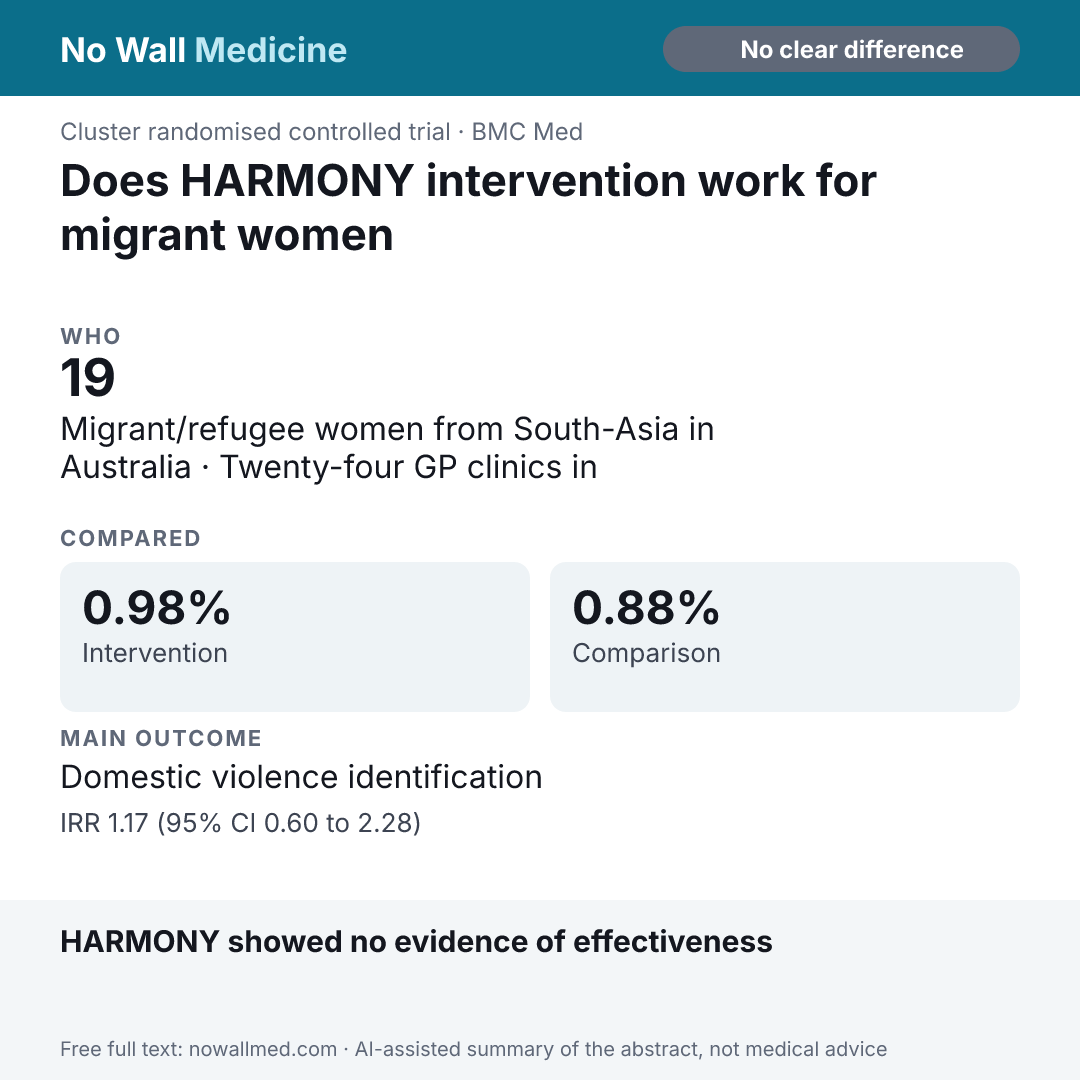
Does HARMONY intervention work for migrant women
Who
19
Migrant/refugee women from South-Asia in Australia · Twenty-four GP clinics in Melbourne
Compared
0.98%Intervention (252/25816)
0.88%Comparison (199/22546)
Main outcome
Domestic violence identification
Result: IRR 1.17 (95% CI 0.60 to 2.28)
Bottom line: HARMONY showed no evidence of effectiveness
Limitation: COVID-19 undermined implementation
BMC Med · 2026-03-21 · Save PNG
Why it matters: Family and general practitioners often have limited training or support to manage culturally competent domestic violence and abuse practice for migrant and refugee women.
Key points
- Researchers studied 24 general practitioner clinics in Melbourne to compare a culturally competent training intervention against routine care for identifying domestic violence and abuse.
- At 12 months, domestic violence identification was 0.98% in the intervention group and 0.88% in the comparison group, showing no statistically significant difference.
- At 15 months, identification rates were 1.01% for the intervention group and 0.96% for the comparison group, with no significant difference found.
Limitation the authors note: The authors state that COVID-19 may have undermined the implementation of the study.
Headline and key points written with AI from the paper’s abstract, with every number checked against it. Read the paper before relying on them.
Was this summary helpful?
Subject terms
Headline, design, result, key points, caveat and citation as plain text.
Cite this article
Taft AJ, Young F, Hegarty KL, et al. A culturally-safe primary care intervention for migrant/refugee women suffering domestic violence and abuse: HARMONY-a pragmatic cluster randomised controlled trial. BMC Med. 2026;24(1). doi:10.1186/s12916-026-04802-2
Spotted a mistake? Suggest a correction