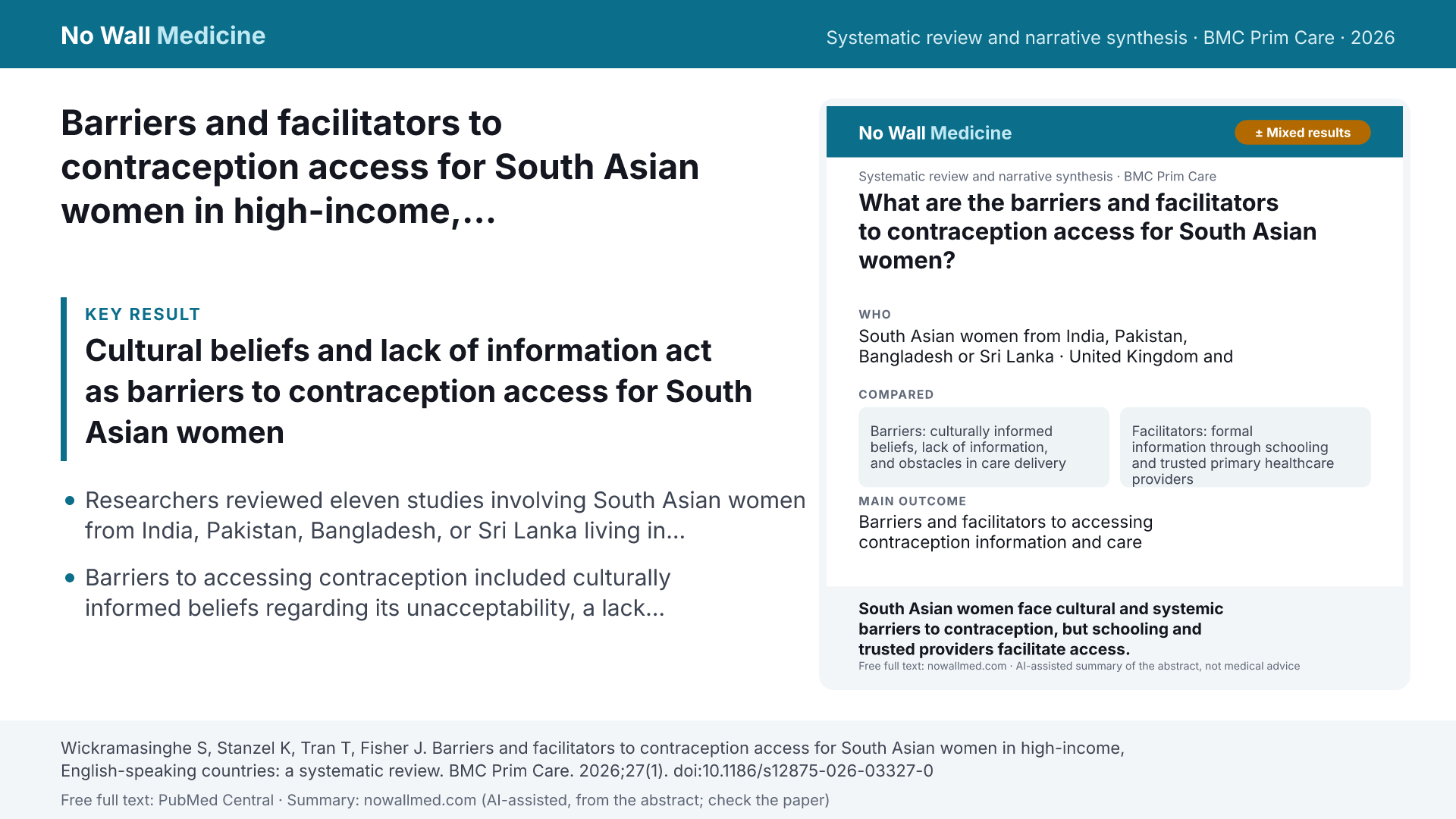
Cultural beliefs and lack of information act as barriers to contraception access for South Asian women
Barriers and facilitators to contraception access for South Asian women in high-income, English-speaking countries: a systematic review
Systematic review and narrative synthesisMixed results
What are the barriers and facilitators to contraception access for South Asian women?
Who
South Asian women from India, Pakistan, Bangladesh or Sri Lanka · United Kingdom and The United States of America
Compared
Barriers: culturally informed beliefs, lack of information, and obstacles in care delivery
Facilitators: formal information through schooling and trusted primary healthcare providers
Main outcome
Barriers and facilitators to accessing contraception information and care
Bottom line: South Asian women face cultural and systemic barriers to contraception, but schooling and trusted providers facilitate access.
BMC Prim Care · 2026-05-01 · Save PNG
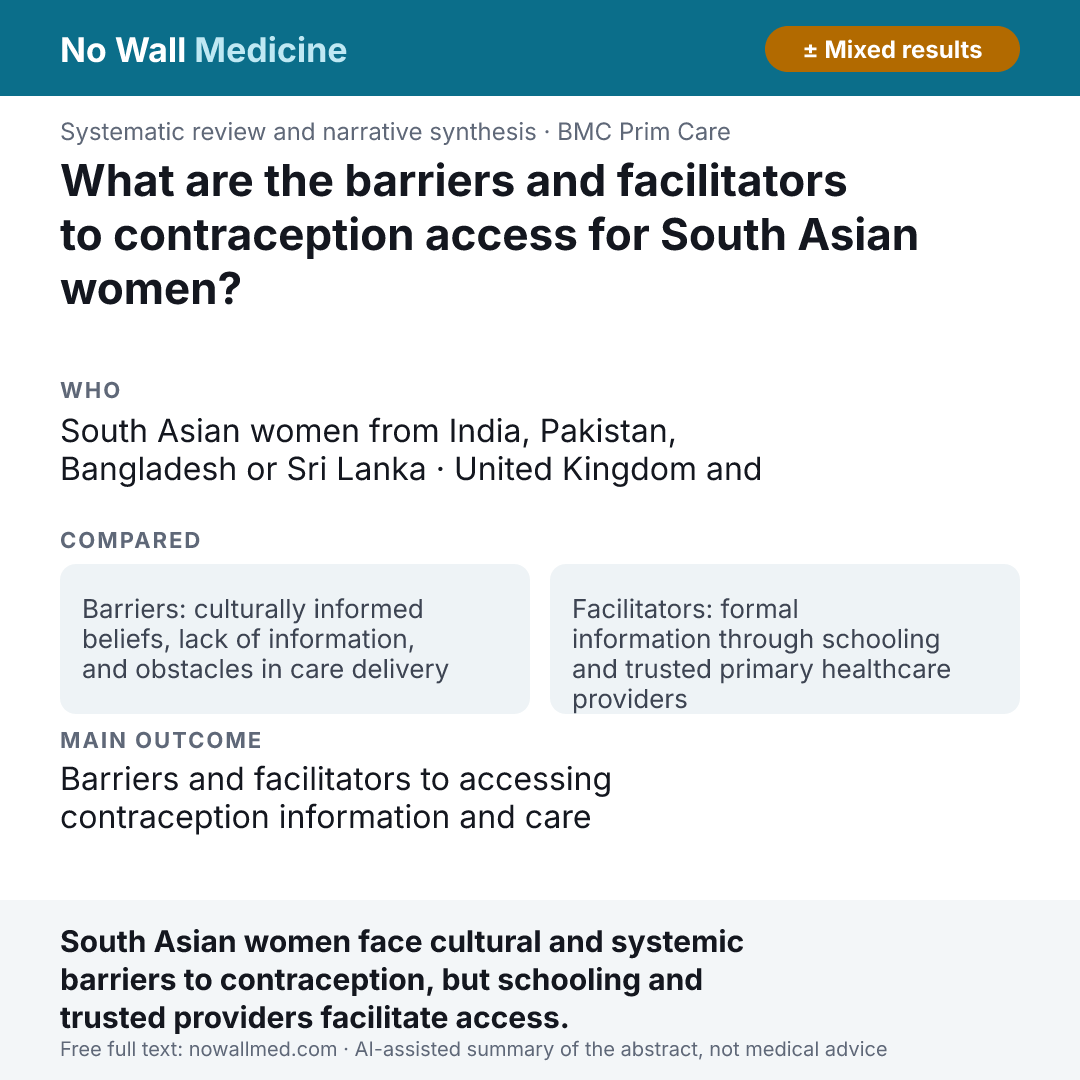
Clinical question: What are the barriers and facilitators to contraception access for South Asian women?
Why it matters: Migrant women may face additional barriers to accessing contraception care and related information compared to other populations.
Key points
- Researchers reviewed eleven studies involving South Asian women from India, Pakistan, Bangladesh, or Sri Lanka living in the United Kingdom and the United States.
- Barriers to accessing contraception included culturally informed beliefs regarding its unacceptability, a lack of information, and obstacles in the delivery of care.
- The most beneficial factors for making informed choices were formal information through schooling and guidance from trusted primary healthcare providers.
Headline and key points written with AI from the paper’s abstract, with every number checked against it. Read the paper before relying on them.
Was this summary helpful?
Subject terms
Headline, design, result, key points, caveat and citation as plain text.
Cite this article
Wickramasinghe S, Stanzel K, Tran T, Fisher J. Barriers and facilitators to contraception access for South Asian women in high-income, English-speaking countries: a systematic review. BMC Prim Care. 2026;27(1). doi:10.1186/s12875-026-03327-0
Spotted a mistake? Suggest a correction