Highly effective contraceptive use increased among young women following a breast cancer diagnosis
Contraception use and changes in young women with newly diagnosed breast cancer
Secondary analysis of a cluster randomized trialMixed results
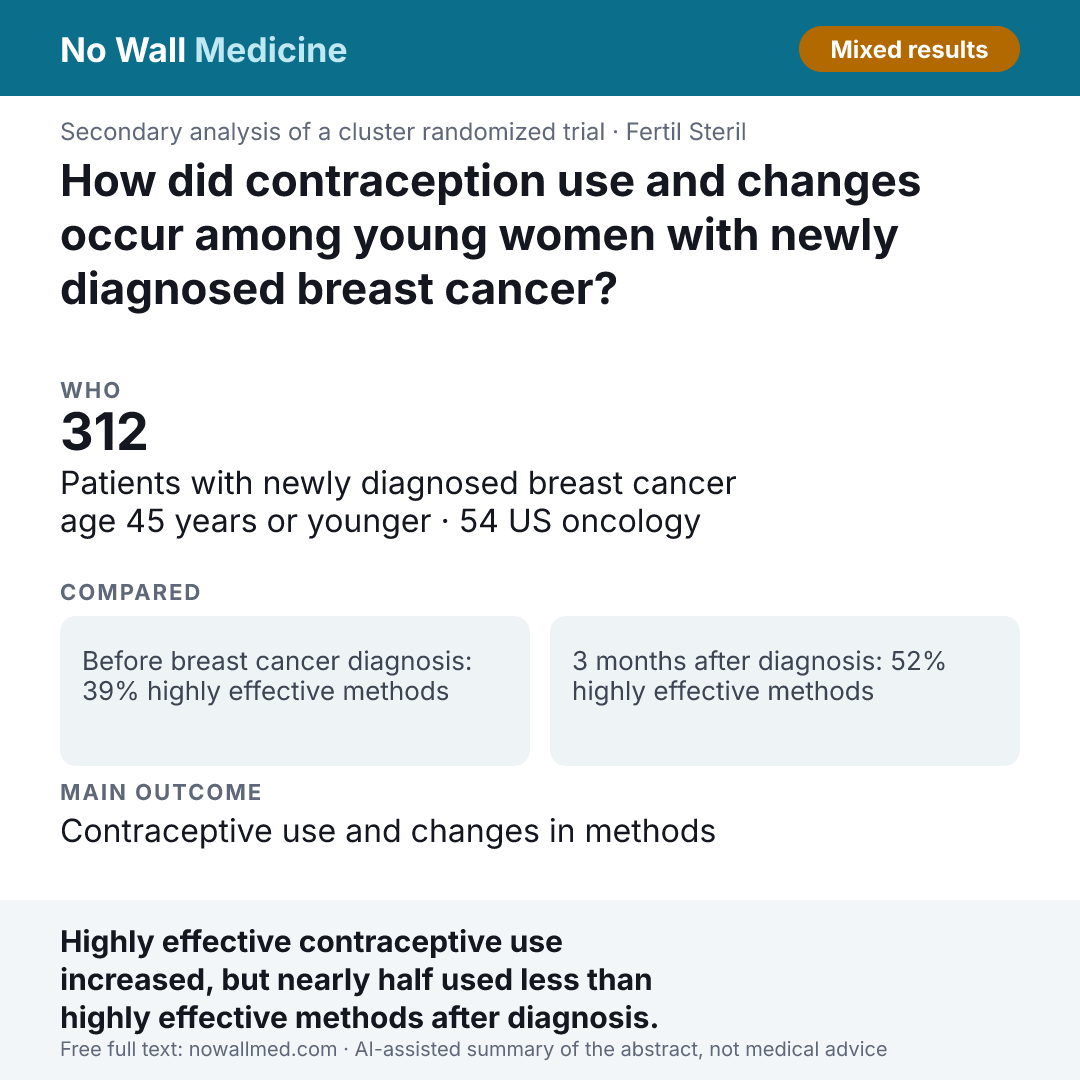
How did contraception use and changes occur among young women with newly diagnosed breast cancer?
Who
312
Patients with newly diagnosed breast cancer age 45 years or younger · 54 US oncology practices
Compared
Before breast cancer diagnosis: 39% highly effective methods
3 months after diagnosis: 52% highly effective methods
Main outcome
Contraceptive use and changes in methods
Bottom line: Highly effective contraceptive use increased, but nearly half used less than highly effective methods after diagnosis.
Fertil Steril · 2024-09-19 · Save PNG
Clinical question: How did contraception use and changes occur among young women with newly diagnosed breast cancer?
Key points
- Researchers analyzed 312 women aged 45 years or younger who were newly diagnosed with breast cancer across 54 oncology practices.
- Highly effective contraceptive use increased from 39% before diagnosis to 52% after diagnosis, while moderately effective hormonal method use decreased from 22% to 3%.
- Desire for additional children was associated with using less than highly effective contraception after diagnosis with an odds ratio of 6.33.
Headline and key points written with AI from the paper’s abstract, with every number checked against it. Read the paper before relying on them.
Was this summary helpful?
Subject terms
Headline, design, result, key points, caveat and citation as plain text.
Cite this article
Tesch ME, Sorouri K, Zheng Y, et al. Contraception use and changes in young women with newly diagnosed breast cancer. Fertil Steril. 2025;123(3):488-498. doi:10.1016/j.fertnstert.2024.09.024
Spotted a mistake? Suggest a correction